The Tally Master, Chapter 16 (scene 77)

They found Lord Carbraes on the stone terrace within the ring of elite apartments just below Belzetarn’s high battlements. The sun had moved westward enough to cast a crescent of shade outside the quarters of the magus. The flue column from the smithies—looming and massive—acted as a sundial, the finger of its shadow still blunt and stubby, but pointing northeast as the afternoon advanced. No smoke rose from its maw at this hour; the charcoal fuels in the forges would be well settled, emitting merely intense heat. The air quivered in a column above the flue.

Carbraes sat in one of the backless bronze chairs in the sunlight outside the march’s chambers, with Dreas in another chair next to him.

Gael almost hated to intrude. The regenen looked easy—even happy—laughing at something Dreas had said, his silver-blond head thrown back, his broad shoulders relaxed, his muscular legs stretched out before him. Dreas, too, conveyed an attitude of comfortable contentment. Despite the march’s thinning white hair, wizened face, and skinnier limbs, his truldemagar seemed less pronounced.

The regenen and the march lost some of their carefree demeanor when Gael and Keir emerged from Carbraes’ public rooms, conducted by a messenger boy. When Adarn and Uwen maneuvered the gong through the narrow doorway, the regenen resumed his normal taut alertness entirely.

The messenger announced the four petitioners—“The Secretarius Gael, the Secretarius Pro Tem Keir, the Peregrine Decanen Uwen, and the Notarius Pro Tem Adarn!”—and retreated.

Gael bowed and murmured, “Regenen.”

Keir, Uwen, and Adarn followed his example. “Regenen.” “Regenen.” “My lord Regenen.”

“There is a difficulty?” Carbraes’ tone was testy.

“There is . . . a complication,” Gael responded. He’d not been able to settle his mind enough during his climb to plan how he would present the new development.

Keir entered the brief pause after Gael’s statement. “The boss of this gong”—she gestured toward the artifact, held between Uwen and Adarn—“is formed of an ancient lodestone of Navellys. That lodestone retains many of its original properties, even in its present location, surrounded by energetic bronze. Without sounding the gong, the lodestone may be used to accomplish feats much more beneficial than the weakness produced by resonance. I used one of them just moments ago.”

“It heals trolls!” Adarn burst out. “Keir healed Gael!”

Dreas shifted in his seat, drew breath, but then subsided without saying anything.

Keir directed an exasperated glance at Adarn, but she did not correct him, waiting on Carbraes’ reaction.

Carbraes studied each of them in turn, taking his time. He gazed longest at Gael. “I see no change in him,” the regenen stated.

Keir nodded. “Over many months, the repositioned nodes will drag the physical structures toward health. Insufficient time has elapsed for that to have occurred yet.”

Carbraes’ nostrils flared. He scrutinized Keir’s sober face. “You are in earnest,” he concluded. “This is no chimera. And not trivial,” he added.

Keir dipped to one knee and bent her head. “No, my lord Regenen, not trivial in the least.”

Carbraes returned his attention to Gael. “Explain,” he said quietly.

Gael nodded. “Keir could best do that. He”—Gael narrowly missed saying ‘she’—“understood the energetic diagrams I brought back from Olluvarde and perceived their ramifications. He used his healer’s training to control the lodestone.”

“Very well.” Carbraes extended his hand toward Keir, allowing his fingers to open. “Tell me what I must know to understand your finding.”

Keir, still kneeling, bit her lip. “You know that when a mage attempts a magery too great for him, the riptide of energea roaring through his nodes tears them from their anchoring.”

Carbraes’ lips curved slightly. “I understand the root of the truldemagar, yes.”

“And do you also know,” continued Keir, “that no force of energea has been found adequate to re-anchor torn nodes. Nor, indeed, adequate to even return the drifted nodes to their correct positions without ripping the nodes of the healer who attempts it?”

“Ah, I confess I had not concerned myself with the technical details of the impossible,” replied Carbraes.

Keir swallowed. “It is a pertinent point, my lord Regenen.”

Gael understood Keir’s formality. She was about to upend Carbraes’ world. It was prudent to show respect in such an exercise.

“Used with the correct angles of force, the lodestone will supply a stream of energea fully equal to that the mage—or healer—pulls through his own nodes, thus doubling the power available without endangering the practitioner’s nodes,” said Keir.

Carbraes pursed his mouth. Given his disapproval of any manipulation of energea in Belzetarn, no doubt the contemplation of such a dynamic display as Keir described repulsed him.

Keir carried on, not acknowledging the regenen’s discomfort. “This doubling of the energea at my command allowed me to move the secretarius’ root node to its proper position and hold it there while I moved his abdominal node. I progressed upward through his nodes in a chain, holding the most recently repositioned node while moving the next malpositioned one. I urge you to open your inner sight, my lord Regenen, and observe the results within your secretarius.”

Carbraes’ lips pressed flat. He glanced at the march beside him. “Dreas? Will you?”

Dreas clearly did not share his friend’s disgust at Keir’s proposal. His eyes were alight, and he’d leaned slightly forward through all of Keir’s explanations, hanging on her words. At Carbraes’ request, the march nodded. He settled back in his chair, straightening his spine and lifting his crown. On a long, slow exhalation, he closed his eyes.

Gael wondered what he saw. Gael had not yet examined his own newly aligned nodes. He could feel their effect—still that subtle sense of rightness—but he had not seen with his inner sight.

When Dreas opened his eyes, some moments later, the march had let go his initial wonder, replacing it with a determination oddly similar to Keir’s when she realized what it all meant.

Dreas addressed Gael. “Your nodes yet float. They occupy their proper places, but will drift over time.”

“So I understand,” Gael answered.

“How does it feel?” asked Dreas, a wistful tone in his gravelly voice.

Gael groped again for words. “Like a swallow of water when you are thirsty. Like the folding of a cloak around your shoulders when you are chilled. Like sitting on a cushioned chair when your legs are weary. It feels . . . right, my lord March.”

Dreas turned to Carbraes, who was looking more sour than ever. “Carbraes! You must command Keir to perform this feat again.” Dreas glanced at Keir. “Are you able to repeat yourself at this time? Are your reserves too drawn down?”

“No, my lord March,” replied Keir. “I can oblige you with one more healing, although not two.”

Dreas continued to press the regenen. “While Keir does his deed, you shall observe it. You must. And I shall be Keir’s patient.”

Carbraes’ jaw pulsed with tension. Gael half expected the regenen to thunder his response, but he did not. Always Carbraes retained control of himself and those around him. The regenen spoke most mildly to Gael and his cohort. “Please give me privy conference with my lord march.” He waved a hand toward the crescent of shadow on the far side of the terrace.

Gael found his feet carrying him to obey Carbraes’ bidding almost without his own volition. Keir and Uwen and Adarn came with him, clustering in the shade and watching the interchange between the regenen and the march. They could hear nothing, but the emotion in the conversation was clear: Carbraes angry and vehement, Dreas pleading, but firm.

Keir stared, intent. Uwen—still gripping his side of the gong—studied his knees, but found his gaze drawn inexorably back to his arguing commanders. Adarn—also clutching his side of the gong—bounced on his toes, eager.

“Do you think he’ll say ‘yes’?” the boy whispered. “Oh, I hope he’ll say ‘yes’!”

Gael felt he was overlooking something, some important detail that would govern their success or their failure. This was all moving much too fast. Surely they should all sleep on it before coming to any decisions.

Across the terrace, Carbraes sat back, resignation in his posture. Dreas leaned forward and beckoned.

*     *     *

Next scene: coming March 3.

Previous scene:
The Tally Master, Chapter 16 (scene 76)

Need the beginning?
The Tally Master, Chapter 1 (scene 1)


Share

Art Detour

In the fall of 2020, I embarked upon a new decluttering venture, guided by Dana K. White’s book, Decluttering at the Speed of Life.

I made a lot of progress, completing a decent first pass through every room on the main floor of our house: living room, dining room, kitchen, bedroom, bath, and the fearsome-and-much-dreaded study.

Daughter on the Scene

I had help with the study! When my daughter returned home for winter break after her first semester in college, she was so impressed and inspired by my progress that she offered to pitch in. What a sweetheart!

The study was only half-tackled when she arrived, but it was done a mere 10 days later, and it looks great!

However, one of the things I did in the study was go through the box of artwork done by my children. It held some of their earliest work (age 2 years), as well as most of what they’d created through age 9.

Time Yields Perspective

Since the artwork had been sitting unseen for almost a decade, I found a lot of clarity when I looked through it. I knew what I wanted to keep, and I knew what I didn’t. I also knew what I wanted to frame and display.

Now, I could simply have set the art aside to be framed later. But I knew that if I did that another 10 years might pass in the blink of an eye. I’d already allowed too much time to pass—I’d not been enjoying the art for the whole time it sat in that box.

Plus there were the three pieces on the dining room wall with the bedraggled construction-paper frames they’d received at school. My husband and I loved the art. They deserved to be properly framed.

So, yes, I paused my decluttering to focus on art. I took an art detour! I thought I’d take you along with me. 😀

Art for Dining

I tackled the dining room art first. Of the four pieces present, I wanted to frame three. The fourth was a crayon that had been faded by the sunlight so thoroughly that it was invisible (faded-to-white crayon on white paper).

I chose a replacement piece by my daughter from those I’d saved from the box, with the idea that I’d have two by my son and two by my daughter on the wall.

But when all four were framed, I discovered that mattes and frames together made the art MUCH LARGER. They wouldn’t all fit.

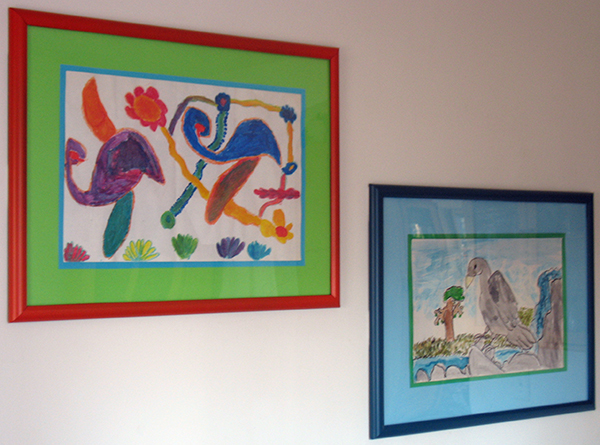
So, “Vulture Falls” by Miles Ney-Grimm and “Tropical Flight” by Rachel Ney-Grimm went up as a duo. They’re in the photo at the beginning of this post. I love that wall now—it looks so much better with the art framed.

Art for Sleeping

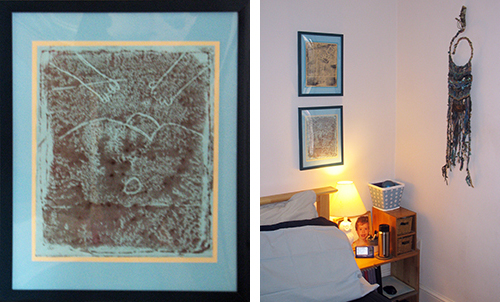
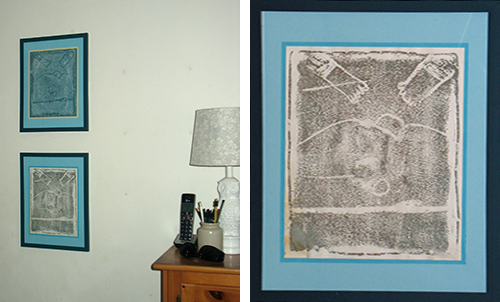
My next focus was a set of prints created by Rachel, “Heavenly Hands” done in four variations: blue, cream, aqua, and white.

When my now-18-year-old daughter saw them, she wasn’t sure they were hers. She said, “Are you certain they’re mine? I wish they were—such a cool metaphor for deity—but maybe Miles did them.” She was happy when I showed her her own signature on the backs.

Art for Phoning

I’d imagined all four over my bedside table, but once again I’d mis-estimated the size of the framed pieces. Too large. So I put the Cream Variation and the Blue Variation in the bedroom. The White Variation and the Aqua Variation went beside the phone table in the living room.

(Yes, we still have a land line. Such boomers, as my daughter calls us, her parents.) 😀

The holidays interrupted my art detour, just as the art detour interrupted the decluttering. And then getting both my children back to their respective colleges constituted yet another interruption. But I did get back to the art. (And I will get back to the decluttering.)

Art en Route

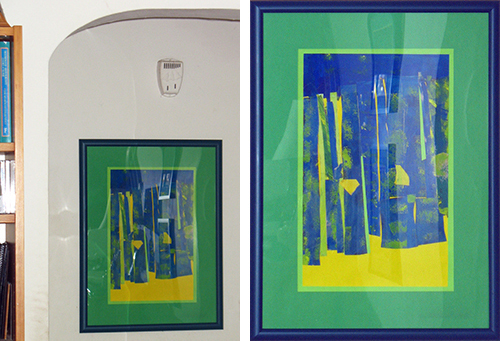
My son’s “Aqua Verticality” was next. It was tricky, because the yellow construction paper that served as the backing had faded, even away from light exposure in the box. I knew it would turn from yellow to a dull tan once up on the wall, just as had the old blue construction-paper frames on the dining room art.

So, at all the gaps between the painted strips of the collage made by Miles, I used an Xacto blade to cut out the fading backing. And then I re-mounted the entire assemblage on a sheet of fadeless yellow art paper. I think it turned out well.

I painted the frame. (Black frames and white frames are easy to acquire. But if you want another color…well, I suppose you could spend a boatload of money to get them. I chose to spray paint all except the two that I needed in black.)

Then I matted the piece, framed it, and hung it in our hall. I love it. I’d almost say that it is my favorite, except that I say the same thing of several of the others. 😀

Art to Work By

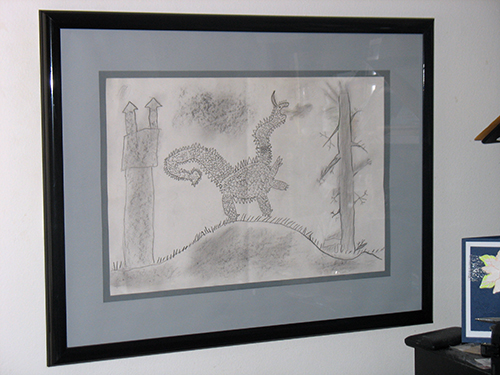
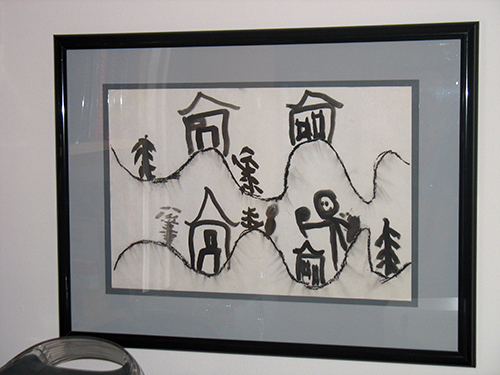
Next up were “Dragon” by Miles and “Houses,” also by Miles. They too had their tricky aspects. I’d been using fadeless art paper to create “floating” mattes, but the only fadeless paper in shades of gray came only in bulletin board sizes—4 feet by 8 feet! And the grays weren’t the right shade either.

So I decided to spray paint some of the art paper that I wouldn’t be using (such as the violet and the pink sheets). That worked really well.

“Dragon” had been in the dining room, but it is one of my husband’s favorites (mine, too, actually), so I put it over his desk in our study.

“Houses” went on the other side of the window, over the desk that currently still holds my ancient desktop computer. My daughter helped me get the old photo files off it, so I will take it to an electronics recycling drop-off once the pandemic is over. Then that desk will become a craft/art table.

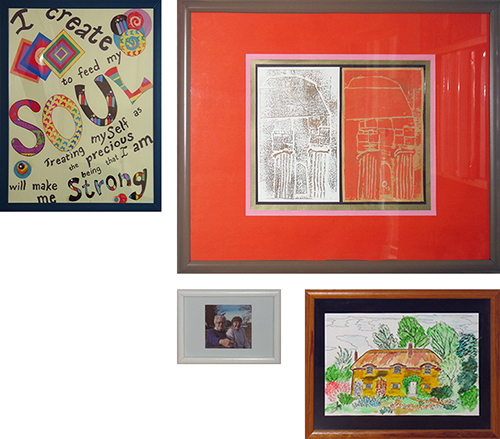
The last of the art was a print duo by Rachel. The orange variation of “House” had been in our dining room, while the gold variation lay in the box. I decided to frame the two together and put them over my main desk in our study.

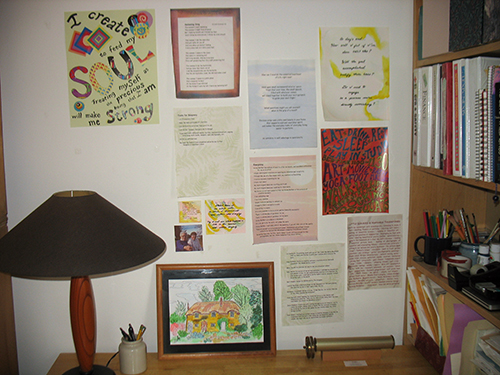
First I had to take down the dozen pieces of art/reminders/affirmations that I’d generated back in 2007 while working my way through The Artist’s Way by Julia Cameron. I’d been inspired and supported by them for several years, but they were seriously old news now.

I did keep (and frame) “Soul,” as well as the watercolor (“Cottage”) and the photo portrait of my parents. But everything else is in a folder destined (eventually) for a scrapbook.

The new arrangement has “Soul,” “Cottage,” and the photo portrait grouped around “House” by Rachel.

And that is the close of my art detour. It’s time to get back to writing—and decluttering.

I’ll admit that when I’m head-down in a novel, I usually neglect my house. But I am hoping to find a way to balance the two. We’ll see! And I’ll keep you posted. 😀

*     *     *

For more about decluttering, see:
Whole House Purge
Getting Started with the KonMari Technique


Share

The Tally Master, Chapter 16 (scene 76)

As Gael locked the tally room door, his fibula of keys pinned to his waist once more, a muscular boy with curly chestnut hair and a sprinkle of freckles across his cheeks and nose rounded the newel post of the Regenen Stair.

“Adarn!” Keir exclaimed. “Good. I’m needing you.”

Ah. So Gael had remembered correctly. Adarn was one of the reformed bullies. Interesting that Keir had selected the boy as her messenger. And interesting that Theron had released him to the tally room. More of the castellanum’s courting of Gael’s notarius?

Keir swept Adarn along with her, murmuring explanations to the boy as she followed Gael up the nearly two spirals to the landing outside Gael’s chambers.

There Gael discovered a black-browed warrior in full regalia: bronze scale mail, bronze greaves, bronze helm, scabbarded sword and knife at his belt, brown tabard with a stooping golden bird of prey depicted on it. One of the Peregrine opteogint.

The warrior stood very straight and struck his chest with his closed fist as Gael stopped before him.

“Secretarius!” he barked.

Gael frowned, but returned the salute, allowing the warrior to lower his arm and stand easy.

Turning to Keir, Gael asked, “What is this?”

Keir grimaced. “When two locks were not enough to prevent meddling with the gong, the regenen ordered a guard placed. The whole tower learned what rests in your storeroom in the debacle with the cleaning scullions. Lord Carbraes does not want a repeat incident.”

Gael repressed a sigh. “Of course.”

Keir greeted the warrior. “All well here, Uwen? The boys have not recommenced tapping your mail?”

Gael’s eyes narrowed. “Scullions were baiting a warrior?”

Keir stifled a snicker. “On a dare. Yes.”

Uwen smiled, utterly changing the fierceness of his visage in repose to something genial, approachable. “Once the notarius granted me permission to be creative, the problem ceased.”

“And, ah, how were you creative?” asked Gael.

“The boys had not realized I was quick enough to catch their tapping fingers. Or strong enough to keep those fingers in my grasp, once caught. They found it quite embarrassing to sit at my feet simply waiting until I chose to let them go.” Uwen’s smile broadened into a grin. “I kept each tapper longer than the last. They stopped their prank quite resoundingly.”

“Indeed.” Gael gestured at his door. “May I?”

“We’ll be accessing the gong, Uwen,” clarified Keir, “so you’ll need to accompany us. And I’ll need your help with it, in any case.”

Uwen’s eyebrows rose, but he stepped aside.

Gael unlocked the portal to his chambers and passed within. The sitting room was very tidy, with the backless chairs and slant-end divans aligned precisely, the trays on their tripod stands exactly level, and the floors immaculately dustless. The glass panes of the casements showed the effects of rigorous cleaning, with both inner and outer shutters open and no smudges visible in the afternoon light. Someone had even removed the stain that had disfigured one of the leather hangings that covered the stone walls.

It should have felt like home. These chambers had been home for the past seven years. But Gael felt less relaxed in his private sitting room than he had in either the smithies or the tally chamber. Maybe it was just that he intended to tangle with the cursed gong forthwith. Or rather—to let Keir tangle with it.

Keir bustled about, closing the inner shutters, pulling a divan out from the wall, shoving several tripod tables out of the way, and generally arranging things to her liking.

“I’ll need you lying down, Gael,” she instructed.

Gael started to obey, sinking onto the divan. He stopped halfway to survey their presumed helpers. Uwen stood waiting beside the closed door, broad-shouldered, armed and armored, formidable. Beside him, Adarn—although a well-grown lad—looked nervous and very young, shifting his weight from one foot to the other. His head rose only to Uwen’s shoulder, if that.

Gael’s prolonged scrutiny gathered their attention. He waited a moment, then nodded and started the explanation he felt was due to them. “You know Lord Carbraes has consigned the gong of the ancients to my authority.”

Both the boy and the warrior nodded.

“Keir and I believe the gong may possess a power other than the weakness generated by its sounding. We are going to attempt to prove our surmise true or false. Now. In this room.”

Uwen frowned. Adarn swallowed.

“Your role, should you choose to accept it, will be merely to hold the gong at the angle Keir specifies. I do not expect you to be in any danger. But the gong is perilous, and I could be wrong in my assessment. I have the right, granted by the regenen, to require your duty in this trial. But I will not do so. You may choose freely to assist. Or not.”

Uwen’s frown deepened, and Adarn positively gulped. Keir—seen out of the corner of Gael’s eye—looked exasperated, but she said nothing.

“We will not be sounding the gong,” Gael added.

Uwen’s face lightened. “I do not fear your trial, my lord Secretarius. I am willing.”

“Good,” said Gael. “Adarn?”

The boy squirmed, glanced at Keir, then straightened his shoulders. “I am not afraid either,” he declared. “I’ll help.”

“Keir will not think the less of you, should you decline,” said Gael.

Keir’s look of irritation ebbed. “Indeed, I will not,” she confirmed. “You may choose freely. Indeed, you must choose freely.”

Adarn grinned. “No, I know. I want to help. Please?”

“Very well,” said Gael, handing his fibula of keys to Keir, leaning his upper body against the slanting end of the divan, and lifting his legs onto its long, flat end. The padlock on the storeroom clunked open. Then came a scraping sound—metal on stone—and footsteps. Uwen and Adarn stationed themselves to one side of the divan, the gong held between them, its metal glimmering in the shutter-dimmed light. Gael noticed that the grip of Adarn’s lower hand fell considerably lower on the disk’s bottom hemisphere than did Uwen’s, the same for their upper hands. Which meant that the boy bore slightly more weight than the warrior. Gael’s lips pressed flat. He wondered if he should intervene. Keir was directing them to raise the gong higher, focusing on the angles she needed. Was she paying any mind to the differing capabilities of her helpers?

“Gael, I’m going to need you on the floor. The angles aren’t right, and I need you flat anyway, not propped up,” came Keir’s clear voice.

They all rearranged themselves, Gael lying on a sheepskin, Keir seated on a backless chair, and Adarn and Uwen across from her, holding the gong just barely off the flagstones. Adarn showed no signs of strain, his eyes alight with curiosity and interest.

“Good. That’s perfect,” said Keir. “Try to keep those positions, everyone.”

Adarn’s muscles twitched. Was the boy trying to lock them in place?

“Not like a stone statue, Adarn,” chided Keir, “but like a tree. It’s all right to sway a bit.”

Gael could see the boy relax.

“That’s right,” said Keir. “Now,” she continued, “I’ll be working with energea, and Uwen and Adarn, you may watch, if you wish. I’d prefer to have witnesses other than myself.”

Adarn’s shoulders settled as the crown of his head lifted. Uwen’s adjustments were subtler, but Gael could tell that he too was preparing to follow Keir’s wishes. Gael allowed his own breathing to slow and his spine to lengthen. This promised to be very interesting.

Keir spoke again. “But, Gael, you must not open your inner sight. I need you utterly quiescent, and you won’t be if you are watching. In fact, I want your outer sight closed as well. Shut your eyes, please.”

Gael switched his gaze from Adarn and Uwen to Keir. She looked calm and confident. Gael closed his eyes. In the reddish black behind his eyelids, his awareness of his other senses deepened. The breathing of his companions in the silence of his sitting room sounded restful and relaxed. The scent of the leather wall hangings perfused the warm air. The sheepskin under him felt resilient and firm.

Even with both his inner and outer sight closed, he knew immediately when Keir began working with the energea of his nodes and arcs. A strange drawing sensation pulled at his root node, located just behind the source of a man’s seed. The tug strengthened and then subsided altogether, segueing into an inward pulsation. Then the drawing sensation started afresh in his belly.

Abruptly, Gael needed no sight to understand what Keir was doing. She’d moved his root node closer to its correct position, and now held it there while she pulled his belly node nearer to its ideal location. The one had been too high, the other too low.

The tugging sensations deep within him were not painful, but they were disconcerting. He kept his breathing very even, uncertain whether muscular tension would impede Keir or not. Surely relaxation could only help.

As she moved from node to node—belly to plexial node to heart and upward—Gael realized that he’d become so accustomed to the subtle tug of the drifting anchors of his energea arcs that it felt normal. But there was a rightness to the new arrangement that Keir imposed. This was where his nodes belonged. It was like coming home, only far more profound than a return to the smithies or his tally chamber. More satisfying than even an imagined return to Hadorgol. He was coming home to himself.

When Keir released her hold on his crown node, he felt utterly new.

“You may open your eyes now,” came Keir’s clear voice.

“Tiamar on his throne,” Gael breathed.

Uwen and Adarn looked awestruck. Keir looked merely serene, not weary precisely, but . . . drained?

“How do you feel?” asked Keir.

Gael shook his head. He wasn’t sure there were words to describe how he felt. Surely no one had felt like this since the ancients used their lodestones to heal trolls. “I feel well,” he said. “I feel . . . right.”

And then Adarn and Uwen and Keir were babbling. “Did you see . . . ?” “Did you notice . . . ?” “I can’t believe it!” “Can I go next?” “How was that possible?” “We have to show the regenen!”

That last was shouted by Adarn.

Keir nodded. “I do think Lord Carbraes needs to know of this.”

Gael tried to sort through his thoughts. He was still trying to understand the miracle that Keir had just wrought, to assimilate what had happened to him, to accept that his truldemagar had been rolled back by years. It was hard to think calmly, or at all.

Someone said, “Let us seek Lord Carbraes then.”

Only as he stood up did he realize that it was he who had spoken.

*     *     *

Next scene:
The Tally Master, Chapter 16 (scene 77)

Previous scene:
The Tally Master, Chapter 16 (scene 75)

Need the beginning?
The Tally Master, Chapter 1 (scene 1)
 

Share

The Tally Master, Chapter 16 (scene 75)

Chapter 16

Staring at Keir’s alarmed expression and dilated eyes, Gael felt a villain. He’d intended to keep his new knowledge of Keir’s gender to himself. For very good reasons. Why had he changed his mind? Keir undoubtedly knew quite well just how dangerous it was to be a woman in Belzetarn. And now her protective disguise was revealed.

What if Gael denounced her to Carbraes? Would the regenen banish her to the wilderness?

What if Gael announced her secret to the tower at large? What might the horde do to her?

What if Gael took advantage of her vulnerability, stuck as she was in a citadel of trolls, far from any defenders?

Tiamar’s throne! She must be wondering all those and more. So unlock your throat and reassure her, you fool! he admonished himself.

He forced himself to refrain from reaching to grip her shoulder. Or rising to fold her in a comforting embrace. Under the circumstances, any movement from him—any touch from him—would be the reverse of reassuring.

“I shall tell no one that you are a girl, a young woman,” he amended.

Keir’s white face flushed red. Her mouth opened, shut. She swallowed.

Gael continued, “I shall treat you just the same. As though you are the boy you pretend to be.” He nodded. “Although . . . how old are you? Perhaps I’d best recalibrate my expectations. You scarcely need parental guidance, do you?” He lifted an eyebrow, hoping his dry demeanor would help restore her equanimity.

“Gael, I’m so sorry!” gasped Keir.

“You needn’t be,” he said. “What else could you do, when the scouts dragged you here?”

She bit her lip. “That was it, of course.”

He nodded again. “Of course.”

“I’m twenty-five,” she said, a slight twinkle returning to her eyes. “Not fifteen. Or sixteen.” The twinkle became quirking lips, barely restrained from laughter.

Gael chuckled. “I quite missed the date on that one, didn’t I?”

“You did,” she agreed. “Gael—”

He tilted his head.

“I knew I could trust you. And I felt a little . . . strange, keeping it a secret from you. But I just thought . . . it would be safer if we didn’t have to worry about keeping our stories straight. Who knew and who didn’t. When I should act like a boy. When I didn’t need to.”

“Very sensible,” he concurred. “And we should continue in that way. For all intents and purposes, you are the boy you pretend to be. Go ahead and act the boy, even around me, so that you don’t slip where you shouldn’t.”

She nodded, then looked at the floor, her cheeks still slightly flushed.

Gael felt a touch awkward, too. What could he do to get them back on their old footing?

His gaze caught on his satchel. Of course. Olluvarde. He’d not planned on explaining the details of his scheme for the gong to Keir, but showing her his sketches of the ruin would distract her—and him—from their present embarrassment.

“I made renderings of most of the bas relief murals in the underground passage at Olluvarde,” he said. “But some of the energetic diagrams surrounding the first panel—the one depicting the creation of the lodestone from meteoric iron—didn’t make sense to me.”

He unfastened the satchel’s flap and pulled the top bunch of parchments out.

“I didn’t study the energetic vignettes that closely,” Keir confessed. “I was too enthralled with the amazing quality of the stonework at first. And then . . . the trolls captured me before I could retrace my steps to see more.”

“What do you make of these?” Gael handed her his sketches.

Like Nathiar, she paged through them in silence. Unlike Nathiar, her face held a look of appreciative wonder.

“These are beautiful, Gael. We should preserve them in a scroll, when you finish using them for a technical guide. Why do you not—?” She broke off, shaking her head.

“Why what?” he asked.

“I was going to ask why you do not make such drawings of your surroundings here, but”—she wrinkled her nose—“why would you want to immortalize a troll citadel.”

“There are other subjects than trolls here,” he said mildly. “But truthfully, I always associated sketching with the more tedious exercises set by my teacher. Perhaps I should reconsider my opinion.”

Her lips curved slightly, and then she returned her attention to his drawings. She went through them more slowly, a frown growing on her face. Her fingers traced a series of broad curves, then tapped on a tangle of intertwined fronds. Her frown deepened.

“This is the base pattern for any energetic pattern that addresses the root node,” she murmured. “Except those lopsided spirals indicate movement. This is very strange.”

She brought the sketch closer to her eyes, scrutinizing the details for a long moment.

Abruptly, she thrust five of the parchments toward Gael, fanning them out.

“Gael, do you realize what these seem to indicate?” she asked, her voice sharp.

He scanned the renderings. They were some of the energetic diagrams that had mystified him. He’d taken particular care with them, figuring they might be critical to Nathiar’s understanding of how the lodestone in the gong operated and thus critical to devising how to make the artifact harmless. But Nathiar had skipped over these diagrams lightly, referring almost exclusively to the ones from the seventh panel while they strategized.

“I didn’t understand how they pertained to the creation of the lodestone,” he admitted.

“That’s because they don’t,” said Keir, a certain intensity to her expression. “Look”—she brandished another set of drawings at him—“these show how the lodestone was adjusted and used to power a spinner’s spinning wheel, and these”—another set—“show how to make it lift a platform up the side of a tower.”

“And that first set?” asked Gael. He was not sure he wanted to know. Keir’s demeanor gave him pause—growing determination mixed with unease.

She placed all except one parchment on his desk and held that one out for his perusal. It was the scene depicting a healer and her patient.

“Don’t you see?” Keir persisted. “The man is not ill or injured, not in the typical sense. He’s a troll!”

How had Gael missed that? Were the curved and elongated noses, the enlarged ears, and crooked thumbs common in Belzetarn become so normal to him that he did not mark them any more? Perhaps so.

He glanced up from the drawing to meet Keir’s intense gaze.

“Those energetic diagrams”—she stabbed the stack of parchments on Gael’s desk—“show how to use a lodestone to move a troll’s nodes back to their proper positions. Gael—” she paused to take a breath “—I could heal you. I could heal Arnoll. I could heal Kayd. Gael—” she swallowed “—you cannot destroy the gong’s lodestone. You must not.”

“You could re-anchor floating nodes?” Gael felt breathless. It had been a tenet of the ages, from the beginning of the truldemagar—whenever that was—that troll-disease could not be healed. The nodes, once ripped from their moorings, could not be reattached.

“No.” Keir’s excitement ebbed, but her determination strengthened. “Not re-anchored. But think! Moving the nodes to their correct locations, and maintaining them there, would gradually drag the obvious physical deformations back to normalcy, and many of the other symptoms along with them. A troll maintained in this way might live to a normal old age. And die a normal, human death. Gael, this is an incomparable resource!” She sounded almost fearful. He felt fearful. This forgotten bit of lore from the ancient world . . . could change everything about their present world.

Or would it? Suppose Keir were to heal every troll in Belzetarn. What then? Would the humans re-admit trolls to their enclaves? Unlikely. Would the trolls even want to go? They’d made lives for themselves here. Would the Ghriana-folk—Belzetarn’s current foes—cease to attack? Would Carbraes cease to defend?

The lodestone contained within the gong—if preserved in its current configuration—might change the world eventually. But nothing would change immediately. Or even within a few years.

So what was he to do with this disconcerting piece of possibility?

He almost wished he’d not shown his sketches to Keir. Surely he could have come up with some other distraction. But if the healing properties of the lodestone were to be plumbed, it would have to be done immediately. The morrow, after Gael reforged the blasted thing—with the help of Nathiar and Arnoll—would be too late. The lodestone would have an altogether different configuration then, and its effects would either be nullified—his goal—or utterly changed.

If the lodestone could generate healing now . . . tomorrow it would likely no longer do so. If.

“We need to know whether the lodestone within the gong still functions as it did outside of the gong,” he decided aloud. “This could all be furor for naught.”

“Yes,” said Keir, her tone definite. Had she reached that conclusion ahead of him? “I’ll need two trolls to hold the gong at the right angle. And I’ll need”—she gulped—“a volunteer.”

“That will be me,” said Gael.

She opened her mouth, closed it.

“It cannot be you,” said Gael. “Or can it?”

She sighed. “No. Drawing energea through my nodes, as I must to perform healing, makes the nodes much more difficult to move. Even impossible to move. Another healer could use the lodestone to move my nodes, but I cannot do so. If the lodestone still works in this fashion. You are right that it may not.”

Gael continued, “I would keep this experiment between us two. And I have no healing skills. Indeed, even my magery is very rusty. Therefore, you shall be healer, and I shall be healed.”

“Gael, what if the lodestone does injury in its current configuration?”

“Then you will cease the instant you perceive the problem and repair it by normal methods, if that is possible.”

She looked at him, her gaze steady for a moment. Then she nodded, firmly.

*     *     *

Next scene:
The Tally Master, Chapter 16 (scene 76)

Previous scene:
The Tally Master, Chapter 15 (scene 74)

Need the beginning?
The Tally Master, Chapter 1 (scene 1)
 

Share

The Tally Master, Chapter 15 (scene 74)

Entering the smithies had felt like coming home. Entering the tally chamber felt like achieving sanctuary when a pack of wolves—or trolls—nipped at one’s tired heels.

The glass casements, as well as their inner and outer shutters, were open, admitting the sweet summer air and light—not the morning’s flood of brightness, the sun was already tilted around to the other side of the tower, it being early afternoon—but a softer radiance, welcoming and easy on the eyes. The dark wood of the pigeonhole cabinets looked mellow and sheltering, a harbor for their precious scrolls. The warm scent of parchment, laced by the flat odor of ink, wrapped Gael round like a velvet cloak. He felt his shoulders let go a tension he’d not been aware of.

Keir remained seated at her desk, head bent forward over her work, her straight, blond hair just touching the dark brown thistlesilk folds of her overly large caputum.

She didn’t glance up as Gael rounded the cabinets flanking the door, merely saying, “Yes? How did the bladesmith reply, Adarn?”

“Oh, did you select Adarn”—one of that crowd that had bullied the lunchboy, if Gael was remembering correctly—“as your messenger?”

The quill dropped from Keir’s fingers, spattering ink on her tally sheet. What was that slight jump about? Had the sound of his voice, when she’d expected the lighter tones of the boy Adarn, startled her so badly?

If so, she recovered quickly enough, turning easily around in her chair, a delighted—and genuine—smile on her lips, eyes shining. The tone of her greeting was calm, however, as she stood. “Gael! You look well!”

Gael found himself speechless for a moment. How had he ever thought her a boy? Her smooth skin, finely molded lips, even her strong chin and straight-gazing gray eyes, all spoke of the feminine. He’d been a fool. And yet . . . nearly all of Belzetarn took her for a boy. Maybe most folks saw what they expected to see.

“I am well, thanks to your good work before I departed,” he replied. “How goes it here?”

“Without hitch. Let me tidy this”—she gestured at the spilled ink—“and I’ll make a proper report.”

Gael went around to his own desk, pulling out its chair, while she busied herself with blotting sand and whisk. As he sat, she corked her ink jar, took a handful of papers from the shelf above her desk, and pulled her own chair nearer to him. Her proximity felt both strange, now that he knew her to be a young woman, and as comfortable as it had been for the past two years.

Gael lifted the satchel’s strap from his shoulder and placed the case on his desk. “I spoke with Arnoll just now, and he said that you’d encountered no lack of respect for your authority.”

One corner of Keir’s mouth turned up. “You’d think I was either a feared tyrant or everyone’s best friend. Every scullion in the tower was eager to run my errands, each smith addressed me punctiliously by my full title—Secretarius Pro Tem—and the castellanum insisted I take your seat at the high table every evening.”

Arnoll—as Keir’s opteon in potestas—must have done a superb job of terrifying the entire troll community. Gael smiled, saying nothing. Keir had clearly gotten over her qualms about occupying the role of authority. He’d seen her scruples in her face, misgivings that were now gone.

“Even Martell began giving his notary a chance without my doing or saying anything. In fact”—Keir looked a little guilty—“I stopped directly supervising the transfer of metals into the privy smithy. I was wasting my time and Martell’s.”

“But, indirectly?” Gael knew Keir too well to think he—she—had dropped the matter and its attendant concerns.

Keir grinned. “I told Martell that I would require that his notary give me an accurate report each evening as to the degree of support and cooperation he received from Martell.”

“I’m imagining you put it to Martell in such a way that you secured his enthusiasm.” Gael could almost hear Martell exclaiming, ‘But, yes, my dear Secretarius Pro Tem, you shall receive most excellent reports of Martell each night, and his notary shall be the envy of all!’

Keir face acquired a more serious cast, and she straightened her shoulders. “My report in brief is that all proceeded smoothly, with fewer than the usual small problems, no major ones, and no interference from the castellanum. But let me go over the details.”

She set her handful of parchments on his desk and started reviewing the contents. The works-in-progress and the ingots checked out to the various smithies were exactly as Gael had expected, save for one thing.

“How is it that Olix forges twelve blades instead of his usual eight each day?” asked Gael, somewhat astonished. Was Keir just that good? Was this what happened when newer, younger blood entered an established position? Should Gael think of retiring? What then would he do, in Belzetarn’s dark tower? A quiver of unease—similar to that he’d felt when he first stumbled upon evidence of theft—ran through him.

“You remember the quartermaster had wondered if we could speed production?”

Gael nodded. The official results from the quartermaster’s audit of the legions’ stores had not been complete upon Gael’s departure, but he’d suspected it would turn up a faster resupply rate in the swords being issued to the warriors. One could not tally for years without gaining a gut sense as to how the numbers were running.

Keir continued, “I met with him, but I took Opteon Olix with me.” Her eyes narrowed. “It turns out that the blade smithy has several decanens ready to move up to opteon, and many more scullions skilled enough to fill a decanen’s boots. They’re running two shifts now, the first starting a little earlier, and the second ending a little later, each producing six blades.”

Gael frowned. “Olix will tire and fall into error, if he maintains such a pace for longer than two deichtains. Does he intend to return to the old schedule at intervals?”

“Oh, Olix supervises only the first shift,” explained Keir. “His decanen confided to me that the opteon must be finding it difficult to fill his leisure time, because he usually hangs about the smithy for a while into the second shift.”

“Incidence of accident?” asked Gael, almost automatically.

“Down,” answered Keir.

“Well done, then.”

Keir smiled demurely. “Thank you, Secretarius.”

Gael drew his mind back to the here and now. Fascinating as improvements to the efficiency of the smithies might be, he had more immediate concerns.

“No thefts while I was gone?” he asked.

“No.” Keir looked troubled.

“And no annoyance to you from the magus?” After Arnoll’s assurances and Nathiar’s admissions, Gael was certain there had been no trespass, but he had to hear it from the party most nearly affected.

Keir smirked. “He’s one of the ones who seems almost afraid of me. He leaves a room, if I enter while he is present. And all those nights Theron insisted I dine at the high table? Nathiar dined in his own chambers.”

Studying Keir’s beaming face, Gael felt abruptly an idiot all over again. It was one thing to pretend to Belzetarn at large that he believed Keir to be the boy she pretended to be. But when they sat in close conference, she knowing herself to be a young woman, but keeping the pretense of boyhood, while he also knew her to be a young woman, also pretending he knew it not—it was too ridiculous.

He drew in a short breath.

Keir glanced at him inquiringly, her face innocently expectant, almost confiding.

“Keir,” Gael said abruptly, “I know.”

Keir’s face went white as a newly washed fleece.

*     *     *

Next scene:
The Tally Master, Chapter 16 (scene 75)

Previous scene:
The Tally Master, Chapter 15 (scene 73)

Need the beginning?
The Tally Master, Chapter 1 (scene 1)
*     *     *

Buy the book:
The Tally Master


Share