Slow Blogging and Other Variations

Backlit keyboardSeveral years ago I read a humorous blog post by comedic mystery writer Anne R. Allen about “slow blogging.” I laughed and enjoyed it, but I was also relieved. Back in 2012, most successful bloggers were recommending that anyone who wrote a blog should post something new every day.

I’d never attempted that schedule. I knew I’d spend all my creative energy on my blog and have nothing left for writing my novels. But I worried about my choice to post something new only once a week.

Ms. Allen’s thoughts on slow blogging reassured me.

She listed eight benefits to less frequent blogging, some more serious than others, but the gist of it was that you’d probably have an active blog for many more years if you paced yourself, you wouldn’t overwhelm your blog readers, you’d enjoy it more, you’d have time and energy for writing novels, and that quality over quantity would draw an audience.

With Ms. Allen’s bolstering behind me, I carried on posting once a week, missing only a few times when a cold virus laid me low or a family emergency pulled me away.

Then, in the spring of 2015, I found myself head down in my doorstopper novel Fate’s Door. I had four other stories that I planned to publish on the same day that I released Fate, and it had been over a year since I released anything new.

I didn’t want to take any time away from the novel.

So I didn’t. My blog languished while I wrote 2,000 – 3,000 words a day of fiction. And I refused to feel guilty. Surely, when you were on a hot deadline, skipping the weekly blog post was the very essence of slow blogging.

I finished the novel at the end of July and sent it off to my first reader.

Then I returned to writing blog posts with what seemed pent up ideas and vigor. Not only did I write that week’s post, but I wrote extras to have ready when my first reader gave me her feedback and I dove back into the novel to revise it. I ended up with more than a dozen blog posts “in the bank” by the time I’d completed two revision passes on Fate, prepped all five books for release, and then clicked the publish buttons on Amazon.

I envisioned those extra blog posts as lasting through a good portion of the time it took me to get well started on my next novel. Especially since I felt moved to write a new addition to my banked posts every now and then.

We all know what happens when plans meet reality.

In my case, the retina of my left eye tore, taking me out of the writing game completely for a while. Then I discovered that my next novel required a lot more research and world building than I’d realized. And here I am, nearly 40,000 words into that novel (which feels great, btw) and every single one of those banked blog posts is up and live for you to read. 😀

(Except the one announcing the paperback edition of Fate’s Door, which (a) can’t be posted until that paperback is available – soon, and (b) probably won’t ever be posted, because I’d written of the the newly released novellas making good stocking stuffers and the new novels being great for under the tree. Yes, it was December then, while the Fate paperback will be released this June. I’ll need to draft a new announcement.)

My deadline for Tally the Betrayals is not nearly so pressing as the the one for Fate’s Door. But I’m totally immersed in the world – the Bronze Age of my North-lands – and I don’t want to take time away from Tally to research the blog posts I have swirling in the back of my mind.

Summer Landscape Telemark

I’ve already been a bit erratic in posting my last few posts, waiting until Saturday, or even the next Monday, before I clicked the “go live” button. I thought about skipping this week’s post altogether.

But then I realized I could give you all a head’s up. Tell you that I’m head down in Tally and that blog posts may be sporadic for a bit. I enjoy blogging a lot. But right now, Tally has me in its grip. 😀

ETA: In the comments below, Anne R. Allen – author of the post on slow blogging that I mention above – said: “I guess maybe it’s time I blog about blogging again.” While I was reading her blog a few days ago, I discovered that she’d made good on that promise. As usual, the post was excellent, I’ll share the link: What Should an Author Blog About?

For more about blogging from me:
Copyright Statement for My Website
Why Create a Site Map?
SPAM Deluge
New Home Page

 

Share

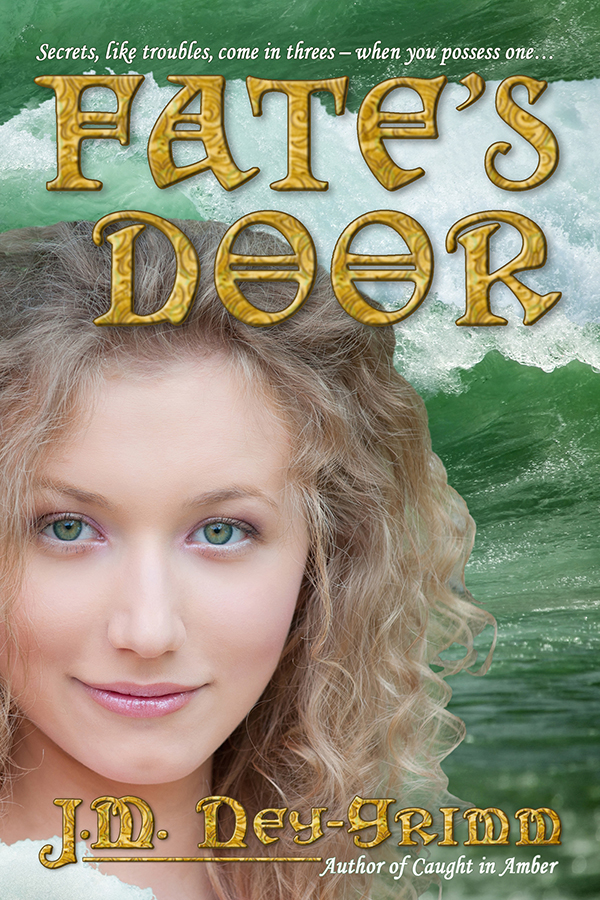
Book Cover for Fate’s Door

Last month, when I shared my step-by-step process for creating the book cover for my novel Fate’s Door, I concluded by saying that I was not quite satisfied with the gold texture that appeared in the title and byline.

Since that post, I’ve found a texture I love. Take a look!

Fate ebook cover 600 px

If you’d like to see the full account of my search for the right gold, read the Edited to Add section at the very bottom of the post: Building Fate’s Cover.

Fate’s Door is available as an ebook. Amazon

Fate’s Door is available as trade paperback.
Amazon I B&N I Fishpond I Mysterious Galaxy Books


Share

Gael’s Tally Chamber in Belzetarn

The protagonist of my work in progress, Tally the Betrayals, monitors and controls the copper and tin used to forge bronze swords for the warriors that defend his home, the tower Belzetarn.

In my North-lands, mages who reach too greedily for power in their magery succumb to troll-disease. This affliction ravages their bodies and – eventually – destroys their sanity. My protagonist – Gael – is a troll, and Belzetarn is a troll stronghold.

I’m having a lot of fun telling Gael’s story!

I’ve done research on Bronze Age technologies, the mining methods used to obtain tin and copper, and the differing qualities of those metals when heated. I’ve watched videos of modern-day smiths creating authentic replicas of ancient bronze swords. I’ve watched videos of a re-enactor testing the strength and durability of one of those replicas. It was a little scary to see what that sword could do!

I’ve also done a lot of world building.

Gael’s assistant comes from Fiorish. I know what the island nation of Fiorish is like in the Steam Age of my North-lands. What was it like in the Bronze Age? What sorts of names did the people have then?

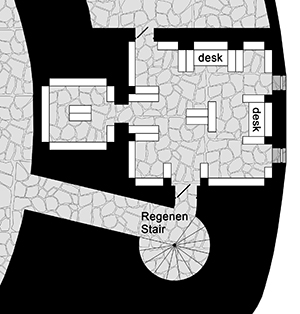
tally chamber, 300 pxI drew floor plans for the entire tower of Belzetarn, from the smithies in its foundations to its lofty top battlements. A very important place in the tower is the tally room, where my protagonist keeps his records and reconciles the tallies from the notaries working in the smithies with his own tallies of metal ingots released to the smiths for their work.

Metals, especially tin, which is rare, are very precious. Every ounce must be accounted for. 😀

Gael marks his tallies on parchments using a quill pen and ink. He stores the scrolls in pigeonhole cabinets, lining the walls of his tally room.

The tally room is located within the thick wall of the tower, about a third of the way up.

The world of Tally the Betrayals fascinates me, and you know what I do with things of that nature. I share them! I hope to post more about Belzetarn as I write, so long as I can avoid spoilers. Watch this space! 😀

For more about The Tally Master, see:
Mapping Ancient Rome onto Belzetarn
What Does the Tally Master Tally?
Map of the North-lands in the Bronze Age
The Fortress of Belzetarn
The Dark Tower
Belzetarn’s Smithies and Cellars
Belzetarn’s Formidable Entrance Gate
Belzetarn’s Treasures
Belzetarn’s Great Halls
Bronze Age Swords
Brother Kings


Share

Getting Started with a Bullet Journal

I’ve kept a journal since 1980, and I’ve used to-do lists for longer. But both of those tools have evolved considerably over time.

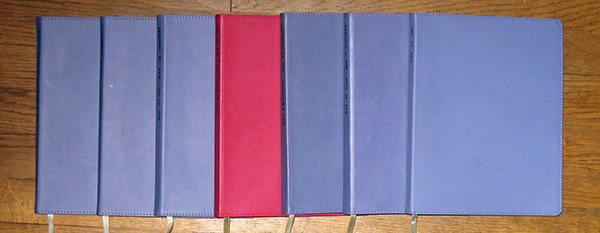
row of journals

The journal was originally a way to think about my feelings, so that I could try to make sense of them. The to-do lists were written on loose scraps of paper, with the various items being crossed off as I did them or being transferred to fresh scraps of paper when the original one grew too crowded.

Those simple systems worked, although I always had a feeling that there might be a better way. (But not one of the myriad organizers available for purchase, which were far more complex than I needed.)

My two systems started to merge about 9 years ago. I’d scribble short lists on the edges of my journal pages, drawing a box around the list to make it easier to find when I needed to refer to it. I still wrote my feelings out – a good tool – but I didn’t need to do it as often. The contents of my journal tended to be ideas for my future combined with brainstorming and notes on whatever novel I was writing at the time.

When I wanted to refer to either my plans for the future or my story notes, it was a real pain to locate the right page with the right information. Often, I couldn’t find the information at all.

bullet journal, page label, 600 px

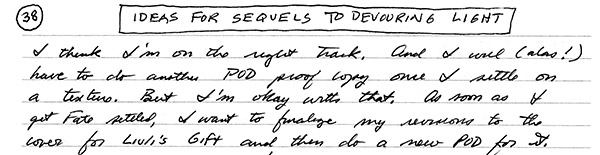
I started labeling pages that I knew I would want to refer to again, and drawing a box around the label, so that it didn’t fade into the wall of writing.

That helped a lot. I still had to flip through the pages, and sometimes I missed the label and had to flip through repeatedly. But generally I could find what I needed.

But I wished I could find it more efficiently.

(In the image above, the ideas for the Devouring Light sequels were farther down the page. That’s why the label does not match the text. I didn’t need to label my plans for the Fate’s Door cover, because I won’t need to refer to those thoughts later. I’m working on the cover revision right now!)

Then a friend suggested I type up a table of contents whenever I filled a blank book. I liked that idea and tried it, gluing the TOC into the flyleaf of the journal.

It was awesome! I could check the TOC and flip right to the pertinent info.

Except, it was a pain numbering all 254 pages in one go. Plus I had to actually create that TOC.

I learned to number the pages as I went, but I tended to drag my feet in typing up the TOC. It was such an unappealing chore. And then I needed to make sure I hadn’t run out of rubber cement to glue the dang thing in.

I loved the results of the TOC, but I often had two journals lingering without them. And, of course, it was the more recent journals – the ones missing TOCs – that I needed to access the most.

Such was the state of things when I stumbled across the concept of a “bullet journal”- so named for the bulleted lists that appear within it.

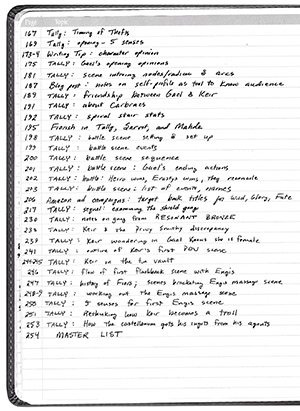
bullet journal, table of contents, 300 pxOne important element of a bullet journal is that the first few pages are left blank!

Why?

So that, as you write in your journal and realize you are writing something you’ll need to refer to again, you can write the page number (or numbers) and the topic on a line in those deliberately available first pages. You create the TOC as you go!

It seems like a perfectly obvious solution to my TOC problems, but I don’t know when (or if) I would have thought of it myself.

I jumped on it, even going so far as to type a TOC for the first 77 pages of the current journal and then add blank lines for future entries, so that I could start with the create-as-you-go TOC immediately. I didn’t want to wait until I started a fresh blank book. I’m glad I didn’t wait. It has been marvelous. I can find everything I need with no trouble, and jotting down the page number and topic is easy peasy.

The sample page above (that I scanned from my February – April, 2016 journal) has mostly entries for my novel-in-progress, Tally the Betrayals. Yes, I’m a little obsessed. 😀

It was the method of handling the TOC that thrilled me, but I’ve found some of the other bullet journal tools to be useful as well. Instead of scribbling my to-do lists in the margins, I allow them a more generous space. But I don’t feel compelled to set them at the beginning of an entry. Nor do I create one every day.

As I read what various bloggers had to say about bullet journals, it seemed clear that their number-one feature was their customizability. Everyone recommended using only those bullet journal tools that suited you.

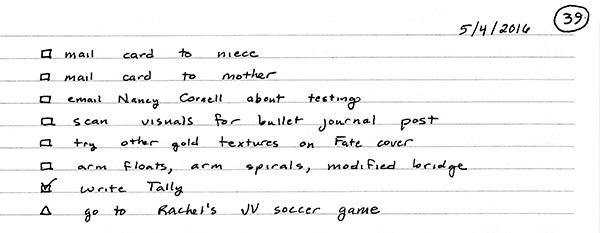
bullet journal, to-do list, 600 px

So I adore the TOC, and I use it. I like to-do lists on busy days, but I don’t need them on days when all I do is write.

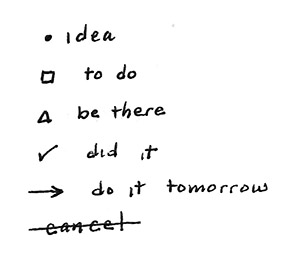
bullet journal symbols, 300 pxI like a small subset of the symbols developed for use in bullet journals. The empty box = something to do. The empty triangle = somewhere to be. The check mark means I got there or did it. A bullet = an idea, such as a new recipe I want to try. A line through an item means I decided I didn’t need (or want) to do it after all. And – my favorite – an arrow through a triangle or a box means I moved the task or the appointment to another day.

The fact is that some things are best done later or skipped altogether, and the bullet journal system plans for it. I love that! I might think I need to do laundry today, and sometimes I do. But if I’m exhausted when laundry time rolls around and everybody has clean clothes to wear tomorrow, it’s fine to push laundry until later.

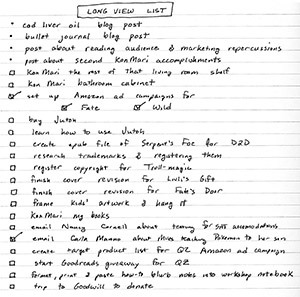
bullet journal, future list, 300 pxThe other item I find helpful is the “future list” or “master list.” This consists of tasks and ideas that I’ll need or want to do in the future, but that are not right for today. For example, I write down ideas for blog posts on my list, as well as things such as a note to purchase Jutoh (software for creating epub ebook files).

If I eventually decide I don’t want to purchase and learn Jutoh after all, I can simply draw a line through it on my “long view” list, before it ever migrates to a to-do list.

Many bullet journalers suggest putting the master list immediately after the TOC. I knew I would hate that. I allow 3 pages for my TOC. Flipping through them to get to the 4th page every time I want to check my master list would make me crazy. I put it on the very last page of the blank book. No flipping needed at all. I just open up the back cover.

Some bullet journalers create really decorative journals that rival scrapbooks. They use washi tape, draw sketches, and include photos. And I gather there are many more tools and systems than those I’ve discussed here. But simple, practical, and functional is what works for me.

About that to-do list I shared above…?

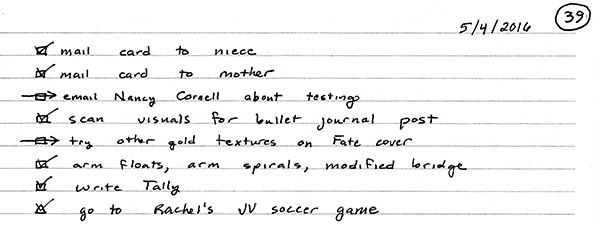
Here it is at the end of the day: a bunch of stuff done and checked off; two items moved to tomorrow. 😀

bullet journal, checked to-do list, 600 px

The bloggers whose info on bullet journals I found most helpful:
The Art of Simple
Carrie Willard
The Lazy Genius Collective


Share