Cover Copy for Troll-magic . . . One. More. Time!

There’s a promotional opportunity for my novel Troll-magic coming soon, so I reviewed its marketing copy to be sure everything was ready. Most promo newsletters require a considerably shorter story description than the one present on the web page of retailers such as Amazon, Kobo, Apple, etc.
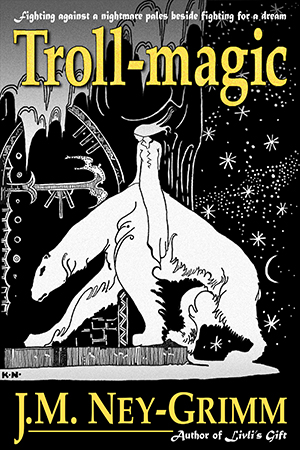
cover image for Troll-magicSince Troll-magic released way back in 2011, when promotional opportunities were much scarcer on the ground than today, I suspected the marketing copy was not ready to go, and I was right.

Oh, I’d created a version for the “short blurb” that Smashwords requires. But – upon review – I didn’t like it much. Worse, I found that as I studied the full-length version, I had some problems with it as well.

None of this surprised me. Or even dismayed me. (Even though I’d revised that blurb extensively not too many months ago.) I’d expected that I had some work to do. That’s why I was reviewing the material.

Here’s the marketing copy I was reading:

Prince Kellor, cursed by the troll-witch Mandine to live as a north-bear, wrestles with the challenges of his beast form. Pain wracks his body. Unpredictable rages blur his mind. And his thoughts spin out of all sense, confusing his search for the loopholes that every curse possesses.

His curse turns on the choices of his childhood friend Elle. She once shared Kellor’s idyllic rambles through the wilderlands. She now loves all things musical. Might Kellor persuade her to neglect her own life and save his? Should he?

But no troll-witch permits her prey to escape with ease. The illusory loopholes in Mandine’s curse all twist back to its entombing heart.

Troll-magic tells a lyrical Beauty and the Beast tale, rife with moments of shining glory and dark magnificence, tumbling toward a lethal battle of wills and the impossible choices forced by clashing loyalties.

There was a lot to like there. I still felt it was a huge improvement over what it replaced. But several phrases bugged me. I’m going to show which ones and why.

north-bear banner

First Paragraph

Most of the first paragraph works well. The mention of a curse and a troll-witch lets the browsing reader know right away that the book is fantasy. The protagonist and his interesting problem are introduced. His goal – finding loopholes in the curse – is also presented. All good.

But “And his thoughts spin out of all sense” didn’t sit right with me. It was a little too vague and, even though I like archaic phrasing, this was a little too archaic. I thought about eliminating the entire sentence, but I needed “confusing his search for the loopholes that every curse possesses.”

So I worked to develop a better phrase. And got one after a little wrestling.

And straight thinking proves elusive, confusing his search for the loopholes that every curse possesses.

Second Paragraph

I liked most of what I had here also. Elle and her critically important role are introduced, along with Kellor’s moral dilemma: should he yank his old friend out of her own vital concerns to minister to him, thus exposing her to considerable danger?

But I didn’t like the phrasing I used to state Kellor’s dilemma.

Might Kellor persuade her to neglect her own life and save his?

It’s true that it’s a life-or-death situation for him. And it’s true that he would be asking Elle to neglect her own concerns. But this phrasing makes it all seem rather black and white, maybe even straight forward. And it is not straight forward at all. Nor is it clear what his best move is. Kellor has to do a lot of heroic inner work before he develops a cogent plan.

Also, I really regretted that my latest revision of the cover copy had removed the front cover tag line from the blurb: “Fighting against a nightmare pales beside fighting for a dream.” I wondered if I could bring back some of those concepts. And – with a bit more wrestling – I did!

Might Kellor persuade her to neglect her own dreams to confront his lethal nightmare?”

Third Paragraph

I had qualms about the simple “But” that I used to introduce a further complication: the loopholes in Mandine’s curse are not really loopholes. It’s a little bald. On the other hand, cover copy needs to be relatively spare. And the alternatives I came up with to replace it were overly ornate. I decided to keep it. For now. 😀
star banner

Last Paragraph

Okay, this was the paragraph with the most serious problems. Yes, Troll-magic is a Beauty and the Beast tale. But it is also so much more than that. How on earth was I going to convey its “more-ness” without diminishing its “Beauty-and-the-Beast-ness”?

I felt like I was Sisyphus pushing the proverbial boulder up the hill. Everything I tried was totally not what I was looking for. Finally I resorted to my most effective hack for when I’m stuck. I write about my stuckness in my journal, as though I were telling a dear friend all about it.

This is what I wrote:

Beauty and the Beast at heart, but the story of how the fate of one young man, one couple, affects the fate of everyone in the world.

But it’s not just one person. Three people develop solutions: Kellor, Helaina, Gabris. The point isn’t that one person does it. The point is that an individual triumph can affect the larger world. The outcome of a private struggle or battle can guide the turn of events in the larger world.

The outcome of Kellor’s struggle will shape the history of the North-lands. The turn of events in the North-lands will echo the outcome of Kellor’s struggle.

Kellor’s curse reflects the curse of the world. I’m having a hard time getting this into words that work in a blurb.

The fate of a world and a people…

I need to let the reader know that the book is Kellor’s story, but it’s also the story of an empire, a people, and a world.

J.M. Ney-Grimm tells a lyrical Beauty and the Beast tale…

…that opens out from its Beauty and Beast heart into an epic steering the fate of an empire, a people, and a world.

lyrical telling
Beauty and the Beast tale
rife with glory and dark magnificence
fate of an empire, a people, and a world
epic

The lyrical telling of an epic with Beauty and the Beast at its heart.

Troll-magic is an epic of…

After all that, my journaling yielded the result I was looking for: something clicked, and I wrote the paragraph I wanted.

J.M. Ney Grimm tells a lyrical Beauty and the Beast tale, rife with moments of shining glory, dark magnificence, and unexpected significance. The fate of an empire, a people, and a world unfurls from Kellor’s deeds and Elle’s choices.
snow and stars

The New Marketing Copy

Putting all the revisions together gives us:

Prince Kellor, cursed by the troll-witch Mandine to live as a north-bear, wrestles with the challenges of his beast form. Pain wracks his body. Unpredictable rages blur his mind. And straight thinking proves elusive, confusing his search for the loopholes that every curse possesses.

His curse turns on the choices of his childhood friend Elle. She once shared Kellor’s idyllic rambles through the wilderlands. She now loves all things musical. Might Kellor persuade her to neglect her own dreams to confront his lethal nightmare? Should he?

But no troll-witch permits her prey to escape with ease. The illusory loopholes in Mandine’s curse all twist back to its entombing heart.

J.M. Ney Grimm tells a lyrical Beauty and the Beast tale, rife with moments of shining glory, dark magnificence, and unexpected significance. The fate of an empire, a people, and a world unfurls from Kellor’s deeds and Elle’s choices.

Of course, I still need to create the short version. But at least I’ll be working from a solid foundation! 😀

Troll-magic Amazon I B&N I iTunes I Kobo I Smashwords


Share

How Long Should My Story Be?

Open book on stack of closed books

What’s the right length for a story?

One way to answer to that question is to categorize the story by type. If it’s a short story, then it’s under 7,500 words. If it’s a novelette, it’s between 7,500 and 17,500 words. Novellas fall in the 17,500-to-40,000 range. And novels are anything over 40,000 words.

I’m very fond of the novella length. There’s enough room to fully develop characters and setting, enough room to allow for more than one event in the story. I have 5 novellas currently published (plus 2 novellettes that are barely short of novellas), and I’ll undoubtedly write more.

But right now I’m working on a novel. How long should it be?

In traditional publishing, YA novels are usually 80,000 words. But Tally the Betrayals is not a YA story. Its protagonist is a 38-year-old suffering from troll-disease who controls the supplies of copper, tin, and bronze in the “dark tower” of my North-lands. I expect that teens will enjoy Tally, but no more so than adults.

Traditionally published mainstream fiction often goes for about 100,000 words. And doorstopper fantasy novels can hit 200,000 or even 300,000 words apiece.

By now, some of you may be longing to tell me that my question is a trick question. And you’d be right, because indie writers like myself have much more freedom in choosing the length of our stories.

Traditionally published writers have to hit the word-count specified in their contracts. If a story is coming in long, the writer must chop it until it fits, never mind what that does to the quality of the work. If the story is coming up short, then a loop must be added in order to fill the word quota.

Dean Wesley Smith, a talented and experienced writer from whom I’ve taken many workshops, and from whom I’ve learned an incredible amount, has been known to say that a story should be exactly as long as it needs to be. I agree with him!

So why is this topic on my mind?

I noticed that when I reached 40,000 words on Tally the Betrayals, I’d just started the 7th chapter of the book. My outline possesses 19 chapters. So, if the chapter lengths are not too disimilar, 6 chapters should equal roughly one-third of the book.

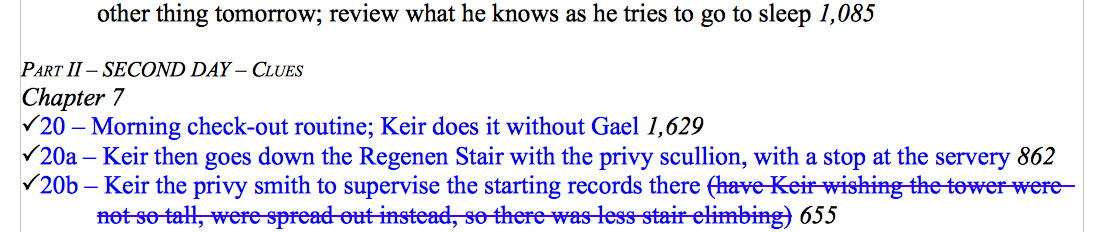
Tally outline scrap

(No spoilers in the screen shot above. All the good stuff is in my head and on the manuscript page. I was lucky in that this bit of the outline possesses merely some notes on where and when the revelations take place, so I could show it here. Other pieces of the outline are much less circumspect!)

I’d estimated that Tally would be 160,000 words, because it’s got a lot going on in it. There’s a redemption story mingled with a mystery mingled with . . . well, that third element would be a spoiler, so I won’t say. But I felt like I might need 160,000 words to tell it all.

But if the first third is comprised of 40,000 words, then perhaps the total for the story will be closer to 120,000 words.

Of course, I can’t really know at this stage. My novel Troll-magic has 169,000 words, but only 10 chapters. And each succeeding chapter is a little longer than the one before it, which means that the first chapter is much shorter than the tenth.

For a short interval, I let my math convince me that Tally the Betrayals would be 120,000 words when I reached the end. Now I’m approaching 50,000 words, and I’m halfway through Chapter 8. Math would put me on track for that 120,000 words at completion. But I’m skeptical. I just have a feeling . . . that the chapters may get longer as I go along. Or that I’ll realize that a few of those chapters should really be divided to become two chapters.

Luckily, it doesn’t really matter. I’m indie. Which means the story can be exactly as long as is right for it! 😀


Share

Fate’s Door in Paperback!

I’m enjoying this moment. Just for now, every single one of my published stories is available both as an ebook and as a trade paperback.

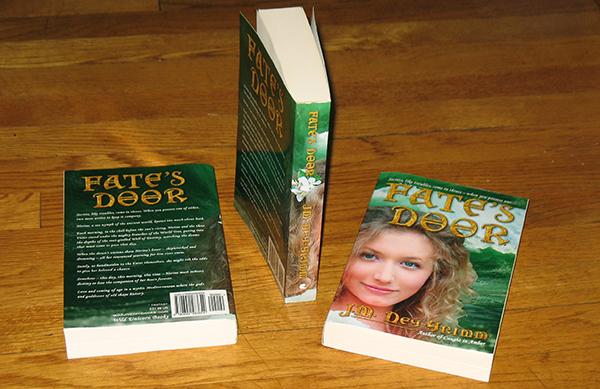
Fate's Door paperback edition

For the last 6 months, every title except one could be obtained in either format. But now Fate’s Door has joined the pack.

I keep aiming to close the gap of time that typically opens between the release of an ebook and its release in paperback. I’ve made some progress. Troll-magic was published as an ebook in December 2011, but its paperback edition didn’t arrive until December 2012.

Four of my latest books – Caught in Amber, Winter Glory, Hunting Wild, and Serpent’s Foe – were actually released with the paperback edition preceding the ebook edition by 3 days! I’d intended Fate’s Door to enjoy a similar dual release, but it was not to be. You’ll know why, if you’ve read the saga of its cover. 😀

Over the last 4 years, it seems I’ve always had one or two books that were not available as paperbacks, so it feels great to see all of them in that format today.

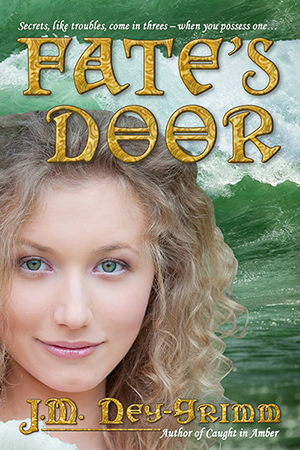
Fate's Door cover 300 pxSecrets, like troubles, come in threes. When you possess one of either, two more arrive to keep it company. Nerine, a sea nymph of the ancient world, knows too much about both. Love and coming of age in a mythic Mediterranean where the gods and goddesses of old shape history.

Fate’s Door as a trade paperback: Amazon I B&N I Book Depository
Fishpond I Mysterious Galaxy Books

Fate’s Door as an ebook: Amazon


Share

Sunlight as a Source of Vitamin D

Vitamin D has been in the news a fair bit lately. It’s an essential nutrient that keeps our bones strong and our immune systems functioning well. And – apparently – most modern people don’t get enough of it.

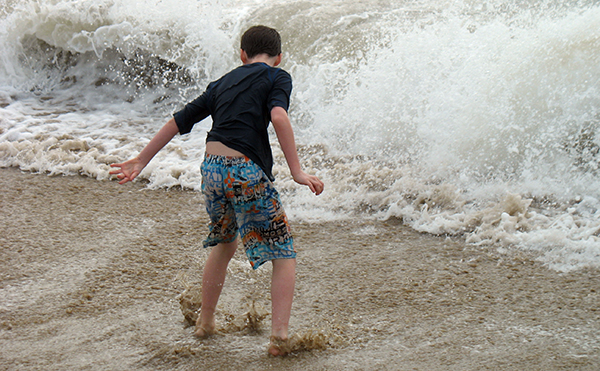
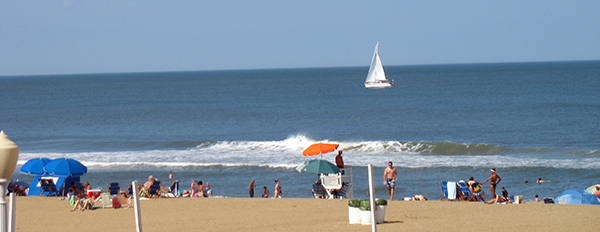
beach fun

I’d read that it’s very difficult to get enough vitamin D from sunlight. Since I’ve had a melanoma (the most dangerous kind of skin cancer), I don’t dare even try to get my vitamin D from the sun. But I was curious about the claims that it is possible. And about the claims that it is not possible.

So I went hunting online to see what I could find.

First off: how much vitamin D does an adult need?

The standard these days is quoted as 5,000 IUs a day, although I also found a mention that it may not be enough. Different people at different ages metabolize D with varying efficiency. The experts seem in agreement that the only way to know for sure that you’re getting enough D is be tested for your blood levels. One study that tested D supplements found that 8,000 IU was needed to produce the correct D blood levels.

But let’s say the commonly cited 5,000 IUs is enough. How long would I need to soak up rays?

beach sun

The angle of the sun in the sky is critical to determining the answer. Human skin makes vitamin D when exposed to UVB radiation. When the sun is below 50 degrees in the sky, all of the UVB rays are filtered out by earth’s atmosphere. There are many locations where there are no UVB rays to be had for some portion of the year. Mine is one of them.

I live at latitude 38°2′ and the first day of the year when the sun reaches 50 degrees is March 15. Between 1:10 pm and 1:40 pm on March 15, UVB rays reach my patch of the planet.

The last day of the year when this happens is September 27, between 1:00 pm and 1:10 pm. Only 10 minutes!

From September 28 through March 14, there are no UVB rays and thus no vitamin D to be garnered in the garden at Casa Ney-Grimm.

How did I find out this sun angle information? The United States Naval Observatory makes a sun calculator page available at http://aa.usno.navy.mil/data/docs/AltAz.php. If you live in the US, you can just type in your city and state and the date to get the sun angles for your spot on earth. If you live elsewhere, you’ll need to know your latitude and longitude. A simple online search should produce them.

The next step in calculating my vitamin D production would ordinarily be a visit to the page created by the Norwegian Institute for Air Research. Every expert I could find referenced this page as difficult-to-use, but accurate. But I could not get the page to load. Maybe, with summer right around the corner in the northern hemisphere, too many people like me are checking their vitamin D production. 😀

(Maybe you will have more luck than I did in getting the page to load. Here is the URL: http://nadir.nilu.no/~olaeng/fastrt/VitD-ez_quartMED.html.)

I was not ready to give up, however.

beach wave

With yet more searching around, I discovered that there was a consensus that light-skinned individuals (which I am) produce 1,000 IUs after 4 minutes of UVB exposure, while wearing shorts and a t-shirt. So, to get my 5,000 daily IUs I would need 20 minutes in the sun, at a time when UVB rays were getting through the atmosphere. If I needed 8,000 IUs, then I would need 32 minutes in the sun at the right time.

I suspect this general consensus probably refers to vitamin D production when the angle of the sun is at its steepest, well over 50 degrees. Which means that the spring months and fall months, when the sun barely reaches the minimum angle, would produce considerably less than 1,000 IUs in 4 minutes. But I won’t be able to check this until I can get that Norwegian page to load for me.

There are two problems, then, with getting vitamin D from sunlight.

One: In my locality, there are no UVB rays for nearly 6 months of the year.

Two: Light-skinned individuals will start to burn after 16 minutes in the sun. If I wear sunscreen, then it will block the UVB rays, and my skin won’t make any vitamin D. If I don’t wear sunscreen, then I must get out of the sun after 16 minutes, which limits my vitamin D to 4,000 IUs.

I could strip down to a swimsuit. According to the Vitamin D Wiki, wearing shorts and a t-shirt yields 32% of the skin exposed, while a one-piece swimsuit yields 73% of the skin exposed. Doing the math, in a one-piece swimsuit, I’d make 2,281 IUs in 4 minutes. Thus, 9 minutes would get me 5,000 units. And 14 minutes would get me 8,000 IUs. Possible, in the summer.

beach sceneOf course, due to my melanoma history, I would be unwise to spend 9 – 14 minutes in the noonday sun every day. And even if I were to pursue that course, I still couldn’t get my vitamin D from sunlight from September through mid-March.

I think I must conclude that it is, indeed, not possible to get enough vitamin D from the sun. Fortunately, there is another way. But that’s another blog post. Yes, I will write it. But no promises as to when. Tally the Betrayals, my work in progress, continues to call. 😀


Share