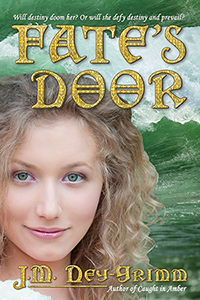
Building Fate’s Cover

Fate web cov 200Usually I don’t think about a book’s cover until I’m close to completing the manuscript, but the cover concept for Fate’s Door leaped into my mind fully formed as soon as I started writing of Nerine in the Mediterranean Sea.

I could see her so clearly on my mind’s eye, emerging from the water, with her blond hair and hazel green eyes, and a wave crashing behind her. That vision stayed with me all through the writing of the novel, and I began the search for the right photographs much earlier than usual.

After several separate tours through the Dreamstime site, I thought I’d found the right model. She looked like a sea nymph to me. Finding the right wave was even easier. I wanted one that was still rolling along part of its length, while crashing into white foam on another part.

2 The wave

I downloaded comp copies of both photos to see if they would work together the way I thought they would. And they did! I was pleased.

However, I did not immediately purchase the files and set to work on building the cover. I was still in the middle of writing the book, and it was important that I not distract myself from that task. It’s a good thing I made the prudent decision.

I remember Lois McMaster Bujold mentioning on her blog, some years ago, that a certain novel of hers remained just three chapters from the end for a good half of the book.

(Unless my memory is utterly wrong. Which it could be. I have a terrible memory.)

But Fate’s Door was like that book of Bujold’s. Once I’d written 100,000 words (roughly 300 pages), I was just 15,000 words from the end. For the next two months! At 160,000 words (roughly 400 pages), Fate’s Door had finally reached “The End.”

After I readied the manuscript for my first reader and sent it to her, I turned my attention to the cover. And decided that I didn’t like my choice of photo representing my heroine. She was too serious. Just as important, she simply wasn’t Nerine.

This same thing had happened to me when I designed the cover for Caught in Amber. I had to go photo-hunting again, and discovered exactly what I wanted among the dozen or more models I’d originally considered. That was Nerine!

1 Nerine

Once I’d purchased the right to use the photos on my cover, I downloaded the files. Then I isolated the wave from the sky over it, and clipped Nerine out from her background of tree leaves. I’ve shown the clipping required in the images above.

3 Wave on coverThe next step was building the progression of waves in my cover file. I’d already done this in the test comp file, so I followed it as a guide. The waves flowed together very nicely, creating a marvelous sense of the sea’s power. I was pleased.

The next step was to place Nerine. Again, I followed what I’d done in the comp cover, but using the newly chosen photo of a different model. I discovered that the green of the tree leaves shining through her hair was very close to the green of the sea. A stroke of pure luck!
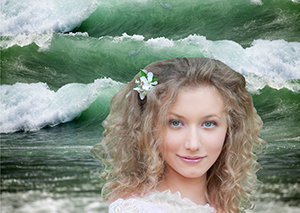
4 Nerine on coverI carried on with placing the title and the tagline that goes above it. Next came my byline and the tagline that goes below it, as well as the underline that visually connects the descending letter “J” to the tagline “Author of Caught in Amber.”

At this stage in building a cover, I can see whether or not the design is coming together. The design for Fate’s Door was definitely coming together, but like every other cover I’ve created, some problem areas remained which would require tweaking.

The first correction I made was to place a translucent green screen over all of the water. It’s fully 70% opacity, but with the light quality set for “soft light” rather than the more usual “normal.” I did this, because I really liked the color quality of the water in my test comp, and the full resolution photograph had a darker, more blue quality. My green screen gave the water a more inviting hue and restored it to that of the comp image.
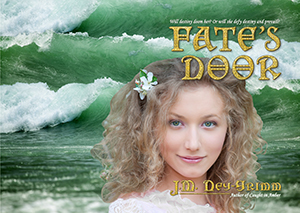
5 first conceptionHowever, the most obvious problem area was the back cover. While I really liked the scene I’d created – Nerine rising from ocean waves – the back cover was not going to provide the even color tone required for cover copy. In fact, the alternating white of sea foam and dark green of the waves would provide the very worst possible background for text.

The dark green would call for white text, while the white foam would need black text. And alternating black and white text would look awful, as well as being hard on a reader’s eyes. Something would need to be done. That something felt rather obvious to me. I’d had doubts about the layers of waves from the beginning, but been beguiled by the scene I was “painting.”
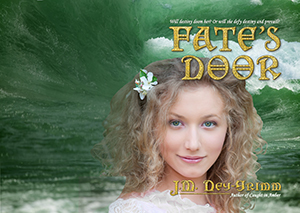
6 Adjust the backThe solution was to stretch the dark green portion of the wave to cover the entire back cover and feather it to gently transition into the foaming wave on the front cover.

Fixing the most egregious problem caused the next worst one to leap to my eye. The title was hard to read, because its first word – Fate’s – was neatly bisected by where the white foam of the frontmost wave gives way to the green of the next wave rolling in. I tried moving the frontmost wave down, so that the color change occurred between the two words of the title. The golden color showed up equally well on the two colors – white and green – so it worked, in that sense. But I didn’t like it.

I didn’t like splitting the title. And I didn’t like how the overall composition looked with the white sea foam positioned at that lower level. I decided to try something else. What if I left the sea foam essentially in place, but stretched it vertically, so that the upper edge fell near the top of the first word?

I tried it.

And I liked it. Very much.

7A Move wave

I considered Nerine’s dress. I’d already changed it from pale pink to white. I’d hoped it might look like sea foam, but it didn’t. And Nerine doesn’t wear dresses in the sea. But I had a plan. I selected a section of sea foam with the right shape, copied it, and placed it over her dress.

It needed a little stretching to make it right, but Photoshop’s warp tool is a handy thing for just these situations. The foam was a little too white, as well, since it was out from behind that “soft light” green screen that I’d placed over all the water. Another easy fix: place a similar screen over just this front portion of sea foam.

Next I poured in the back cover copy.

Still looking very good.

Now it was time for the final tweaks, mainly placing translucent screens with softly feathered edges behind some of the text. The tagline above the title got a 20% screen of wave green behind it. My byline received two screens, a hair-colored one at 30% behind “Ney-G” and a 20% wave screen behind “rimm.” I made both large enough to also fall behind “Author of Caught in Amber.”
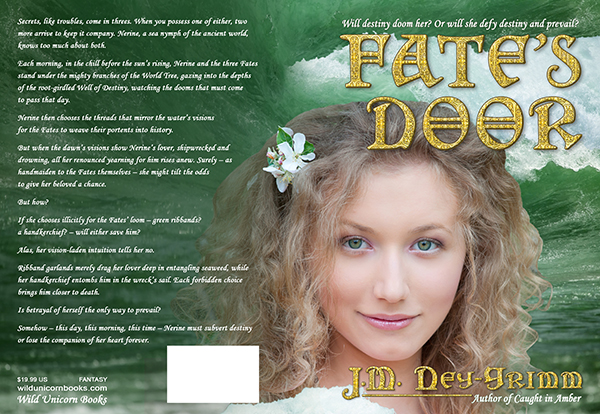
8 final Fate cover

A few more similar screens went on the back cover behind “Wild Unicorn Books” and the price and genre. I decided to remove a small awkward piece of Nerine’s hair, where it protruded from behind the ISBN box and simply looked odd, separated from Nerine herself as it was.

My cover was nearly finished. The spine needed all three of the usual elements: title, byline, and Wild Unicorn logo. The elements themselves are simple, but I expected to have trouble with them because of the pesky flower in Nerine’s hair.

Now, I love the flower. I can just imagine it plucked from a blooming tree by a lover, and cast on the waves as a wish, to alight in Nerine’s hair as she surfaces. But its location on the spine is problematic, because it might all-to-easily interfere with the title – either crowding the title or making it hard to read by peering out from behind the letters.

This proved to be the case when I first placed the title. The flower was located behind it. Not good.

However, I usually start with the title larger than I need it, because making it smaller is always an option. Whereas, if I decide I need it larger, I must start over with the larger image again. Each time I shrink an image, some of the data is discarded. Taking the small image and enlarging it does not restore the lost data.

As I made the title smaller and smaller, I could see that it would probably fit very nicely between the top of the spine and the flower. There is even a little room (considering aesthetics) to make it smaller yet, if required. But I’ll need to see an actual physical book – the proof copy – before I decide. On my computer screen, the title looks a little crowded by the flower.

But the only place the spine will be seen is when a reader holds the trade paperback in his or her hands. And I’ve learned that the size of type on a screen appears very different from its appearance on a physical book. This post will likely go live on my blog before I’m working on the paper edition, but I’ll add a note to tell you how the title issue turns out.

Once I placed my byline on the spine, I saw that the flower was not the only constraint. The title has essentially 9 “letters” in it, when you include the space between the two words. My byline has 12 “letters.” I like the letters of title and byline to be the same size on the spine. Which meant, in this case, that the letters had to be small enough for both title and byline to fit, along with the unicorn profile which is my imprint’s logo.

All of the elements required translucent screens behind them to make them easily readable – hair-colored for most of the type and the logo, water-colored for the “E” and the “S” in “Fate’s.”

And here it is, with the spine complete. For now. 😀
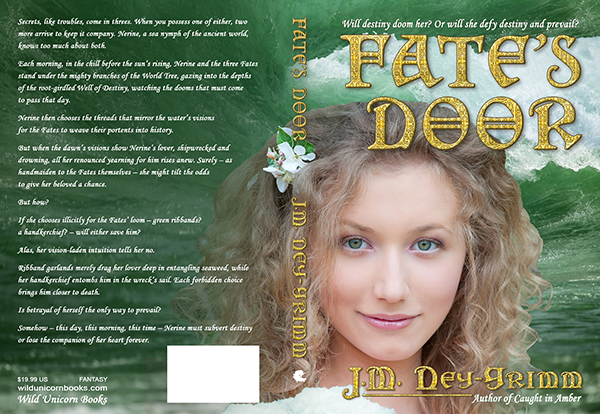
9 cover spine

Edited to Add April 2016

My first reader gave me excellent feedback on Fate’s Door. I made revisions to correct the issues she found, and then sent the manuscript off to my second reader. My second reader gave me equally good feedback, and I made yet more revisions.

All in all, three-and-a-half months passed while my readers read and while I wrote revisions.

During that time, I also revised the copy that appears on the back cover of the paperback. Below is the corrected version of the cover.
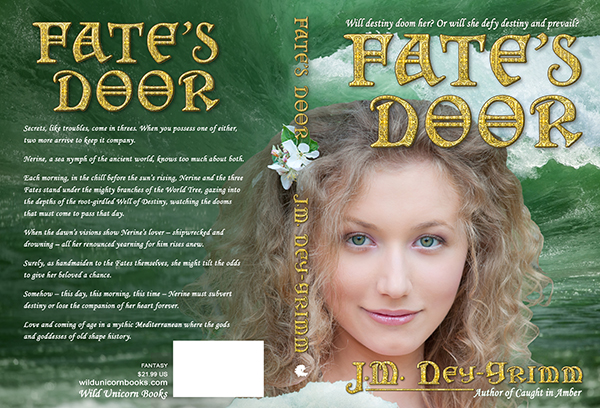
Fate's Door, final cover, 600 px

Given that the cover for the paperback is complete, where – you may be wondering – is said paperback? Why can it not be ordered on Amazon or anywhere else?

Here’s my problem: the metallic gold title looks good at full size on the paperback. But it’s not quite right at thumbnail size on a website page. I’ve tried many variations to see if I could improve it: metallic brass, jade green, copper orange, and more. All of the variants looked worse than the metallic gold. Much worse.

Fate's Door, cover variations

I’m not quite ready to throw in the towel and go with the gold filigree.

And thus the paperback still waits on my hope that I can figure out a solution to my title quandary. Cross your fingers for me – and for my readers who prefer paper to digital – that I dream up my solution soon! 😀

Edited to Add May 2016

In the comments below, my friend Alicia suggested that I try a different gold texture for the title treatment. Her suggestion stuck with me all week after I read it. I’d already tried five alternate gold textures, and none of them worked. But I had a feeling she was onto something.

I searched for yet more gold patterns and found half a dozen possibilities. None of them worked either, but I still felt that Alicia was right. I took a week’s break and then searched again. This time I found one, but I hoped it just might be the one.

When I tried it…I liked it! A lot! Alicia was right when she said, “You’ll know the minute you find the right combination…”

Thank you, Alicia! I doubt I would have persevered so long and so successfully without your suggestion and your encouragement.
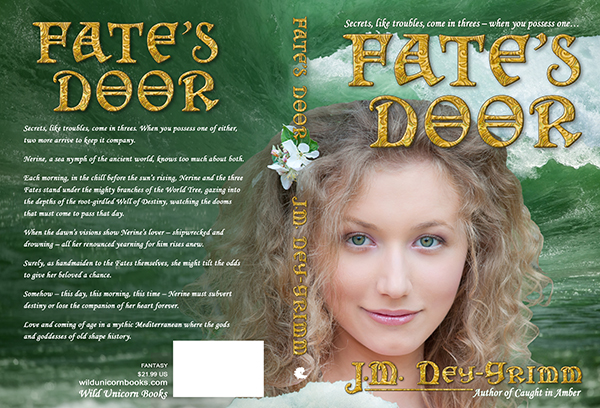
Fate tapestry cover

I saw one more problem after I created the new title treatment. It’s a little crazy that I hadn’t noticed it sooner. I did my first work on the cover when I was still writing the book’s manuscript draft, and when I returned to the cover (many months later) I’d forgotten that the tag line above the title was originally a placeholder.

I’m still shaking my head at myself. Really, J.M.? Really?!

Alas, really. It’s fixed now. 😀

Secrets, like troubles, come in threes – when you possess one…

Fate’s Door is available as an ebook. Amazon

Fate’s Door is available as trade paperback.
Amazon I B&N I Fishpond I Mysterious Galaxy Books

For more cover builds, see:
Building Wild’s Cover
Building Glory’s Cover
Cover Creation: Perilous Chance

 

Share

When Scrolls Gave Way to Codices

I understand that this has been around for a while, but I just encountered it a few weeks ago. I laughed hard enough that I whimpered, so naturally I had to share it with you. Enjoy!

That was me when I was given my first iPod. “Where is the manual?” I asked. And was answered: “It’s online.”

Aaaaack! 😀


Share

Getting Started with the KonMari Technique

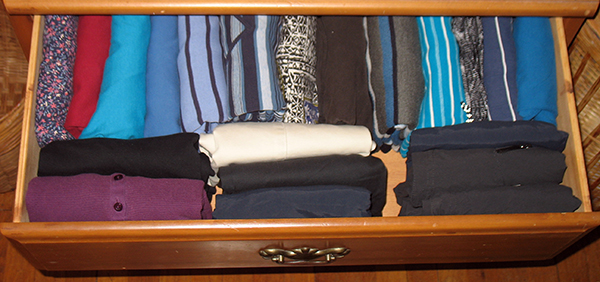
KonMari drawerMy mother once remarked that she’s amazed at the useful tidbits of information that I find online. I was surprised by her observation. I’m not particularly adept at search terms. Nor am I truly computer savvy. I manage. But when I thought about it, I realized we were both right.

While skill has little to do with my online efforts, serendipity has played a large part in leading me to water in the online world.

When I finished my novel Troll-magic, I discovered Dean Wesley Smith’s blog with all his marvelous information for the writer who wants to get her work out to readers.

When I was longing for a greener way to wrap gifts, I stumbled upon a video that showed how to wrap presents using cloth.

When I realized that our modern ideas about what comprises healthy eating were probably incorrect, I bumped into Sally Fallon’s book, Nourishing Traditions.

There were more happy discoveries, but I’m not going to list them all now. 😀

So what’s my latest discovery?

The KonMari technique for tidying up.

I’ve always had a liking for books about organizing and de-cluttering. The first one I ever encountered remains one of my favorites: Clutter’s Last Stand by Don Aslett. It made me laugh out loud even while it inspired me. Organizing From the Inside Out by Julie Morgenstern was another good one. And Clear Your Clutter with Feng Shui also had some good points, although I disagreed profoundly with some of the information presented.

With my penchant for books on de-cluttering, you might think I struggled with tidying and organizing, but for much of my adult life I didn’t. My home felt comfortable to me and not overburdened with things. I read the books for enjoyment and for inspiration when I embarked on one of my periodic pruning of the possessions.

But after my husband and I bought a house, the balance tipped. Our house had less storage than my previous living spaces. My parents asked me to take the boxes I’d been storing in their house. (They were generous to keep them for as long as they did.) And my book collection reached a size that overflowed our bookshelves.

Then we had kids. Then I experienced a long string of illnesses interspersed with injuries, during which housekeeping fell even further behind. And, and, and.

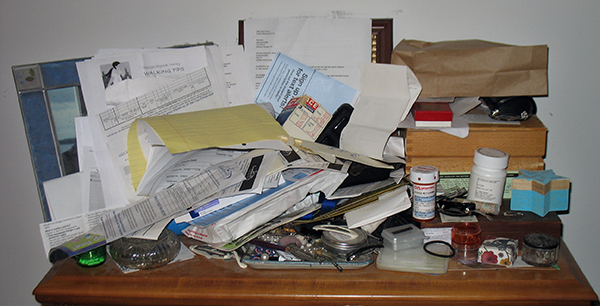
Twenty years down the pike, my home was cluttered, and even my own spaces within it were cluttered. Cluttered enough that I felt overwhelmed and stuck. I didn’t know where to start.

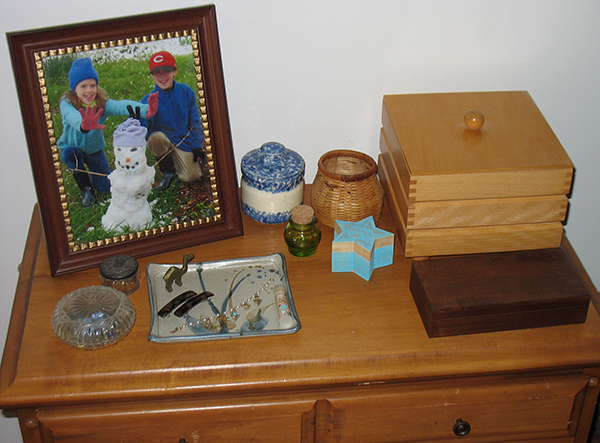
cluttered bureau surface

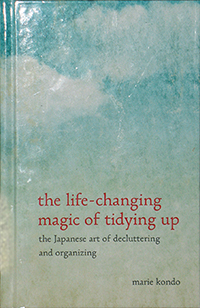
That was the unhappy state of Casa Ney-Grimm when I saw mention of Marie Kondo’s book, The Life-Changing Magic of Tidying Up, on the monthly newsletter from LibraryThing. The title attracted me, and I poked around on the internet to learn more about it. I discovered oodles of videos while I waited for my turn at the copy in our local library. What I found inspired me.

I’d looked at a few new books on de-cluttering when I noticed how stuck I felt around the whole issue, but they seemed to merely re-hash all the stuff I already knew. I needed a fresh, new angle of approach to deal with my situation. Neither plain commonsense nor the old advice from experts was enough. Marie Kondo’s technique looked to be that new angle I needed. I decided to give it a try.

The Life-Changing Magic of Tidying UpWhat is Marie Kondo’s technique?

1 • Tidy by category, not by location
2 • Keep only those items which spark joy

I liked the first of those two instructions, because it was different from anything I’d heard before. And I needed something different. I’d always tidied and organized room by room. The bedroom. The living room. The kitchen. And so on. What might organizing by category be like? What categories would Kondo use?

The second instruction reminded me of the quote by William Morris: “Have nothing in your house that you do not know to be useful, or believe to be beautiful.” I wasn’t convinced it would be helpful, but I was wrong. After I’d heard Marie Kondo speak (via a translator, since she is Japanese) and after I’d read her book, I realized that there was one detail that was critical to my success with instruction #2.

Hold each item in my hands and notice how my body feels.

If my body feels energized and light, the item “sparks joy” in Kondo’s vocabulary. That item is a keeper.

If my body has that slight (or not so slight) sinking sensation, then the item does not “spark joy.” It needs to go elsewhere.

The first instruction – tidying by category – also possessed more to it than I’d initially realized. Kondo not only recommends tidying by category, but tackling the categories in a specific order, from easiest to hardest. That way, you train your ability to discern which items “spark joy” and which do not.

What is her order?

1 • Clothing
2 • Books
3 • Papers
4 • Miscellany
5 • Memorabilia

With that information, I dove into my clothing. It was time to stop thinking and pondering, time to start doing.

Kondo recommends finding absolutely everything in your house in each category, placing it on the floor of one room (or on your bed), and going through it in one fell swoop.

I can see why she does. Most people say: “Wow! I didn’t realize quite how many clothes I owned!” Plus comparing how each of two dozen tops makes your body feel makes it really obvious which ones “spark joy” and which do not.

But I’ll confess that I didn’t follow her instructions to the letter. I started with the clothes in my wardrobe and my chest of drawers. I didn’t pull out the dresses stashed in the back corner of my daughter’s closet. I didn’t pull out the trunk of clothes buried in the eaves under the roof. I knew that if I wanted to get started NOW – and I did – I needed to go with what could be accessed easily.

So I went through my clothes, and it was easy.

I discovered two consistent mistakes that I’d made all the other times I’d de-cluttered in my life. It hadn’t mattered when I was younger and didn’t have as much stuff. But it was a heavy contributor to the clutter that built up later.

I’d tended to get confused about useful things. Using the “spark joy” criterion cut through my confusion and showed me what was really useful and what was not. In the past, I been keeping at least a few things that might be useful, but were not truly so, because I never did actually use them.

I’d also kept things that were beautiful, but that I didn’t love. I’d never realized that just because I found something beautiful didn’t mean I loved it. I’d always assumed the two things went together. For me, they do not.

Getting rid of three gigantic leaf bags of clothing that didn’t “spark joy” felt wonderful. Of course, I’d felt that particular relief before, but this time there was something else that I’d never felt before. Kondo had mentioned it in her book, but I’d not truly realized what it would be like.

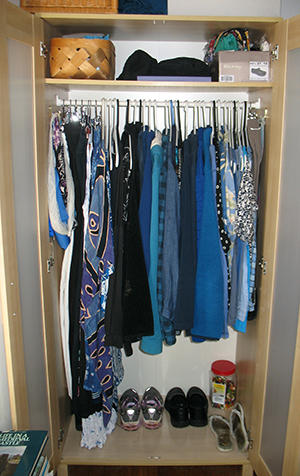
tidy wardrobeWhen I open my wardrobe now, I see only clothing that I love.

I’d never had that experience before. Never.

Always, until this month, my closet included a few (or more than a few) garments that I didn’t love. Opening the wardrobe doors onto only clothes that I love feels really different. It’s energizing. I begin to see why Kondo says her method is life-changing. Imagine if my whole house – not just my wardrobe – produced this feeling! I hope to find out!

I also discovered that I really did have enough clothes, even when I kept only those I loved.

I’d wondered about that, and apparently I’m not alone. Many of Kondo’s clients have wondered the same. What I learned is that the reason I’d felt like I didn’t have enough clothes before I got rid of so many was that the clothes I loved were hidden by all the clothes I’d grown to hate. It’s a paradox. Now, with fewer clothes, that “not enough” feeling is gone. I have enough.

Imagine that feeling multiplied through the whole house!

Kondo also recommends folding clothes into neat rectangles that can be placed in a drawer the way a book is placed in a bookshelf. This allows you to see everything in the drawer at a glance. It allows more items to fit in the drawer. And it prevents items at the bottom of stacks from getting crushed and creased, because there are no stacks. (The photo at the top of this post shows one of my drawers with the clothes folded and placed in this way.)

I was so energized with my experience of KonMari-ing my clothes, that I wanted to go on.

The next category should have been books. But I hated looking at the messy top of my chest of drawers, when the interior was so wonderful. And most of the clutter was paper generated by doctors’ offices during my last two illnesses. I didn’t want to wait until I’d finished books and started on papers. I decided to do a little location-based de-cluttering and tackled both the nightstand by my bed and the top of the chest.

I put the papers in a pile on my coffee table in the living room and went through them all in one swoop. Most could be discarded – either recycled or shredded. I placed them in the appropriate bins. A few went into a medical file folder.

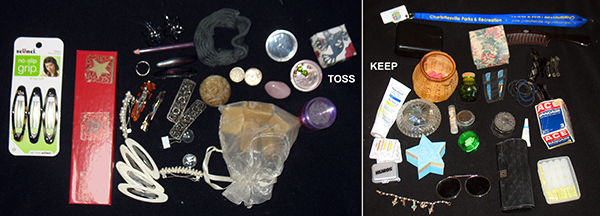
I placed all the items on my bed and then sorted them – holding each in my hands – into keep or toss (give away). Here is where my discernment of the difference between “might be useful” and “actually useful,” as well as the difference between “beautiful” and “loved,” made a huge difference. I tossed many useful and beautiful things and felt great about it, because I kept the things I really use and love.

KonMari keep & toss piles

I changed my mind about the fabric-covered box that I’d thought to keep. It was actually useful (to store my barrettes), but I didn’t love it. In fact, just looking at it produces that sinking feeling, so it definitely needs to go. I chose an old blue and white sugar bowl from the china closet to keep my barrettes instead.

I aimed for quick in my first stab at the KonMari technique, rather than perfect. I suspect I will need to fine-tune some of the work I’ve done. I know I’ll realize that some of the items I’ve kept really don’t “spark joy.” That’s okay. Kondo herself recommends doing it right and doing it once. But I’m comfortable with revisiting my work after I’ve done it. I don’t fear the dreaded “rebound.” Maybe because that doesn’t feel like my problem.

My problem has been getting out from under. And doing this quickly will get me out from under. Once I’m out from under, I won’t feel overwhelmed. I’ll be up for tackling a little fine-tuning and the correcting of any mistakes.

KonMari tidy bureau

My spot de-cluttering has worked so well, that I’m going to do a bit more. There’s a shelving unit in the living room that really belongs in the study. It’s slowly accumulated clutter while awaiting its transfer to the proper room. I’m going to de-clutter it next. It will surely need that before it can be moved anyway!

And then I’ll move on to books!

I plan to share how each of the different categories goes for me. Cheer me on! 😀

For more life-changers, see:
Writer’s Journey
Test First, Then Conclude!
Butter and Cream and Coconut, Oh My!
Great Soap & Etcetera Quest


Share

Mother Holle

"I am half sick of shadows," said the Lady of Shalott by John William WaterhouseMother Holle (or Frau Holle) is one of the stories collected by the Brothers Grimm, but it may be far more than a fairy tale.

In most of the other Brothers Grimm stories, anonymous and magical beings enter the world of the protagonist to assign heroic quests, bestow blessings, or mete out punishment.

Mother Holle is quite different, in that the magical being is named, she lives in the heavens, and the protagonist of the story must go to her by paradoxically diving into a spring. When Mother Holle shakes her featherbed, the loosed feathers fall to the earth as snow. These features suggest that the story is an origin myth for a supreme Mother Goddess with roots in the early Bronze Age.

Holle seems to be a northern version of the southern Perchta or Berchta, a goddess of spinning and weaving. She had both a light and a dark aspect, the one beautiful and shining, the other old and haggard. The name Perchta seems to derive from both beraht (Bright One) and pergan (Hidden One).

In my novel Fate’s Door, I imagine Holle as a Great Mother Goddess and the first weaver to sit at the loom of fate, weaving the lives of her children – mortal and immortal – into being.

Windswept by John William WaterhouseAfter millennia of weaving alone, she longs for company. When a wandering oread – a nymph of the mountains – climbs too high and is carried away by a cloud to Mother Holle’s cottage, she begs shelter. Mother Holle gives it, and the nymph stays for some time, recovering from her ordeal in the sky.

As she regains her health, the nymph helps the goddess with her tasks – both those of the household and those involved with her weaving. The two become friends. The nymph asks if she might make the cottage her home at the same moment when Mother Holle asks the nymph to stay forever, thus becoming a spirit or a numen of time.

This is the young Orroch, who eventually becomes the eldest norn.

In time, Mother Holle acquires another helper. When she is weary, the two young numeni play music to soother her and themselves, for the burden of crafting destiny is heavy.

Saint Cecilia by John William Waterhouse

After yet more millennia, another young nature spirit joins the family, and Orroch persuades Mother Holle to seek her freedom and leave the weaving to her helpers. Orroch promises the goddess that they will faithfully hand down the traditions of destiny to the new heirs that arise, and only then does the goddess depart.

Orroch imagines the goddess roaming the cosmos beyond even the confines of the sky, meeting strange denizens, and pursuing adventure, but no one really knows where Mother Holle has gone.

Gather Ye Rosebuds While Ye May by John William WaterhouseOrroch herself takes the role of weaver, while her helpers become the Pattern-maker and the Shuttle-catcher. They also seek the materials needed for the loom.

As the centuries roll by, Orroch remains steadfastly at her weaving, but newcomers take the roles of her assistants. No longer are they selected by chance. Invitations are sent to promising candidates. Orroch is content that this should be so until a certain lake nymph named Cinnisuent learns the ways of the norns. Only then does tragedy enter Orroch’s breast.

Mother Holle from the Brothers Grimm

A widow had two daughters. Her stepdaughter was beautiful and industrious, but the widow favored her birth daughter, allowing the girl to become lazy and spoiled. Thus the stepdaughter had all the work to do, becoming the Cinderella of the house.

Every day the poor girl sat by a well, next to the highway, and spun so much that her fingers bled. Now it happened that one day the spindle was completely bloody, so she dipped it in the well, to wash it off. It slipped from her hand and fell in. She ran to her stepmother weeping, and told her of the mishap. She was scolded sharply and mercilessly.

Her stepmother said, “Since you have let the spindle fall in, you must fetch it out again.”

The girl went back to the well, and did not know what to do. Terrified of more scolding, she jumped into the well to fetch the spindle. As she sank below the water, she lost her senses.

The Flower Picker by John William WaterhouseWhen she awoke and came to herself again, she stood in a beautiful meadow where the sun was shining, and there were many thousands of flowers. She cupped one in her hand to study it more closely.

Then she walked across the meadow and came to an oven full of bread. The bread called out, “Oh, take me out. Take me out, or I’ll burn. I’ve been thoroughly baked for a long time.” So she stepped up to it, and with a baker’s peel took everything out, one loaf after the other and set them in a wide basket lying nearby.

After that she walked further and came to a tree laden with apples. “Shake me. Shake me. My apples are all ripe,” cried the tree. She shook the tree until the apples fell as though it were raining fruit. When none were left in the tree, she gathered them into a deep basket which lay under the tree, and then continued on her way.

Finally she came to a small cottage. An old woman peered out through the open window. She had very large teeth, which frightened the girl, who wanted to run away. But the old woman called out to her, “Don’t be afraid, dear child. Stay here with me, and if you keep my household in an orderly fashion, all will go well with you. Only you must take care to make my bed well and shake it diligently until the feathers fly, then it will snow in the world. I am Mother Holle.”

6 Boreas by John William WaterhouseBecause the old woman spoke so kindly to her, the girl took heart, agreed, and started in her service. The girl took care of everything to Mother Holle’s satisfaction and always shook her featherbed vigorously until the feathers flew about like snowflakes. Therefore she had a good life with her: no angry words, and roast meat to eat every day.

After she had been with Mother Holle for a time, she became sad. At first she did not know what was the matter with her, but at last she determined that it was homesickness. Even though she was many thousands of times better off with Mother Holle than at home, still she had a yearning to return. Finally she said to the old woman, “I have such a longing for home, and even though I am very well off here, I cannot stay longer. I must go up again to my own people.”

Mother Holle said, “I am pleased that you long for your home again, and because you have served me so faithfully, I will take you back myself.” With that she took her by the hand and led her to a large gate.

The gate was opened, and while the girl was standing under it, an immense rain of gold fell, and all the gold stuck to her, so that she was completely covered with it. “This is yours because you have been so industrious,” said Mother Holle, and at the same time she gave her back the spindle which had fallen into the well.

Then the gate was closed and the girl found herself on earth again, not far from her mother’s house. As she entered the yard the rooster, sitting on the well, cried, “Cock-a-doodle-doo, our golden girl is here anew.”

The girl went inside and, as she arrived all covered with gold, she was well received, both by her mother and her sister. The girl told all that had happened to her, and when the mother heard how she had come to the great wealth, she wanted to achieve the same fortune for her other daughter. She made the lazy girl go and sit by the well and spin. To make her spindle bloody, the girl shoved her hand into a thorn bush and pricked her fingers. Then she threw the spindle into the well, and jumped in after it.

Like the other girl, she too came to the beautiful meadow and walked along the same path. When she came to the oven, the bread cried again, “Oh, take me out. Take me out, or else I’ll burn. I’ve been thoroughly baked for a long time.”

But the lazy girl answered, “As if I would want to get all dirty,” and walked away.

Next she came to the apple tree. It cried out, “Oh, shake me. Shake me. My apples are all ripe.”

But the girl answered, “Oh yes, one could fall on my head,” and with that she walked on.

When she came to Mother Holle’s house, she was not afraid, because she had already heard about her large teeth, and she immediately began to work for her. On the first day she forced herself, was industrious, and obeyed Mother Holle, because she was thinking about all the gold that she would receive.

But on the second day she grew lazy, on the third day even more so, and then she didn’t even want to get up in the morning.

Ophelia by John William Waterhouse

She did not make the bed for Mother Holle, the way she was supposed to, and she did not shake it until the feathers flew. Mother Holle soon became tired of this and dismissed her from her duties. This was just what the lazy girl wanted. She thought that she would now get the rain of gold.

Mother Holle led her to the gate. She stood beneath it, but instead of gold, a large kettle full of pitch spilled over her. “That is the reward for your services,” said Mother Holle, and closed the gate. The lazy girl walked home, entirely covered with pitch.

As soon as the rooster on the well saw her, he cried out, “Cock-a-doodle-doo, our dirty girl is here anew.”

The pitch stuck fast to her, and did not come off as long as she lived.

The End
 

When I envision Mother Holle as she appears in my protagonist’s thoughts, I see a queenly woman resembling those painted by the Pre-Raphaelites of the 19th century.

Therefore, when I began my search for images for this post, I looked among the works of the Pre-Raphaelites. Although John William Waterhouse painted several decades after the break-up of the Pre-Raphaelite Brotherhood, his style blended theirs with that of his contemporaries, the Impressionists.

And it was amongst the Waterhouse paintings that I found images that matched those of my mind’s eye, as you can see from the selections above. While searching, I also discovered a video combining a slide show of many Waterhouse paintings with the music “Tu chiami una vita” by Jan A.P. Kaczmarek, lyrics by Salvatore Quasimodo. It is so beautiful that I simply must share it with you. 😀


For more about the world of Fate’s Door, see:
Nerine’s Room
Brocade and Drawlooms
Cottage of the Norns
The Norns of Fate’s Door
The Baltic Sea
The Ancient Goths
Lugh and the Lunasad
Crossing the Danube
The Keltoi of Európi

For more about Mother Holle, see:
Mother Hulda on Wikipedia
Frau Holle on Wikipedia
Perchta on Wikipedia

For more about John William Waterhouse, see:
John William Waterhouse on Wikipedia
Waterhouse Signatures on the Pre-Raphaelite Sisterhood
The Winds of Waterhouse on the Pre-Raphaelite Sisterhood
Waterhouse’s Undine and Mermaids on the Pre-Raphaelite Sisterhood
 

Share

Why to Add a Lemon Rinse to Your Hair Care Routine

beautiful hairSome years ago I learned that the soaps and lotions and shampoos we moderns use can be nearly as harmful – over the long haul – as the cosmetics used by the ancient Egyptians or the Renaissance English and Europeans. I looked for safer alternatives. Finding them was quite a search. Many offered on the marketplace were just as bad or didn’t work or irritated my sensitive skin.

Eventually I found a handful of products that worked for me. (Discovering along the way that conventional products had been irritating my skin in a chronic, low level way that I thought was normal for me. It was not.)

But my hair was shorter then. As it’s grown to shoulder length, I’ve found myself wishing for some kind of conditioner. Not enough so as to take up another laborious search. More as a passing wish when I combed my hair.

I’m not really sure how I stumbled upon homemade lemon rinse. Something must have prompted me to do a little googling, but I no longer remember what it was. I bopped around a few websites, and what I learned made me decide to give it a try. Naturally I’m going to share my experience with you. 😀

First some basics.

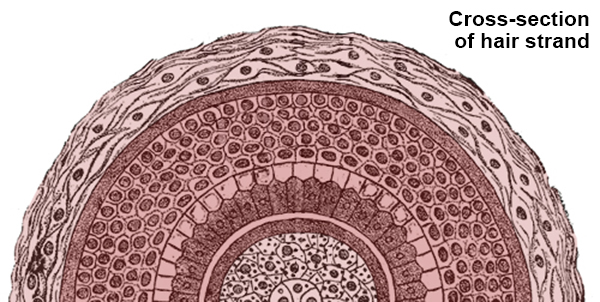
A strand of hair has layers, sort of like an onion (or an ogre, if that ogre is Shrek). At the core is a pith or marrow that is light and airy. It occupies about one-third the diameter of the strand. Around it are rod-like bundles of keratin. And on the outside is the cuticle, a layer of flat, thin cells that overlap one another like roof shingles.

hair cross-section

Normal hair is somewhat acidic.

Substances that are acidic have a pH between 0 and 6.9. While those that are alkaline have a pH between 7.1 and 14. (A pH of 7 is neutral.) Human hair varies between 4.5 and 5.5.

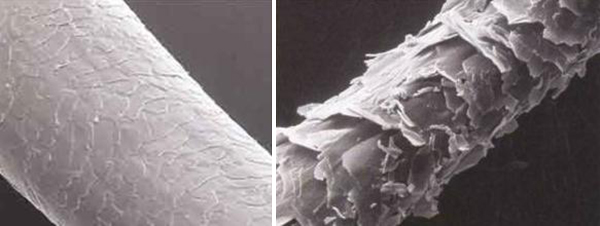
This natural acidity of human hair prevents fungi and bacteria from growing on it. That’s critically important, obviously, but the acidity serves one other important function. When the hair strand has its proper acidity, the cells of its cuticle lie flat and tight, creating a smooth outer surface. When the hair is less acidic than it should be, the cuticle cells loosen and flap, creating a rough surface.

For this reason, a vinegar or lemon rinse serves as a beautiful conditioner.

Electron microscope scans of human hair

Reading about it, I wasn’t sure I believed it. It seemed to simple. Too easy. But I decided to try it.

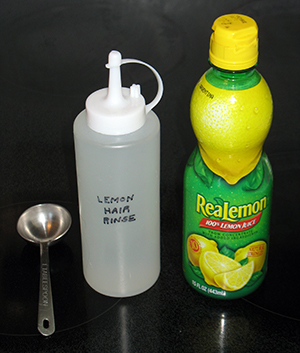
I purchased some ReaLemon® juice and mixed 2 tablespoons of it with 1-1/2 cups water, and poured the solution into a ketchup dispenser.

homemade hair rinse(You need to dilute the lemon juice with water, because undiluted lemon juice is too acidic. You want a rinse that will put your hair right smack in the middle of its natural range.)

When I next washed my hair, after I’d rinsed out the hairwash under the shower, I poured my homemade lemon rinse over my tresses, gently working it into the strands and into my scalp (which should also be mildly acidic).

I was astounded to notice that my hair did indeed feel slippery, just like with using a conventional conditioner, except without that super gooey, gunky feeling. My hair felt slippery, but still clean. Once I was out of the shower, dry, and in my robe, I took a comb to my hair. And was delighted to have the comb slide through the strands easily. Yay! Total success!

ETA: I did rinse the lemon rinse out of my hair after I’d worked it in. You don’t want to simply hop out of the shower leaving the lemon in. Let it do its work of making the hair strands properly acidic and then rinse the lemon away.

That experiment was 6 months ago, and I’ve continued to be very pleased with the results of my lemon rinse. It works. Simple as that.

I do have one caution, if you decide to make your own lemon rinse experiment.

I like to keep my rinse right in the shower with my hairwash and soap. I can do so when I use ReaLemon® as my source for lemon, because it has preservatives in it. But one time I ran out of ReaLemon® and couldn’t find it at the grocery store. I purchased the type of lemon juice that must be kept refrigerated. After 3 days of sitting in my bathroom, my rinse had a nasty coating of mold floating on the top, and I had to throw it away.

So, if you prefer to avoid the preservatives (and I do in the food I eat, but I’m willing to suffer them in my hair rinse for the sake of convenience), keep your lemon rinse in the fridge, pull it out for your hair washing, and put it back after. 😀

For more about safe and effective toiletries, see:
Hair Wash with Rhassoul Clay
Great Soap & Etcetera Quest
Facial Soap Eureka


For more info about alternative hair care, see:
Kanelstrand.com


Share