Broad Distribution: Assessing 2016

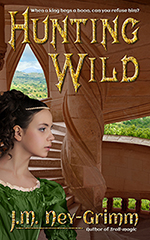
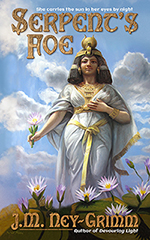
The e-book editions of Hunting Wild and Serpent’s Foe are now both available for purchase at Apple and B&N, as well as several other e-tailers. Check them out!

Hunting Wild cover image, 150 pxHunting Wild

Young Remeya worships the forbidden horned god. A worship made taboo half a millennium ago. Performed still in secret by a few. Quietly tolerated by the king. Epic fantasy in which old beliefs and old loyalties clash with hidden magic in the Middle Ages of J.M. Ney-Grimm’s god-touched North-lands.

Amazon I B&N I Inktera I iTunes I Kobo I OverDrive
Scribd I Smashwords I 24Symbols


Serpent’s Foe

Once she stalked the duat by Ra’s side, carrying his light in her eyes and battling the monsters that assailed them. Now, tormented by confusion and her own fury, she longs to regain the unique powers which – inexplicably – elude her in captivity. In this mythic tale of pride and revelation, a fight beyond death delivers one last chance at redemption.

Amazon I B&N I Inktera I iTunes I Kobo I OverDrive
Scribd I Smashwords I 24Symbols


I’m excited that these stories are now more widely distributed. I’d meant to make them so much sooner. I had the end of January 2016 in mind! There’s a tale behind why I didn’t come close to that date. Naturally…I’m going to share it with you. 😀

Going back to the beginning…

In November 2015, I released 5 titles all on the same day: Hunting Wild, Serpent’s Foe, Winter Glory, Fate’s Door, and Caught in Amber. I’d decided to try several marketing strategies, all at once.

• The Liliana Nirvana Technique: releasing 5 titles within a very short span of time
• Promotional Release Price: 99 cents per title
• Promotional Advertising: multiple ads – with eBookSoda, BKnights, and GenrePulse – capped off by a run of Amazon free days
• Amazon Select: releasing the titles into the Select program, so as to make them available for Amazon’s subscription program, Kindle Unlimited

The Results

In the sort term, looked at within narrow parameters, these strategies worked well. I sold nearly five times as many books in the last two months of 2015 as I normally would have.

In the long term, from a business person’s point of view, the strategies were a failure.

Sure, I sold more books, but because they were priced at 99 cents, the advertising cost more than the money brought in by the sales. I lost money.

Even worse, once the advertising blitz was over and the prices returned to normal, there was no significant change in the rate at which I sold books.

For most of 2015, up through October, I’d sold roughly 15 books per month. By April 2016, I was selling 18 books per month, and I knew where the extra sales were coming from: not my big promotional push.

Losing money in the short term in order to have more readers discover my work over the next year might have been a good move. But losing money to maintain the the same rate of sales? Not so much.

Every Reader Counts

Now, I continue to be delighted with the fact that new-to-me readers continue to discover my books. Marie Force recently wrote about the importance of one’s readers, as did Kris Rusch. Dean Wesley Smith has always said: (paraphrased) remember that there’s a real person behind every sale, a reader who has decided to spend several hours enjoying your story. That means something. That’s real.

I do remember that, every single time someone buys a book of mine, and it’s a wonderful feeling.

However, I won’t be releasing five books all at once again. I won’t be releasing books priced at 99 cents again. I won’t be purchasing ads that lose me money again. And I’ve been slowly pulling those 2015 titles out of Amazon Select.

The Best Laid Plans

I’d intended to keep the stories in Select for only 90 days, or 6 months at most, but two things derailed my plans.

The first was the rip in my left retina that occurred in January 2016. The cryopexy repair was incredibly painful, as was its immediate aftermath. I was barely capable of anything. I couldn’t even sleep much. I certainly couldn’t tackle publishing tasks.

Once the pain subsided, I had to hold my head at an awkward angle, 24/7, for months. I still wasn’t doing much!

When the ordeal was over, I dove into writing. It had been a long time since I’d written fiction, and I was missing it dreadfully.

I also pulled Serpent’s Foe out of Amazon Select, making it available on Kobo and Smashwords. I set up an account with Draft2Digital, another distributor like Smashwords that could reach two new e-tailers that I’d heard good things about: 24Symbols and Tolino.

The Second Hitch

Draft2Digital proved to be my second sticking point.

Many indies speak positively about Draft2Digital. Indeed, I hope to join their number. They like the customer service. They like the modern and up-to-date website and author dashboard. They like the monthly payment schedule. They like the ease with which one can upload files. A few even speak of an increase in sales that occurred when they started using D2D.

I’d wanted to try D2D myself for nearly a year. I figured it would be good to “test the tires” with a short story, and uploaded Serpent’s Foe, planning to distribute the story to Apple and B&N through D2D.

The hitch I encountered was how D2D creates e-book files from uploaded Word files. They want each book uploaded as three separate files: front matter, the story, and back matter. When I uploaded all three of those parts as one file, the resulting e-book was not structured and formatted properly.

Furthermore, the table of contents had the quirk that I, as a reader, hate: no vertical space between the chapters, so that I’m always tapping the chapter just before the one I want or else the chapter just after the one I want.

I realized, of course, that dividing Serpent’s Foe into three files would be a relatively simple matter. That would have solved the structural problems with the e-book. But the only way to solve the TOC problem would be to build the e-book file myself, using one of the software programs designed for that: Scrivener, Vellum, or Jutoh.

Pursuing Jutoh

I had already looked into all three of these programs, and I knew I wanted to learn how to use Jutoh. But I also knew that if I were to purchase Jutoh on the spot and dive into learning how to use it, my writing on The Tally Master would come to a complete halt.

I’d already spent many months not writing, first due to all the publishing tasks required to release 5 titles simultaneously, and then because of my torn retina. It would have broken my heart to stop again. Plus, without the writing, I have nothing to publish. My writing has to come first.

So I wrote, loving my characters, loving my story, and loving being immersed in the creative process again at long last.

Learning Jutoh would keep. So would distributing my books through Draft2Digital. And, since I intended to distribute to Apple and B&N through Draft2Digital, broader distribution of my most recent five titles would also have to keep. I didn’t want to distribute them through Smashwords only to pull them down a few months later in order to go through Draft2Digital.

That was then, June 2016.

But now – now! – I’ve seized my moment.

Pursuing Broad Distribution

Just last week I’d finished all my work on the appendices for The Tally Master, but my second reader was not yet ready with her detailed story feedback. I cannot do my final round of revisions until I hear from her. I had a gap in my workflow!

I filled that gap with learning Jutoh.

I must say that I’m delighted with the program. It took me a full day to really understand all the controls and how to use them; another full day to create the e-book files for Serpent’s Foe (mobi for Amazon and ePub for everyone else).

Now Serpent’s Foe is structured exactly as I want it to be, including the table of contents. It uploaded smoothly to Draft2Digital and maintained its formatting. It’s available at 5 of the 6 e-tailers to which I have D2D distributing. I’m sure it will soon go live at the sixth, 24Symbols. (ETA: It’s live now.)

Since my second reader was still reading and making notes, I dove into putting Hunting Wild through Jutoh. I wanted to cement my mastery. Hunting Wild is longer than Serpent’s Foe, and thus took longer to format, but it too came out beautifully. And it too is now available at 5 of the 6 D2D e-tailers.

I’m on my way to broader distribution with all of my books! I like it!
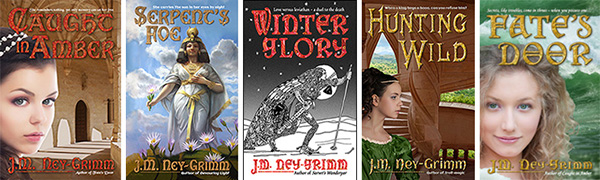
Take a moment and consider the horrible possibility that a Nook devotée couldn’t get Hunting Wild at B&N, or an iPad aficionado couldn’t get Serpent’s Foe from iTunes. Now they can! And soon Winter Glory, Fate’s Door, and Caught in Amber will be available there as well.

Limiting Participation in Amazon Select

I’ve never liked the idea of being entirely dependent on one e-tailer, but that is exactly what Amazon’s Select program requires: any book available on Kindle Unlimited cannot be offered by any e-tailer save Amazon. For that reason, I’ve only dabbled in Select in the past, trying it for 90 days to see if it might boost my discoverability. When no such boost arrived, I pulled the book with which I was testing the waters.

One might argue that only a longer trial would open Select’s benefits. Well, now I’ve made that trial, and it doesn’t. Not for me, at least.

In the future, I plan to use Select for short intervals – just 90 days – because I have some readers with very tight book budgets, who won’t be able to read my books unless they appear at least once in Kindle Unlimited. But after a new release spends its brief time in Select, I’ll send it wide, so that my readers who patronize Apple, B&N, Kobo, and other stores can snag their copy.
Hunting Wild cover image, 150 px

Hunting Wild Amazon I B&N I Inktera I iTunes I Kobo I OverDrive I Scribd I Smashwords I 24Symbols

Serpent’s Foe Amazon I B&N I Inktera I iTunes I Kobo I OverDrive I Scribd I Smashwords I 24Symbols


Share

What Does the Tally Master Tally?

The wealth of Belzetarn is measured in its metals.

How many ingots of bronze, copper, and tin – tin, so rare – lie in its vaults? How many bronze swords? How many shirts of bronze scale?

The technologies required to make superior weapons and tools of iron don’t exist yet, but those for the working of bronze are well developed, and the bronze implements of Belzetarn rarely fail. Were it not for the scarcity of tin, the denizens of the citadel would be well equipped. But tin is incredibly rare, and every grain of it must be well guarded.

Gael, the tally master of Belzetarn, is the one who ensures that none of the tin – or any of the metals – is lost or stolen. The day he discovers that his vaults are one ingot short is grievous!

* * *

In order to write The Tally Master, I needed to know a fair bit about metallurgy, about mining, about smithing, and about the shape and size of ingots through history. I researched all of these elements, and some pertinent bits have made their way into the book’s appendices. Here is a sneak preview of the appendix on ingots.

About Tin, Copper, and Bronze Ingots

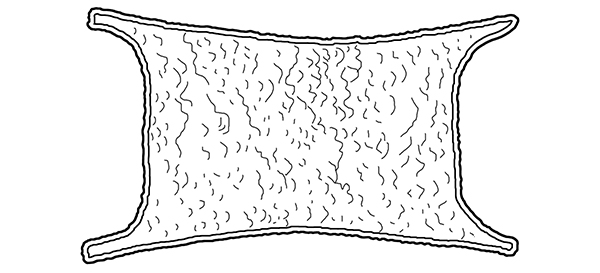
The ingots issuing from Belzetarn’s copper mines are massive ’oxhides’ shaped like an animal hide with four ’legs’ that make it possible to carry them. They weigh 80 pounds and measure roughly 70 centimeters (~28 inches) long by 40 centimeters (16 inches) wide by 5 centimeters (~2 inches) thick.

Belzetarn’s tinworks yield ‘pebbles’ created in a rough smelting on site. These pebbles are transported to the citadel’s forges in sacks loaded onto a mule.

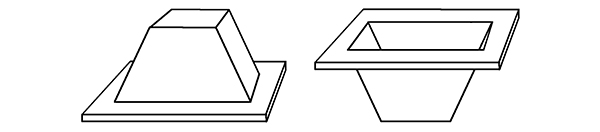
Neither the copper oxhides nor the tin pebbles are pure enough for immediate use. Both must be smelted again to remove impurities, and the resulting high-quality metal is poured into molds which create small ingots shaped vaguely like hats.

These ‘hat’ ingots each weigh one pound and measure roughly 9 centimeters (~3.5 inches) per side of the ’hat brim’ – the widest part. The ’crown’ rises 4.2 centimeters (~2 inches) high.

Tin is the least dense of the three relevant metals – tin, bronze, and copper – and the tin hat ingots have a thickness of 2.421 millimeters. Bronze, with more density, yields ingots 2 millimeters thick. And copper, the most dense, possesses ingots of 1.995 millimeters thickness.

The hat ingots are shaped to nest in neat stacks. But because of their different thicknesses, stacks composed of the different metals would wobble a bit, while stacks of all tin, all copper, or all bronze are very stable.

The smiths of the individual forges – sword, armor, and privy – each create their own bronze from the tin and copper hat ingots, because each requires a slightly different ratio of tin to copper. Any leftover bronze is poured into its own hat ingots. The blade smith regularly produces one bronze ingot every day, so precise and standardized are his processes.

The privy smith, who makes tools and household implements for the citadel, is experimenting wildly with different metal mixtures. He rarely has enough leftover bronze to pour an entire ingot, so his leftovers return to storage at the end of the day as a lump which is weighed.

The armor smithy always needs wire (to ‘sew’ the many small platelets of bronze into mail shirts), so any excess bronze is poured into long narrow molds, yielding metal that can be readily hammered into wire.

THE TALLY MASTER

Seven years ago, reeling from a curse in the wake of battle, Gael sought sanctuary and found it in a most perilous place. But the citadel of a troll warlord—haunt of the desperate and violent—proves a harsh refuge for a civilized mage.

Set in the Bronze Age of J.M. Ney-Grimm’s North-lands, The Tally Master brings mystery and secrets to epic fantasy in a suspenseful tale of betrayal and redemption.

Coming soon!

For more about the world of The Tally Master, see:
Gael’s Tally Chamber in Belzetarn
Mapping Ancient Rome onto Belzetarn
Map of the North-lands in the Bronze Age
The Fortress of Belzetarn
The Dark Tower
Belzetarn’s Smithies and Cellars
Belzetarn’s Formidable Entrance Gate
Belzetarn’s Treasures
Belzetarn’s Great Halls
Bronze Age Swords
Brother Kings


For more about ingots of the ancient world, see:
Photo of an Ingot of Cyprus, British Museum
About Oxhide Ingots, Wikipedia
About Tin “Hat” Ingots, Wikipedia
About Tin “Hat” Money, Time Capsule Money Museum
About “Bun” Ingots, Parys Copper Mines


Share

Milk Is Highly Insulinogenic

When I first encountered that word, insulinogenic, I completely garbled its pronunciation. In-su-lino-whadya-hooya? What the Hades?

In-su-lino-gen-ic. Right.

So what does it mean? It means something that stimulates the production of insulin. In the context of milk, it means that milk produces a much bigger insulin response in the human body than it has any right to, given the amount of carbohydrates present in milk, mostly in the form of the milk sugar lactose. Milk punches so high above its carb content that it produces an insulin response like that of white bread!

Why is this of concern to me?

Well…when I was diagnosed with osteoporosis, I really stepped up my milk intake. I didn’t know that milk was insulinogenic, and I did know that my bones could use all the help they could get.

I found it difficult to drink 4 cups a day, so I began adding a pinch of stevia along with cocoa powder to my evening milk. Yum! It tasted like dessert!

Meanwhile, my weight had been creeping up. There seemed to be several obvious reasons for that. I had two health problems in sequence that kept me away from the gym for nearly 2 years. I’d allowed pasta back into my menu, perhaps once every 10 days. And I was getting into my middle fifties. I didn’t like the upward creep, naturally.

I was relieved when I resolved my health problems enough to return to the gym in May 2016. And I rededicated myself to kicking the pasta back out of my menu. Remembering when I tried Phil Maffetone’s 2-week test with such stellar results, I expected to see the start of a drop in weight. Imagine my surprise when I continued to gain!

“How can this be?” I asked myself. “I’m swimming three times a week. Lifting weights two or three times a week. I’m eating fewer than 50 grams of carbs per day. My calorie intake is modest; I’ve never been a big overeater. What the Hades gives?”

This unfortunate upward trend continued. “I wonder if it is the milk?” I asked myself.

You would think I might have done some more reading about milk, but I didn’t. I was attached to my milk. Besides, it was healthy milk from grass-fed cows lovingly tended by my local farmer, who had managed the apprentices at the famous Polyface Farm. It couldn’t be the milk!

But I suspected it was.

I tried to cut down and found that I couldn’t. Oh, oh! Was I addicted to milk?

Finally, in November 2016, after months of “quitting milk” and then “I’ll just have one last big glass tonight,” I decided I needed support. I’d visited a website devoted to the Whole30 way of eating some while back and noted that the Whole30 was the way I wanted to eat and that the site had forums. A forum sounded like exactly what I needed.

And it was!

Hanging out with a bunch of others who were eating the same way I wanted to eat – and posting on my progress – enabled me to give up the milk and ditch the last remnants of pasta. I saw almost immediate results. I had an annual exam scheduled with my doctor 3 weeks after I started my Whole30, and I found I’d lost 7 pounds. Without counting calories. Just by waving goodbye to milk. (Since I doubt my previous once or twice a month indulgence in pasta was the key to my previous weight gain.)

I also found my energy levels increasing and my mood improving. I felt good!

After 30 days of no milk (and no grains, no legumes, and no sugar – none), I’d lost 9 pounds. I decided to carry on as I was. I liked how I felt, I liked all the new meals I’d learned how to cook, I liked everything about my new routine. So far, I’m still losing weight, 20 pounds and counting at about one-and-a-half pounds per week. My yoga pants are beginning to get too loose!

It was only after these stellar results that I did a little researching on milk and learned that it is highly insulinogenic. Even my healthy milk from a local dairy farm run by a super careful and informed grass farmer.

When I was younger, I could get away with eating insulinogenic foods. At least, they didn’t pack the pounds on me, although – looking back – they did have other more subtle negative effects. But as I’ve gotten older, insulin in my bloodstream started to have the effect that it does in many, acting as a one-way gatekeeper that packs fat into the fat cells and doesn’t allow any withdrawals of that fat for energy. No more milk for this lady!

But what will I do for my osteoporosis?

That’s another blog post. Which I will write. I also plan to share more about my adventures with the Whole30 in future posts. But this is enough for now. 😀

For more about the effects of insulin, see:
Test first, then conclude!

For more on nutrition, see:
Why Seed Oils Are Dangerous
Thinner and Healthier
Butter and Cream and Coconut, Oh My!

Can’t wait for my future posts to learn more about the Whole30? See:
Whole30.com


Share

Why the Long Hiatus in Blog Posts?

My plan, as of November 2016, was to focus on the revisions needed for The Tally Master and the work needed for the holidays. Blogging could wait until the beginning of January.

Part of that plan went forward just fine. I think my kids had fun, I loved the time with my parents, and everyone seemed to enjoy bonding during the last weeks of December. Additionally, I made steady progress on my revisions and turned The Tally Master over to my second reader on January 7.

So far, so good.

The very next day I received the phone call that let me know my mother was dangerously ill in the hospital. I dropped everything and went up for a week to support her and my father. She got better! Was able to go home. I went home, too, arriving just in time to handle a crisis involving one child and school. That took some sorting out, but I did sort it out, and had almost finished with it when I received a phone call that my mother had been admitted to the hospital again, even more seriously ill this time.

I couldn’t drop the crisis at home – my child needed me – but the instant I got it resolved, I dashed up to Maryland again and stayed for another week. And my mother got better! It seemed almost miraculous, and I was so grateful. She was admitted to a rehab this time, and I returned home myself. To discover that my left retina had torn!

Aaaaah!

You may recall that my left retina tore last year in January. The recovery from the earlier repair procedure had been grueling. This time I was lucky. The tear was much smaller and more contained. The ophthalmologist was able to repair it very quickly with just laser, and the aftermath did not require holding my head at a specific angle 24/7 for months.

But I must admit that all of the above really took it out of me!

I haven’t been entirely preoccupied with personal emergencies, however. Many weeks I was. But I’ve also been working hard on the appendices for The Tally Master, as well as communicating with the designer I hired to create the cover.

Yes, I actually hired a cover designer instead of doing the cover design myself! And I’ve learned something.

I’m skilled at using Photoshop. I’m talented at graphic design. The covers I create are attractive and professionally done. But my covers are not adequately conveying the mood and feeling of my stories to many of my potential readers.

How do I know this?

The instant I saw the rough draft for the cover of The Tally Master it fairly leapt to my eye, because this cover did convey the mood and the feeling, and the contrast with – say, Fate’s Door – was dramatic.

I’m still thinking about what I’ll do about covers going forward. I want to see how the commissioned cover affects my sales before I make any firm decisions. But I am leaning toward hiring out cover design for my novels, at least, although I may continue to create the covers for my shorter works myself.

So… while I await feedback from my second reader, I have lots of things to share with you here: cool stuff about the setting of The Tally Master, the new cover, and some new things I’ve been doing on the cooking and nutrition front. I can’t wait! 😀


Share