Lawrence Block on Success

I’ve blogged about Lawrence Block and his book Write for Your Life before. I have immense respect for him, both as a person and as a writer, and I’ve continued to do the exercises he presents in Write for Your Life.

Most of the exercises are one-and-done. I’ve completed those and found them valuable. But I am still at work on a cycle of affirmations designed especially for writers.

As a writer himself, Block has been observing writers and the writing life for decades. He’s seen writers with only moderate talent build successful writing careers, while more brilliant writers fail to do so. And vice versa, of course. But talent does not seem to correlate with success.

He’s seen writers who work only moderately hard find success, while some writers who work ridiculously hard fail. And vice versa. But beyond a certain threshold, hard work doesn’t seem to correlate with success either.

What does correlate with success? Block says that what a writer believes in her heart of hearts about herself is the key. And one way to change that belief—if it is negative—is to work with affirmations.

Several of the exercises in Write for Your Life are designed to help you unearth the central negative belief you hold about yourself, so that you can challenge it and change it. But Block has observed that most writers also hold other beliefs in common.

So he created a constellation of 30 affirmations to challenge those beliefs. Try it for a month, he recommends, focusing on a different affirmation each day.

That’s what I’m in the middle of doing.

Block says that for writers, writing is particularly effective, so the exercise is to write each affirmation 20 times.

Here is today’s affirmation:

I CAN ALWAYS AFFORD TO TAKE CHANCES. It’s safe for you to risk rejection. Taking chances makes you certain of success. The more you take chances, the more you know you’re safe.

Now, I have not been using Block’s affirmations verbatim. I adjust them as needed to speak to my inmost heart. This one became:

I can always afford to take artistic chances.

And my thoughts about it are a little different as well.

It’s by taking artistic chances that I will be most authentic. And it is my authenticity that appeals to readers. By appealing to readers, my readership will grow.

I’ve made one other change. Block suggests that one simply write out the affirmation 20 times. I find it hard to keep my mind focused for that many identical repetitions, so I write the first 5 in first person, the second 5 in second person, the third 5 in third person, and the last 5 in first person again.

Block himself suggests this format for another exercise in Write for Your Life. I thought that was very clever, so I borrowed it for this exercise.

I can always afford to take artistic chances.

     Jessica, you can always afford to take artistic chances.
     Jessica, you can always afford to take artistic chances.
     Jessica, you can always afford to take artistic chances.
     Jessica, you can always afford to take artistic chances.
     Jessica, you can always afford to take artistic chances.

Jessica can always afford to take artistic chances.

     I can always afford to take artistic chances.
     I can always afford to take artistic chances.
     I can always afford to take artistic chances.
     I can always afford to take artistic chances.
     I can always afford to take artistic chances.

Care to join me? 😀 C’mon! Let’s try it together!

I can always afford to take artistic chances.

Fill in your name now!

     ____________, you can always afford to take artistic chances.
     ____________, you can always afford to take artistic chances.
     ____________, you can always afford to take artistic chances.
     ____________, you can always afford to take artistic chances.
     ____________, you can always afford to take artistic chances.

____________ can always afford to take artistic chances.

     I can always afford to take artistic chances.
     I can always afford to take artistic chances.
     I can always afford to take artistic chances.
     I can always afford to take artistic chances.
     I can always afford to take artistic chances.

How do you feel?

Lighter? More positive? With more energy? Stronger?

I do, but this is an affirmation that dovetails with my inner beliefs. I already believe that taking artistic chances is the best way to go. So repeating this affirmation brings my own optimism to the fore, and I feel good.

At least two of Block’s cycle of 30 affirmations drew up my pessimism instead. On them, I chose to use yet another tool that Block presented: writing out the inner protest called up by the affirmation.

The idea is that writing that protest gets it out of your subconscious and into the light of your conscious self, where you can challenge it. I think it works like the broken-record technique one sometimes uses when trying to sort out a conflict with a loved one.

Instead of escalating the conflict by making an extreme response to an extreme provocation, one simply repeats oneself.

Like this:

The more I’m seen and noticed, the more life nourishes me.
     Not sure that’s right.

The more I’m seen and noticed, the more life nourishes me.
     Is it safe?

The more I’m seen and noticed, the more life nourishes me.
     Won’t someone hurt me?

The more I’m seen and noticed, the more life nourishes me.
     I want to be nourished.

The more I’m seen and noticed, the more life nourishes me.
     I wish.

     Jessica, the more you’re seen and noticed, the more life nourishes you.
          I doubt it.

     Jessica, the more you’re seen and noticed, the more life nourishes you.
          Why then have I been so impoverished?

     Jessica, the more you’re seen and noticed, the more life nourishes you.
          I’ve been nourished emotionally and spiritually,
          but I’d like to see some financial nourishment!

     Jessica, the more you’re seen and noticed, the more life nourishes you.
          B.S.

     Jessica, the more you’re seen and noticed, the more life nourishes you.
          Feh!

The more Jessica is seen and noticed, the more life nourishes her.
     Yeah, well, she could use some nourishing now.

The more Jessica is seen and noticed, the more life nourishes her.
     I was struck today by how God has cared for us over the last year.

The more Jessica is seen and noticed, the more life nourishes her.
     I feel trust right this moment.

The more Jessica is seen and noticed, the more life nourishes her.
     But I’m still scared of other people.

The more Jessica is seen and noticed, the more life nourishes her.
     Yet people can be God’s hands in the world.

This affirmation-and-response pattern closes with just a repetition of the affirmation.

     The more I’m seen and noticed, the more life nourishes me.
     The more I’m seen and noticed, the more life nourishes me.
     The more I’m seen and noticed, the more life nourishes me.
     The more I’m seen and noticed, the more life nourishes me.
     The more I’m seen and noticed, the more life nourishes me.

If you found yourself fighting today’s affirmation—I can always afford to take artistic chances—try it again with a response. The response can be anything. Blurt out the first thing you think of, and carry on.

I can always afford to take artistic chances
__________________________________

I can always afford to take artistic chances
__________________________________

I can always afford to take artistic chances
__________________________________

I can always afford to take artistic chances
__________________________________

I can always afford to take artistic chances
__________________________________

     ____________, you can always afford to take artistic chances.
     __________________________________________________

     ____________, you can always afford to take artistic chances.
     __________________________________________________

     ____________, you can always afford to take artistic chances.
     __________________________________________________

     ____________, you can always afford to take artistic chances.
     __________________________________________________

     ____________, you can always afford to take artistic chances.
     __________________________________________________

____________ can always afford to take artistic chances.
______________________________________________

____________ can always afford to take artistic chances.
______________________________________________

____________ can always afford to take artistic chances.
______________________________________________

____________ can always afford to take artistic chances.
______________________________________________

     I can always afford to take artistic chances.
     I can always afford to take artistic chances.
     I can always afford to take artistic chances.
     I can always afford to take artistic chances.
     I can always afford to take artistic chances.

Better?

I hope so. But if not, maybe this affirmation challenges one of your core beliefs. In which case, you might try working with it for several days. You might be amazed at the freedom you gain.

May you be happy. May you be well. May you be peaceful. May you be free.

😀

For more about Lawrence Block and Write for Your Life, see:
Lawrence Block and Unforgettable Characters—Take 1
Lawrence Block and Unforgettable Characters—Take 2


 

Share

The Tally Master, Chapter 8 (scene 38)

Chapter 8

The Charcoal Stair, buried within the wall between the tower and the kitchen annex, was one of the darkest passages in Belzetarn. No arrowslits brought light and air to the narrow well. It could as easily have been a mine shaft delving deep into the earth as an ascent from the cellars to a dortoire tucked under the annex roof. Flaring torches illumined its tightly twisting steps and knobbly newel post. Gael knew that Keir avoided it, misliking its claustrophobic confines. It was true that when one descended, if one met a troll going up, it was a tight squeeze to pass one another.

But Gael was headed to the artisans’ yard to meet the mine teamsters, and the Charcoal Stair provided the shortest route from the regenen’s servery. He’d slipped along the inner wall of the regenen’s kitchen and the regenen’s preparatory, marveling anew at the massive hearths feeding into the colossal stacks that vented their smoke, the high vaulted ceilings, the tiny spiral stairs—tighter even than the Charcoal Stair—giving access to opteons’ chambers emplaced within the thick upper walls, and the ranks of glassed casements providing light for the cooks to see what they were doing.

The kitchens were like smithies for food, impressive in their way, although Gael strongly preferred the metal forges under his own jurisdiction. Which was odd, now that he considered it. Surely feeding the twelve- to fifteen-hundred trolls dwelling in Belzetarn—depending on how many cohorts were rotated home—should be preferable to equipping ten-thousand troll-warriors with the arms and armor needed for battle against the unafflicted.

Did he love the beauty of the worked bronze so much? Enough to counter his antipathy toward the truldemagar who killed the unafflicted? Or was there some other reason he relished overseeing the metal smithies? A desire to rule would be satisfied as well by supervising the kitchens as by overseeing the smithies. No, it was not authority over others that Gael enjoyed. It was the tallying itself, and specifically the mathematical precision that tallying metals for forging required.

Tallying foodstuffs might be demanding, but he’d seen the approximations that Barris resorted to, that seemed to be part and parcel of cooking.

Tallying for the kitchens would never possess the symmetry of the matrices Gael constructed in his tally chamber as he monitored Belzetarn’s metals.

His legs felt better descending the Charcoal Stair than they had earlier. He’d awakened sore and stiff and tired. Pain stabbed up through his heels when he stood, and every joint protested while he dressed. He’d suppressed groans through each of the fifteen spirals down the Regenen Stair, but his discomfort had diminished as his muscles warmed. And his ankle did not click.

Despite his shortened sleep and aching body, his mind was clear. The previous night’s confusion must have stemmed from the shocks of the day. This morning, it seemed obvious that neither his investigation into the thefts of his ingots nor the muting of the cursed gong could be planned in one fell swoop. Each stage of the proceedings would be governed by what he learned as he went along.

Certainly, he must interview the castellanum and then the magus, assessing their potential as thieves while he distracted each with questions about their experiences yesterday when the cursed gong resounded throughout the tower.

He’d considered nabbing Theron when he encountered him on a landing of the Regenen Stair, but the castellanum had been in full spate, haranguing a dilatory scullion.

Gael frowned.

Not a tower scullion or a kitchen scullion, come to think of it, but a smithy scullion. Why would the castellanum feel it behooved him to scold one of Gael’s scullions? Gael would ask him that very question. He’d forborne to interrupt Theron amidst his diatribe. But he’d get an answer soon.

Keir was undoubtedly issuing ingots to the smithy scullions even now. The boy could handle most of the reconciling of yesterday’s morning and evening tallies as well, although Gael wanted to hear those results the moment they were done.

But after meeting with the mine teamsters, Gael would have time enough to question his suspects and time enough, too, to demonstrate the properties of the cursed gong to Arnoll. He would show Arnoll the blasted thing. He needed a smith to look at the gong with his inner sight. A smith might see something that a former magus could not. And Arnoll was the only smith in Belzetarn who Gael trusted enough to make such a request.

And yes—damn it—he still trusted Arnoll. Despite what his friend had done. Beneath his anger, he trusted. By choice and reason, as well as the unreasoning affection of his heart.

After he’d consulted Arnoll, he would devise the next step for the gong.

And after he’d interviewed the castellanum and the magus, he’d figure the next step in catching his thief. Or thieves.

*     *     *

Next scene:
The Tally Master, Chapter 8 (scene 39)

Previous scene:
The Tally Master, Chapter 7 (scene 37)

Need the beginning?
The Tally Master, Chapter 1 (scene 1)


Share

500 Blog Posts!

I started blogging February 2012.

I can still remember my uncertainty at the time. Would I be able to dream up interesting topics week after week? Would any readers find my blog? Would I make it past the 3-year mark that is the end point for so many bloggers?

I really didn’t know how blogging would go for me.

But I discovered that I loved it.

So here we are…this is my 500th post! Celebrate with me and leave a comment. I’d love to hear from some of you, especially if you’ve been following along for a while. Or if you’re new. Give me a shout and say hello! 😀


Share

The Tally Master, Chapter 7 (scene 37)

Cold, gray clouds had blown up during that last afternoon with her father, and the breeze over the white surf of the small cove between two headlands had grown stiff.

Keiran stood barefoot on wet and shell-littered sand, looking out at the silver waves rushing in through the cove’s inlet and crashing around the tall rocks protruding within the smaller body of water. Pater stood behind her, his hands warm on her shoulders.

A rolling billow crashed on the shore and she felt its vibration through the cool, wet sand. The broken wave hissed up the beach toward her toes. A gull cried, blown sideways by a gust.

“Open your inner sight,” came Pater’s gravelly voice, “and direct it where the surf breaks.”

Keiran drew in a deep breath of the sea air—too brisk to carry the scent of salt and brine as strongly as when the breeze was gentle or absent—and held it, then let it slowly trickle out through her nose. She closed her eyes and let her inner perceptions unfurl.

Silver arcs of energea curled more wildly and more tightly in the ocean surf than she’d ever seen elsewhere. Flint and sand hummed with straight lattices. Grasses and reeds featured gentle, simple curves. People, sheep, and goats possessed complex arrays of arches that branched from one another. But the wind-tossed sea, powerful and furious, exhibited tangled spirals, ever changing and snarling.

“Follow the energea from the moment of impact up the beach,” said Pater.

Ah! The spiraling energea bounced against the lattice of the sand and uncurled, flowing in a current of loose spirals that grew ever straighter as they approached the farthest reach of the water. Where the wave ebbed, the energea ebbed with it, tangling anew in its retreat, save for a mist of softly undulating arcs flowing inland, under Keiran’s feet toward the dunes behind her.

“Let the sea energea enter,” Pater instructed.

Keir softened her knees and felt her feet relax, her toes letting tension flow out of them.

The next incoming wave broke, pounding the sand, and the energea surged up the beach. Keir felt the inland flowing mist tickle the nodes at the base of each toe, stroking her own energea into a slightly faster vibration.

“Good,” said Pater. Was he watching with his inner sight? No doubt.

Another wave came in, and another. Her feet seemed to buzz, warm despite their contact with the cold, wet sand. The vibration—still within the energea, not the flesh—mounted through her legs and on up through her torso. Her heart warmed, but the energea cooled as it fountained up her neck and then out through her crown.

“Now follow your own energea out to sea,” said Pater. Was that excitement in his voice?

Her awareness glided on the energea, easy and comfortable, just above the surface of the waves. At the mouth of the cove, she plunged downward, sensing the water in a way wholly different from the interaction of one’s body with the ocean. She was liquid and permeable, yet powerful, with glints of brightness flickering in her lucidity. She surged and flowed. She soared out to sea, through the sea.

The flickering glints within her lambency strengthened, definite and pulsing. Their brightness pierced her, and then she was their brightness, darting and fierce and free.

“Stay with them,” rumbled Pater.

She’d almost forgotten him in the sensations dominating her attention, but she obeyed.

As a hundred or more points of sharp brilliance, she turned and flashed and swooped. I am the fish, she realized dimly. And it was magical.

On and on she swam, one with the water, one with its denizens, one with being, one with all that was. How far had she travelled? How far would she go? How could she ever turn and return? Her larger self beguiled her.

And then her fish school darted forward to envelop a monstrous presence. Darker, more powerful still, with colossal flukes and a mighty tail. Its mood was heavy, remorseless, and compelling. Her awareness entered its shadow, slow and intense. She tightened . . . something. And then the monster was hers, bound to her and caught.

Or had it caught her?

She pulled.

*     *     *

Next scene:
The Tally Master, Chapter 7 (scene 38)

Previous scene:
The Tally Master, Chapter 7 (scene 36)

Need the beginning?
The Tally Master, Chapter 1 (scene 1)

*     *     *

Buy the book:
The Tally Master


Share

TP in the Time of COVID-19

The last time anyone from Casa Ney-Grimm set foot in a grocery store was sometime during the second week of March. It’s been delivery or curbside contact-free pick-up ever since.

Food supplies have been good. TP? Not so much. In fact, not at all.

At first I wasn’t too worried. But as we watched our stash of toilet paper go down and down and down over the weeks, I wondered where the end of it would be.

Would we have to venture into the store to get any? I really didn’t want to do that, given that my husband occupies three of the high risk categories.

I searched on Amazon and discovered a bale of 12 rolls that would arrive sometime between April 23 and May 15.

The reviews were poor. The rolls were scant and the paper itself thin, harsh, and prone to ripping.

But I figured it would be better than nothing at all, so I ordered it.

Then I watched our existing stock of TP go down some more. Even if the Amazon order arrived on April 23, it was going to be close. If it arrived in mid-May…we weren’t going to make it.

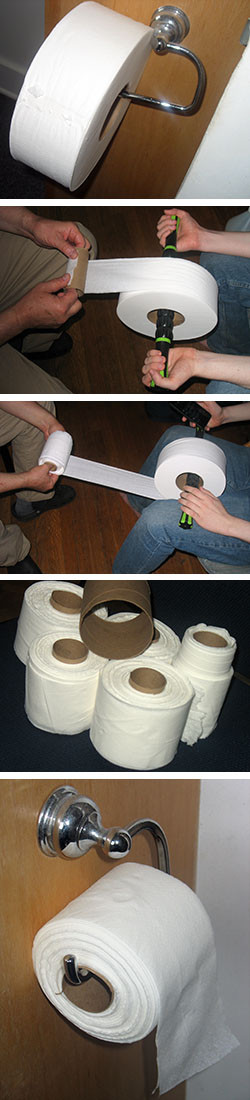
So I decided to search for the commercial rolls that are massive in size and don’t fit on home dispensers. We might have to prop a drum on the side of the tub, but at least we’d have something!

I found a bale of the commercial TP that was reasonably priced, had good reviews, and possessed a delivery date range of April 23 to May 1.

My husband eventually broke out the 3 rolls of camping TP stashed in a backpack. And we made it! Just barely. (One roll of camping TP left.)

I was pleasantly surprised with the quality of the commercial TP. It’s soft, cushiony, and strong—much better than everything I’ve encountered in public restrooms.

As you can see in the photos above, we decided to roll the TP from one gigantic commercial roll onto the multiple cardboard tubes we’d been saving for that purpose. The first attempted transfer (roll on the far right) was…messy! But we got more skillful with practice.

Ironically, a mere 3 days after the colossal bale arrived from Amazon, our grocery store had TP available for delivery. Just one package per order, but still. We ordered it, and it arrived. After coming so close to having none, I’d rather have a little extra now!

For more on how we’re coping during the pandemic, see:
Exercise in the Time of Coronavirus
Conquering Back Pain
Tackling Hip Pain


Share

The Tally Master, Chapter 7 (scene 36)

Keir took the Cliff Stair, the least trafficked of all four and dim, with the sun over on the other side of the tower. She climbed, needing to retrieve her tally sheets from the vaults before retiring to the tally chamber to reconcile yesterday’s accounts. As she climbed, she thought about what she had learned this morning.

The privy smithy, with its laxness, was a clear source of metal for the thief. But was Arnoll the thief? Even hearing Ravin’s story, she couldn’t believe such a thing of Arnoll. He and Gael were thick as . . . hmm . . . thieves. But Keir was more inclined to believe, like Ravin, that Arnoll had taken the tin for a legitimate reason. Even though he had not returned it or reported it yet to the tally chamber.

She would see what Gael thought when she told him.

And she would tell him. If Arnoll were the thief, Gael needed to know. If Arnoll were innocent, then Gael would know what the smith was doing with that tin ingot, and she could cease to consider him a suspect.

The more worrying thing was this morning’s theft, somehow achieved right under her own nose. She supposed it must have happened in the stairwell, one of those times when Jemer plunged into a clump of trolls, with only a flash of his elbow or a bob of his head visible to Keir. Which meant that someone was very slick, winkling the tin out of Jemer’s carry sack within the few moments that the crowd hid him.

She didn’t remember seeing any warriors on the Regenen Stair. They mostly used the West Stair anyway. It had been the usual crowd of the castellanum’s scullions—going to set up the tables and benches in the great halls—and the kitchen scullions bringing bowls of salt and mustard to the tables.

What would motivate a scullion—or a porter—to steal a tin ingot? Surely there would be more trouble than benefit coming to him for such a theft. Unless . . . he was ordered to do it by a superior.

Keir found it easy to suspect the castellanum. She’d seen him looking at her almost covetously, and she’d never liked him. But what use would the castellanum have for tin? Honestly, what use did anyone in Belzetarn—save the smiths—have for tin?

She could see a warrior stealing one of the elite swords reserved for his superiors. Greater prowess in battle might tempt such a troll. She could see someone like the castellanum stealing a finely wrought chalice or a beautifully crafted table. Theron liked rich things. But he had no need to steal them; they were his already as a prerogative of his station.

She could see the scullions stealing food, especially the rarer stuffs served only at the high table.

But the only troll with a real use for tin and copper and bronze would be a troll-lord with legions at his command and smithies supplying them. Could one of the scullions possess such ambitions? The idea was ludicrous. The very nature of the mark of Gaelan—the truldemagar—tended to sort trolls by their innate power. Those with physical might became warriors, those possessing great force of character took leadership, and those with neither served their betters.

If one of the scullions had stolen that tin ingot, he’d done so for someone else.

Keir wondered who Gael suspected.

Had he already heard Arnoll’s account of the tin ingot taken from the privy boys? Had he been shocked? Or had he nodded prosaically, approving Arnoll’s action as proper? And with Arnoll in the clear, who else might Gael suspect?

Keir shivered. She was innocent of theft, but she had other secrets. Gael had always treated her like any other boy in Belzetarn, with fairness and precise instruction. And she’d felt no qualms about passing herself off as a boy. It had been necessary.

But what if the theft of his metals prompted Gael to scrutinize his assistant more closely than before? A cursory scan of the nodes of her energea, sufficient to discern that they were unanchored, had not and would not reveal her sex. But a more thorough scrutiny would. As would a more thorough scrutiny of her person. What if Gael discovered she was—not a boy, but a young woman? How would he respond? Would he feel betrayed by the lie that she’d enacted all this time? And what if he plumbed . . . other things?

Keir paused to lean into one of the arrowslit’s embrasures. Beyond the opening, golden sunlight lay on the forested hills. A thin mist rose from the trees. The northern sky was very clear, white near the horizon and shading to pale turquoise in the upper airs.

If Gael scrutinized Keir, it would be with an eye to his assistant’s actions, not his assistant’s person, she reassured herself. Although . . . her actions were not wholly above reproach either. But why did she care so much anyway? Gael was a troll. Every last denizen of Belzetarn was a troll. She herself was a troll. It wasn’t as though someone still human would be judging her. The way her father had judged her on that last day.

Pater’s opinion had been important.

No one’s thoughts of her here in Belzetarn—not even Gael’s—could matter as Pater’s thoughts had mattered that day.

*     *     *

Next scene:
The Tally Master, Chapter 7 (scene 37)

Previous scene:
The Tally Master, Chapter 7 (scene 35)

Need the beginning?
The Tally Master, Chapter 1 (scene 1)


Share

Moderation in All Things

I’ve had a setback. Gotta say that I’m not happy about it.

My qigong practice was going so well. The weight lifting with my son was fun. And the myofascial release on my hips looked to be heading me toward the ability to take long walks. I was thrilled!

And then it all fell apart.

My middle back seized up. Badly.

The pain was severe enough to keep me in bed for two days. Now it has eased some, but not much more than will allow me to move around the house very carefully.

The day after my back seized, my right foot also went wrong. I’m limping painfully when I walk from room to room.

I think I know what happened.

Everything in the body is connected. When you change the alignment of one section, the parts upstram and downstream from that section have to adjust.

My hips have been misaligned for a very long time—years, probably decades. Which means that my middle back, directly upstream from the hips, was adjusted and acclimated to those misaligned hips.

When I started doing myofascial release on my hips, it began to change their internal alignment. That change really eased the pain in my hips. Which meant I chased the pain relief aggressively. I spent longer intervals on the Miracle Balls. One day I did two sessions (one morning, one afternoon) of myofascial release.

And the next day, my middle back seized up. It just was not ready to make the changes that it would need in order to work smoothly with my realigned hips.

(I think it is the latissimus dorsi—right and left—and the erector spinae that are the source of the trouble. You can see the latissimus dorsi in red in the first image of this post. The erector spinae are displayed in the second image at right.)

I’m less clear on why my foot deteriorated so suddenly, but I figure it has to be related. Perhaps the leg muscles downstream of the hips adjusted to the changes in a way that stressed my foot. Perhaps the way I’m walking with the seized-up back muscles puts undue stress on the foot.

Certainly I’ve had foot trouble for decades. It’s just that it had been greatly improved during the last 3 years.

So…what next?

Well, I’m finding that standing in the qigong stance (just standing) helps those seized middle back muscles release a little. So I’m doing that, and also trying to move gently around the house some.

I’ve also returned to doing some myofascial release, especially on my foot directly.

When my back recovers—when the pain finally ebbs—I will return to weight lifting and perhaps three reps on the qigong Eight Brocades. And then I will move forward much more gently.

Never more than one session of myofascial release in a day. Stay at 3 reps on the qigong. (I had reached 5 reps when my back and body failed.) And if I am able to start taking walks, I will keep them very short for many weeks.

I know the osteopath I’ve seen for my joint problems was always very conservative in the adjustments he did on my foot and back—never too much at one time. Clearly I need to follow that guideline!

Send healing thoughts my way, if you feel so inclined. My aching body could use some help!

For more about my experiences with chronic pain, see:
Conquering Back Pain
Tackling Hip Pain


Share

The Tally Master, Chapter 7 (scene 35)

The tin smelters must have laid and fired their charcoal early, long before their scullion fetched their pebbles from the vault, because they were already packing the unrefined tin into the weighty stone funnel at the top of the slanting upper surface of the forge. A stone trough extended from the funnel’s outlet and down across the slant. The smelters would keep the forge at just the right heat to melt the tin without melting the other impurities in the pebbles. The liquid tin would drip into the large crucible placed below the trough, while the solid impurities remained behind.

The smelters would pour the tin ‘hat’ ingots one by one, setting an empty crucible below the trough and moving the full one inside the forge to re-melt the congealed tin. When the characteristic golden skin formed on its molten surface, it would be ready to go into the mold.

Ravin saw Keir approaching and met her beside the massive pier dividing the tin smeltery from the annealing smithy. She forced herself not to look away from his truldemagar ravaged face. Was it truly hatred she felt? Or was it pity? She wished these flashes of emotion would cease taking her unawares.

Ravin stripped off his heavy gloves and started right in with his account, needing no prompting.

“The privy boys had started a game of blind-troll’s-buff. Tears, you should have seen them!” He shook his head. “Or maybe you shouldn’t have. The blindfolded one was stumbling into anvils and counters. The others were knocking over tool racks and sand buckets as they dodged.”

Keir pursed her lips.

Ravin wrinkled his nose. “Arnoll got involved when one of the boys, leaping away from his pursuer, knocked over the scullion raking the charcoal in the armor smithy’s forge.” Ravin shook his head. “He almost pushed him into the forge. Idiot. I doubt he knows how close he came to a beating, right there and then, from the smith himself.

“But Arnoll lowered his hand, marched the boy back to the privy smithy, and began directing them in their usual chores. He didn’t lecture, just gave orders, but they knew he was furious. Hells, even I knew he was furious a smithy away.”

“Go on,” said Keir.

“Once the boys were busy, Arnoll just stood watching them, leaning against the counter where their ingots and such lay. He pointed at something, maybe a sand bucket—I couldn’t really see—and then looked down at the counter. I think he shook his head, and then put a tin ingot in the sack he was carrying.

“He gave the boys a few more instructions, and then returned to his own tasks in the armor smithy.”

“What did he do with the tin?” asked Keir, wondering if pursuing that question was wise. Ravin seemed oblivious to the possibility that Arnoll might be in the wrong, and she preferred he remain so.

“Just laid it on the shelf under a counter. Why?”

“I’m trying to get the full picture, that’s all,” she replied.

Ravin scrubbed the back of a hand across his lined forehead. “There’s something wrong, isn’t there?”

Keir intended to continue following Gael’s instructions scrupulously on this one. She would not give confidential tally room information away. “You know we hope to find more efficiencies, Ravin,” she said patiently. “I doubt there are any to be found in the tin smeltery or the blade smithy, but the more complex undertakings—armor, blade grinding—might benefit from small changes. And the privy smithy surely needs something. Or many somethings.” She let the corner of her mouth turn up. “Any extra witnesses of privy smithy doings are useful.”

Ravin smiled. “Oh. Of course.” He started drawing his gloves back on. “My opteon will need me soon. Are you—may I—”

“Yes, thank you, Ravin. I’ve heard all I need.” Actually, she’d heard more than she wanted to.

He nodded and hurried toward the furnace, where the first bright droplets of molten tin were trickling down the canted trough.

*     *     *

Next scene:
The Tally Master, Chapter 7 (scene 36)

Previous scene:
The Tally Master, Chapter 7 (scene 34)

Need the beginning?
The Tally Master, Chapter 1 (scene 1)


Share

Tackling Hip Pain

Last Friday, I talked about back pain and using myofascial release for relief. I also promised to share this week what I was doing to relieve the hip pain that had flared up anew in response to my at-home exercise program.

This post is the promised hip-pain post.

It builds on last week’s post, so if you missed that one, go read it first. I’ll wait! 😀

Here’s the link.

So…hip pain. It can occur in a lot of different spots around the hip joint. When I was 16 or so, I pulled something in the front of my left hip joint when straightening up from sitting in the car. For nearly two decades after that incident, if I straightened incautiously, I pulled it again. Each time I pulled it, it grew more susceptible to pulling the next time. The problem spread to the right hip. And both sides began to hurt more and more.

I eventually solved the problem by doing leg lifts religiously. Three times a week, without fail, I would lie on my back and lift the left leg 10 times. Then I did the right leg. Three sets of 10 repetitions for each leg.

It worked! My pain diminished, and re-pulling the muscle happened less and less often.

But it is not front-of-the-hip pain that is bothering me now. Nope. The pain is at the back and deep in the joint.

Let’s take a look at the muscles on the back of the hip, since that’s important both to understanding what is happening, and how to fix it.

The biggest muscle, and the one that gives the derriere a lot of its shape, is the gluteus maximus. This is the muscle that should be doing most of the work when you straighten from sitting to standing. I suspect that mine has been shuffling off some of its work to other muscles that are not meant for it, and that is where my pain is coming from.

(We’re looking at the hips from the back in the images at right.)

Beneath the gluteus maximus is the gluteus medius. The gluteus medius controls rotation of the hip, allowing you to turn your leg inward (pigeon toes) and outward (ballet first position), as well as allowing you to lift your leg to the back and side. It also holds the hips stable when you stand on one leg.
 
 
Beneath the gluteus medius is the gluteus minimus. The gluteus minimus helps the gluteus medius do its jobs of hip rotation and keeping the hips stable when you are standing on one leg. Now that I’m a week into working on the pain in my hips, I suspect that some of my discomfort is coming from the gluteus minimus.

But the majority of my pain seems to stem from a cluster of much smaller muscles underneath the gluteal muscles.

The prime villain is the piriformis muscle.

The piriformis muscle attaches at the front of the sacrum (the base of the spine), and runs sideways at a slant to wrap around the outside of the greater trochanter, the knob at the top of the femur (thigh bone).

At the start of the week, the path of pain mapped quite perfectly along both my right and left piriformis muscles.

So that is where I placed my Miracle Ball. One side at a time, starting at the spot where the piriformis emerges from the sacrum, I lay on the ball, letting it rest at each aching spot along the piriformis for 2 or 3 minutes until I reached the spot where the muscle wrapped around the trochanter.

The relief was amazing. It had that “hurt good” sensation while I lay on the ball. And afterward, my hips felt both less tense and stronger.

I found that changing the angle and rotation of my body as I lay upon the Miracle Ball was helpful for digging into different spots where the fascia was restricted. Sometimes it was quite a balancing act! I let my intuition guide me.

Now that I’ve been doing this process for a week (as I type this), I’m finding that the piriformis muscles are calming down. The right piriformis is still tight right at its center, in the “belly” of the muscle and at the end where it attaches to the trochanter. So that is where I focus my efforts.

The left piriformis is problematic largely where it attaches to its trochanter.

But I can now feel that the three muscles beneath the piriformis are painful (on both sides), both in the belly of each muscle and where they attach to the trochanter.

These three muscles are: the superior gemellus, the obturator internus, and the inferior gemellus.

Additionally, the spot at the end of the gluteus minimus where it attaches to the trochanter is painful.

So when my Miracle Ball reaches the outer end of the piriformis, I walk the ball in a semi-circle around the top of the trochanter.

Here’s a video that gave me some ideas for how to position myself on the ball. Notice how the gentleman is balanced on one hip with the opposite hip angled into the air. Once the ball moves away from the spine, the other hip has to rise so that you stay balanced.

Here’s another that gave me ideas for where the hotspots are located, and how to move the legs while on the ball.

The patient is passive and lying on her front. But seeing how the therapist performed the various releases helped me figure out variants for myself. (The release work starts at minute 10.)

https://youtu.be/2V1sZuNAkqY

The relief is incredible. I can feel the inflammation going down, and I have great hope that not only will the pain resolve completely, but that I’ll eventually be able to walk for exercise again.

I love walking. But every time in the last few years that I’ve tried taking the long walks I adore, this deep hip pain has flared up. Now that I’m using myofascial release on the area, I think I may arrive at a long-term resolution of the problem. Fingers crossed!

I suspect there may be two more pieces of the puzzle, however.

1) Myofascial release of the quadriceps.

2) Mobilizing the gluteus maximus to do its job.

But first things first. Right now I’m focusing on myofascial release of the hips. Wish me luck!

I’ll continue to blog about this particular adventure as it unfolds, but it may be a while before I get to the experiences beyond the piriformis and company.

Important Disclaimer: I am not a medical person in any way. I’m just sharing my journey with the idea that it may point you toward some good questions, if you too suffer from hip pain. Good questions can lead to good answers; coming up with the right question is often the hardest part of solving a problem, in my experience. Just remember that what worked for me may not work for you. Seek out the right experts for help, if you need treatment!

Here are the links to the videos on YouTube:
Activ Chropractic on the Piriformis
iBody Academy on Myofascial Release

Here’s more about my own experiences with myofascial release:
Conquering Back Pain


Share