Claireau’s Retreat House

Disaster falls upon Lealle, the heroine of A Talisman Arcane, as she sits at the top of the steps to the retreat house.

She’s finished her lesson in magic and awaits her mother, who intends to shepherd Lealle home in the family brougham-landau. While Lealle waits, the bullies who tormented her in the opening scene of the book arrive and begin their taunts anew.

But it is what comes of this unpleasantness—not the interaction itself—that proves so horrible.

Lealle’s younger brother gets involved in the debacle, and the two kids eventually find themselves back in the waiting room of the retreat house, and then in an examining room.

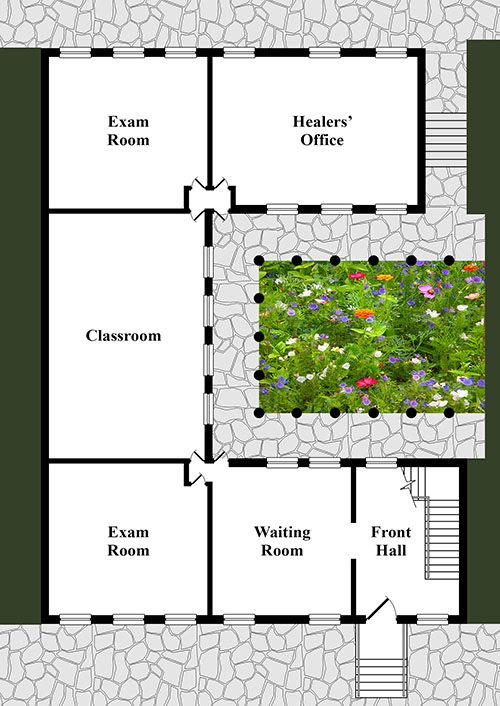
A later scene features the courtyard garden and the colonnade that surrounds the herbs and flowers.

The floor plan below shows the layout of the retreat’s first floor. The second and third floors hold more examining rooms, as well as a library, study rooms, and personal quarters for a few of the teachers who live on the premises.

For more about the world of A Talisman Arcane, see:
Tour Nileau
The Historical Tour Nileau
The Living Tour Nileau
The Dreaming Tour Nileau
Justice in Lealle’s World
Ohtavie’s Home
Wing-clap of the Phoenix


Share

Book of the Month?

Go vote! Go vote! Oh, please go vote!

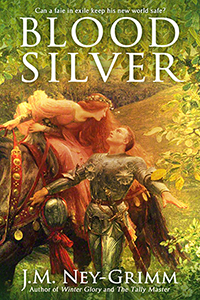
So what’s all this about? ReadFreely has short listed my novella Blood Silver for their Book of the Month.

GO VOTE!

Who are they? A husband-wife team who love to read and started a website with the mission “to find the very best books and bring them to you when they’re at their cheapest—or even FREE!”

They’ve got extensive reach, so I’d love to have their push behind my book.

In a mythical Ireland that never was, mortal villages perch all unknowing beside enchanted knolls. Beneath them dwell the cruel and capricious faie folk.

Tahaern, a faie warrior by birth but not in spirit, eschews his vicious origins. Loving the bright world, he serves a mortal village as healer.

But when the faie declare war upon their neighbors, Tahaern must again take up his sword…

Votes are what narrow the short list of 6 titles down to one.

Let’s make Blood Silver that one! GO VOTE! 😀


Share

Unicorn’s Lullaby

While writing a scene in “The Hunt of the Unicorn,” I found myself engaged with a lullaby sung by the Holy Mother to a maiden in distress.

I went hunting for traditional lullabies for inspiration and discovered the lovely Ar Hyd y Nos (“All Through the Night”) composed circa 1784 by the harp player Edward Jones.

Amy Robbins-Wilson sings the the melody beautifully.

The original lyrics, in Welsh, were written by John Ceiriog Hughes.

Holl amrantau’r sêr ddywedant
Ar hyd y nos
“Dyma’r ffordd i fro gogoniant,”
Ar hyd y nos.
Golau arall yw tywyllwch
I arddangos gwir brydferthwch
Teulu’r nefoedd mewn tawelwch
Ar hyd y nos.

There are more verses, but I will not transcribe them here. Check this link, if you are curious!

Sir Harold Boulton wrote a popular English translation in 1884.

Sleep my child and peace attend thee,
All through the night
Guardian angels God will send thee,
All through the night
Soft the drowsy hours are creeping,
Hill and dale in slumber sleeping
I my loved ones’ watch am keeping,
All through the night.

I imagine my own lullaby being sung to the same tune.

Sleep, my heart, and love wrap round thee
Slumber gently dusk to dawn
Singing angels gather round thee
Chorus sweetly dusk to dawn
Slow the moon doth climb her ambit
Stars attend her, trailing bright
God in heaven guard thy cradle
Slumber gently dusk to dawn

For more about the Hunt of the Unicorn, see:
The Hunters Enter the Woods
The Unicorn Is Found
The Unicorn Is Attacked
The Unicorn Defends Itself
The Mystic Capture of the Unicorn
The Unicorn Is Killed
The Unicorn Lives


Share

Wing-clap of the Phoenix

The antiphoners of Pavelle—magic users—give flowery names to their art.

Basic techniques taught to beginners include things such as the Zephyr’s Gavotte or the Breath of the Pegasus.

Lealle, the heroine of A Talisman Arcane, is learning advanced techniques such as the Nest of the Phoenix and the Flight of the Phoenix.

All of the techniques involve the manipulation of an inner energy referred to as energea.

Aural practitioners hear the energea as music. Kinesthetic practitioners feel it as weight within the body. And visual practitioners see it as glowing, sparking light.

Lealle is a visual practitioner, and her reach within for the energea shapes the both the result (such as healing a bruise) and the pattern of the flow of light.

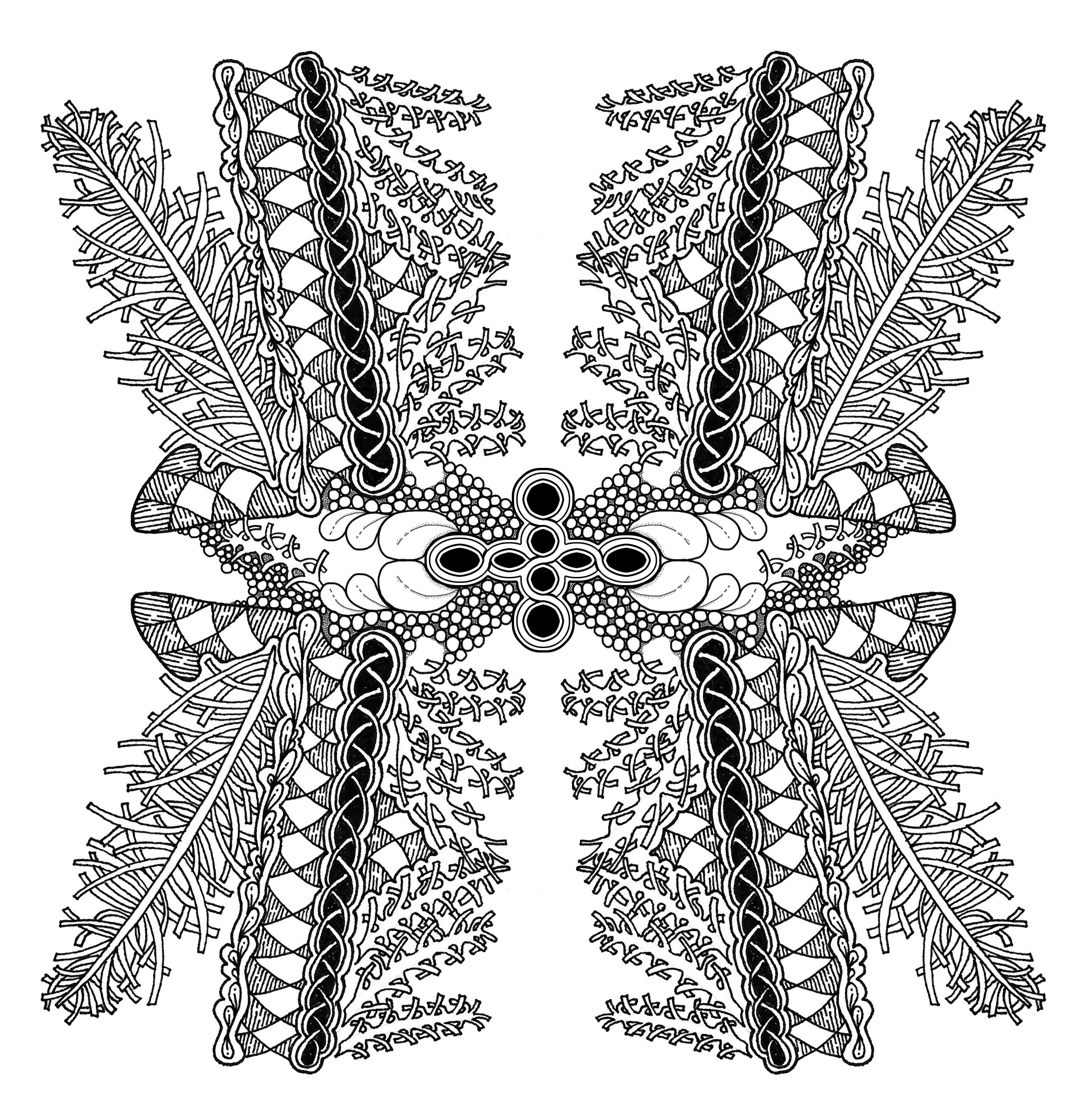
If you were to cut across one of these currents of light and draw the cross-section, you would see a delicate snowflake of a pattern.

I imagined the magic of my North-lands long before I ever tried to tried to draw it.

And when I first put pen to paper, I didn’t realize what I was drawing. I thought I was creating images that had lain within my imagination unrealized until the tools from Zentangle unlocked them. This was true, but incomplete.

It was only when I explored the idea of publishing my drawings as a coloring book that I realized they were renditions of energea, and that there was a story about energea and a young mage I needed to tell!

You can read about the first stirrings of my inspiration, and see two other patterns of energea in these blog posts:
Nest of the Phoenix (Story for My Coloring Book)
Flight of the Phoenix (Page for a Coloring Book)

For more about the world of A Talisman Arcane, see:
Tour Nileau
The Historical Tour Nileau
The Living Tour Nileau
The Dreaming Tour Nileau
Justice in Lealle’s World
Ohtavie’s Home
Claireau’s Retreat House


Share

The Unicorn Lives

In the seventh tapestry of the unicorn cycle, we see the unicorn resurrected and contentedly lying beneath a tree full of pomegranates.

The imagery has departed from the great hunt as medieval nobles knew it to become entirely allegorical.

The hunter is Love, the hunted game is the poet-lover, and the happy conclusion of the hunt is the union between the two.

Jehan Acart de Hesdin wrote a poem of 1900+ verses in 1332—La Prise Amoureuse—in which he speaks of the forest as Youth and the huntsman’s hounds as Beauty, Kindness, Intelligence, Courtesy, and so on.
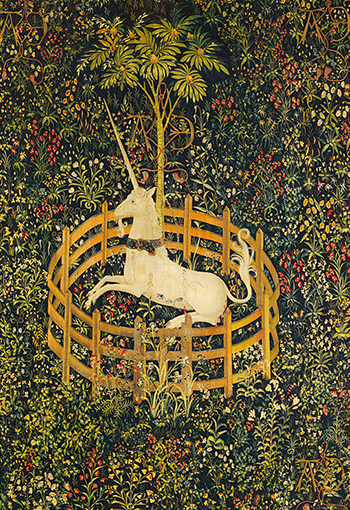
Although the unicorn is both tethered and fenced, we know that he could easily break his leash and leap the low fence. He stays because he chooses to.

The plants in the tapestry symbolize different elements of loving commitment.

Ripe, seed-laden pomegranates were a medieval signifier for fertility and marriage. Wild orchid, bistort, and thistle possess similar symbolism.

The flowery meadow adorning so much of this tapestry is one of the things I love most.

It is a style known as millefleurs (“a thousand flowers”) that was used only in the late European Middle Ages, principally between 1480 and 1520. The plants are of many different varieties, and they fill the ground randomly, without pattern and without connecting or overlapping.

Later tapestries would feature repeats of a smaller number of different plants, usually placed as mirror images of one another.

When the millefleurs style was revived in the nineteenth century by William Morris and the Pre-Raphaelites, the plants often overlapped and appeared as part of the landscape rather than as an ornamental backdrop.
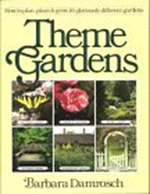
I was utterly charmed when I encountered a millefleurs-inspired garden in the book Theme Gardens by Barbara Damrosch. She describes a plesaunce—a lawn in which the grass has been replaced by low-growing flowering plants such as creeping thyme, catmint, primroses, pinks, violets, and more.

For a while I dreamed of planting just such a garden in my own yard. Then my twins were born, and gardening took a backseat to mothering my children.

But I did include that plesaunce in one scene near the end of my short story The Hunt of the Unicorn. The princess awaits her huntsmen in a walled garden with tall delphiniums and foxgloves along its edges and a flowery mead at the center.

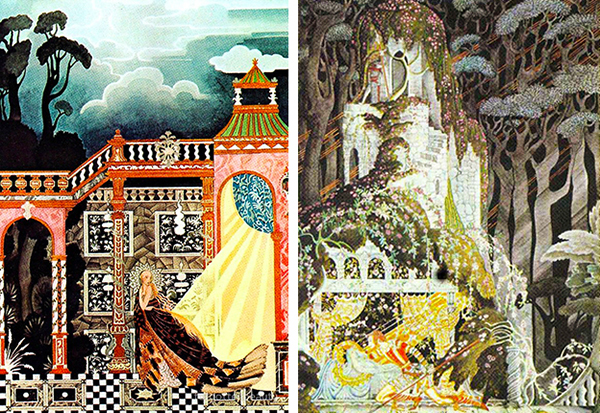
Another scene near the beginning of my story was also inspired by art. The princess walks through the halls of an Escher-like palace with more stairs than makes sense, and more passageways than chambers. But the palace resembles the vibrant structures in two illustrations by Kay Nielsen, more than the terrifying spaces depicted by M.C. Escher.

I didn’t even remember the Nielsen paintings until after I wrote the scene, when I had the nagging sensation that my palace was strangely familiar.

I had to do quite a bit of searching to find them, but find them I did! One illustrated the fairy tale “Catskin” and the other, the fairy tale “Rosebud,” both from Hansel and Gretel and Other Stories by the Brothers Grimm.
For more about the Hunt of the Unicorn, see:
The Hunters Enter the Woods
The Unicorn Is Found
The Unicorn Is Attacked
The Unicorn Defends Itself
The Mystic Capture of the Unicorn
The Unicorn Is Killed
Unicorn’s Lullaby

 

Share