Interesting Times

The waters here at Casa Ney-Grimm have been much choppier than those at Burt Lake in the photo above.

I went to the ER with a kidney infection. Then I had oral surgery. Then I fought through two infections. Urgh! Then came the most crushing blow: the department in which my husband works was targeted for a reorganization, with the result that my husband’s position was eliminated. Effective July 19. Double or triple urgh!

Through it all, I’ve continued my revision of The Sovereign’s Labyrinth (sequel to The Tally Master), but progress has been slow. But now—now!—I think I’m within striking distance of finishing. All of the truly tricky stuff is complete, and I’m excited about the changes I’ve made. This book is going to be good (she says with a modest grin). I’ve got another 8,000 words of the manuscript to review, and then I’ll send it off to my first reader. (Again. She wants to see what I’ve done with her feedback, brave woman.)

So what about Burt Lake?

A dear friend has a cottage there, and she invited me and my husband and children to spend a week with her. It was glorious. Sunny. Warm, but not hot. The lake seventy-five feet from the screened porch. And the best of company.

We swam nearly every day. We lounged in deck chairs by the water. We cooked and ate sumptuous meals. My daughter tried paddle boarding. We forgot all our troubles for a while.

Now we’re back home, and the troubles are crowding close. A job and medical insurance must be found. But the writing is keeping me sane, and I am clinging fast to the maxim: “One day at a time.”

If you’re the praying sort, I’d love your prayers. If you’re not, kind thoughts would be great!
 
 
(Photos by Amy Vandenburg. Copyright © 2019 Amy Vandenburg. Used with her permission.)


Share

Hantidan Garb

Although I draw inspiration from the history and cultures of the real world for my stories, I don’t reproduce reality wholesale. Which means that when I seek out images to represent elements of my fiction, I rarely find any that exactly match the visions I entertain in my imagination. I must make due with photographs and artwork that are almost what I have in mind, or close.

Luckily, almost and close often convey quite a bit. 😀

One consistent feature of Hantidan garb is that it possesses an asymmetric closure, with fastenings that run down the front, along one side, from neck to hem.

The peasants who work in the rice paddies, fish the river, or cut reeds in the wetlands wear linen jackets over skirts or wide trousers. Their garb needs to be practical, permitting free movement of the limbs, durable, and comfortable in the hot, humid climate.

The portrait of Kan Gao (at right) does not have the Hantidan side closure, but the jacket, skirt, and trousers otherwise mimic the Hantidan garb of a country laborer quite well.


City dwellers with less physically demanding jobs tend to wear robes. Apprentices, messengers, journeymen, clerks, delivery men, and other workers sport robes of drab linen.

Master artisans, scribes, business owners, and well-to-do professionals chose well-dyed linens, often adorned by tassels on the sleeves and shoulders.

A sash worn over the shoulder secures a pouch for carrying coin, abacus, or other tools used often in their respective trades.


Senior servants and palace functionaries wear silk robes, but in subdued colors.

The garments worn by the hanfu promoters at right are secured by sashes, whereas my Hantidans would find a snug binding around the waist too hot. But aside from that detail, the dark green silk and monochrome edgings are very like some of the robes Gael and Keir see while sojourning in the Glorious Citadel.

Dark green, dark blue, and dark yellow are common colors, as is dark gray, the robes donned by Gael and Keir.


Wealthy merchants and lesser nobility flaunt silk robes in brilliant colors: crimson, orange, turquoise, leaf green, sky blue, and so on. The most privileged might possess tone-on-tone patterns woven into the fabric, but sumptuary laws prevent more elaborate designs.

The sokutai attire shown at right depicts the shimmering brilliance typical of garments worn by the rich and powerful of Hantida, but lacks the asymmetric neckline and side closure of their robes.


Only the elite among the nobility are permitted to wear elaborate, patterned brocades. Their luxurious robes are commonplace within their city palaces, on their country estates, and within the Glorious Citadel.

But they are rarely seen on the streets of Hantida. The elite take the air in secluded courtyards and gardens or hunt on broad private acreage. When they travel from one city residence to another, or from rural estate to urban mansion, they occupy curtained palanquins more often than not.

The first such robes encountered by Gael and Keir are fashioned of “an ornate brocade depicting herons lifting in flight.” The second feature “a tracery of green leaves and lizards upon a bronze ground.”

The traditional wedding dress (above at right), although beautiful, would be considered a simpler design among the high nobility of Hantida.

The robes worn by Emperor Qianlong (immediate right) are more typical garb for the highest of the high Hantidans.


The guards standing sentry duty on the walls of the Glorious Citadel wear bronze scale mail, but the silhouette of their armor is very similar to the ceremonial armor depicted in the portrait (right) of Emperor Qianlong.

For more about The Sovereign’s Labyrinth, see:
Timekeeping in Hantida
The Baths of the Glorious Citadel
A Townhouse in Hantida
Quarters in the Glorious Citadel
A Library in the Glorious Citadel
That Sudden Leap


Share

Timekeeping in Hantida

The Sovereign’s Labyrinth is an adventure mystery with a good bit of action and fighting.

It’s not a brain-bender mystery like the clever Five Red Herrings by Dorothy Sayers, in which the time tables of trains prove integral to solving the plot.

Nor is it a mystery of manners like Georgette Heyer’s witty Detection Unlimited, in which the behavior of clocks plays an important role.

Nonetheless, as I wrote The Sovereign’s Labyrinth, I found myself thinking about timekeeping and how the Hantidans did it.
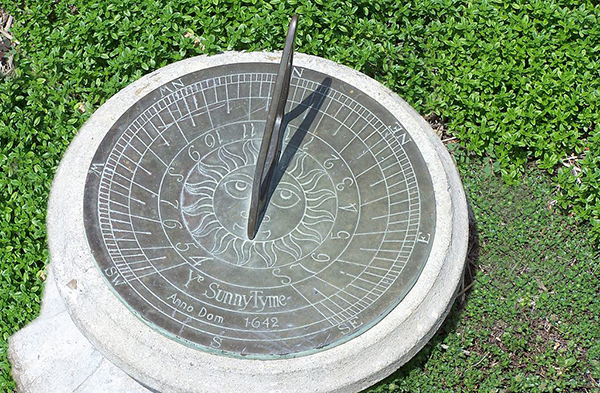
Since the story takes place in the Bronze Age of my North-lands, the Hantidans would not be telling time with clocks or watches or digital phones. So how did they do it?

The earliest timekeeping devices in our own history were sundials. In sunny climes, they worked well…by day. But what about the night time? And what about places with cloud cover?

Hantida has a wet season and a dry season, but even in the dry season, a storm comes through on many days. Which meant that even if they used sundials, they probably used something else to supplement them.
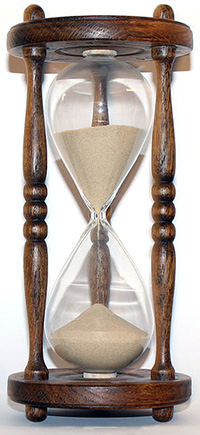
Drawing again from history, I had sandglasses (hourglasses), candle clocks, incense clocks, and water clocks as options.

Some historians speculate that the ancient Greeks and ancient Romans used sandglasses. They certainly had the technology necessary to make them. But the historical record does not contain actual mention of them as it does of water clocks. No one seems to be sure when sandglasses were invented and first used, but it may have been as late as the Middle Ages.

I am not absolutely strict about anachronisms in my North-lands—I write fantasy, after all—but I like to use real history as a guide. So I decided against sandglasses for my Hantidans.

The earliest mention of candle clocks comes earlier than those of sandglasses, in a Chinese poem written in 520 AD. That’s slightly better than the Middle Ages, but candle clocks have other disadvantages, namely that it’s hard to get the wicks and wax uniform enough to prevent inaccuracy in their timekeeping. Drafts were also a problem with the even burning of the candles.

Besides…520 AD still remains a lot later than 1500 BC!

(In the west, the candle clock bore regular markings on the column of wax. In the east, weights were attached to threads embedded in the wax. As the candle burned down, the threads were released, and the weights dropped into a plate below with a clatter.)

Before my research into timekeeping, I’d never heard of incense clocks. When I did— Wow! Just, wow! I fell in love!
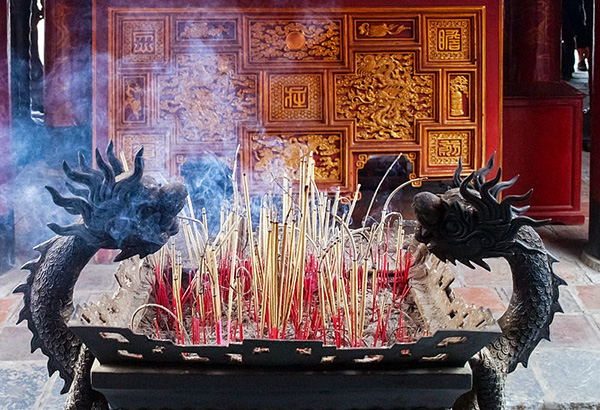
Evidently incense can be calibrated more accurately than candle wax, so incense clocks are more accurate than candle clocks. And differently fragranced incense can be used in rotation, so that different hours are associated with different scents.

I had only one problem with bestowing incense clocks on my Hantidans. I absolutely knew that the Daoine Meras, the people in the next Gael & Keir Adventure, use incense clocks.

I didn’t want to repeat myself!

So my Hantidans received water clocks.

Actually, water clocks are pretty cool. And they appeared in Babylon around the 16th century BC, perhaps earlier still in ancient China (4000 BC). Water clocks and humans have been together for a very long time!

The earliest water clocks were outflow clocks. That is, the water flowed out from a hole in the bowl. As the water level fell, it passed markings on the inner surface that indicated the time. Often the dripping water was not caught by another vessel, but allowed to absorb into the sand or earth below.

Later water clocks were inflow clocks, in which water from an upper vessel flowed through a calibrated channel into a lower bowl. The inner surface of the lower bowl was marked, and as the water level rose, it indicated the time.
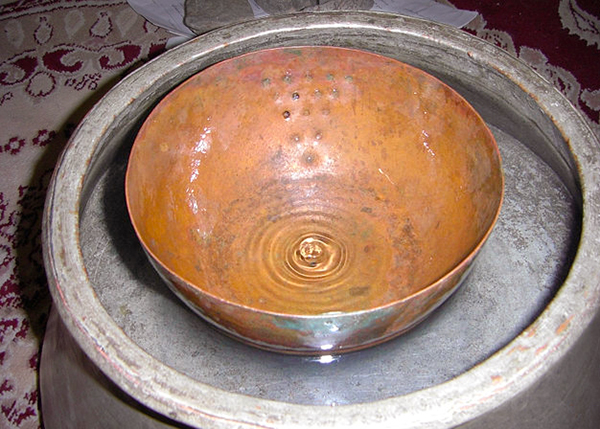
The Persians used yet another style to ensure that the water from their underground irrigation channels was distributed evenly among the farms sharing a given aquifer. They placed a small bowl with a calibrated hole in a larger bowl filled with water. The water flowed through the hole to fill the smaller bowl. When it sank, the clock manager would place a pebble in a container to count that iteration, pour the water back into the larger bowl, and then start the small bowl filling again.

I suspect my Hantidans use the inflow model of water clock.

But how did the Hantidans get started with timekeeping?

There’s plenty of water in Hantida: the river, the monsoons, the near-daily rain in the dry season, and a generous water table below ground. They wouldn’t have needed to divide water so carefully as did the Persians.

Here, real world history came to my rescue once again.

Some of the ancient cities were very populous, counting a hundred thousand people within their walls along with great wealth. They built walls to protect themselves and manned those walls with sentries who stood guard through both day and night.

The sentries needed to know when their watch was up and when the next one started. Timekeeping was required!

That made sense for Hantida.
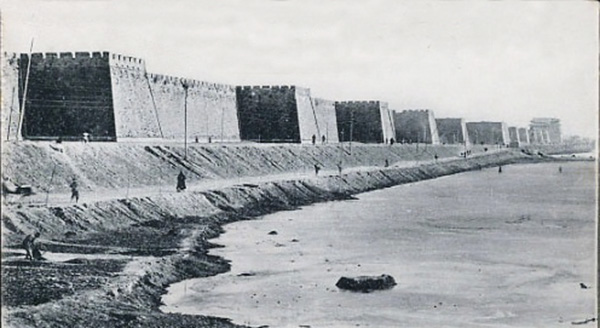
I could just see the Keeper of the Watch sounding the drum in his tower on the city walls when the Keeper of the Clepsydra announced the first beat of the evening watch. And then, all over the city, itinerant time keepers would ring their chimes in echo of the drum beat.

I decided to model the Hantidan schedule of watches after those used by sailors.

Each day possesses seven watches. Five of them are 4 hours long. Two of them are but 2 hours long. This ensures that the sentries rotate through the watches, rather than staying with the same one indefinitely.

Each long watch has eight beats or chimes, each short watch, only four.

Midwatch     midnight – 4 am
Morning Watch     4 am – 8 am
Forenoon Watch     8 am – noon
Afternoon Watch     noon – 4 pm
Aja-watch the First     4 pm – 6 pm
Aja-watch the Second     6 pm – 8 pm
Evening Watch     8 pm – midnight

So…did Hantidan timekeeping come into The Sovereign’s Labyrinth at all? Or was it one of those fun bits of research that never make it onto the page?

I’m not telling! 😉

For more about The Sovereign’s Labyrinth, see:
The Baths of the Glorious Citadel
A Townhouse in Hantida
Quarters in the Glorious Citadel
A Library in the Glorious Citadel
That Sudden Leap


 

Share

The Baths of the Glorious Citadel

“The Hantidans know how to draw a bath,” Gael agreed.

Although the real benefit of the palace baths might be that a quiet bather could overhear useful gossip.

I must side with Gael on this one. Hantidans do indeed know how to draw a bath. I envisioned the Hantidan bath as resembling those of the Japanese: very deep, very hot, and including a view through a sliding screen of a stylized garden.

If I could visit Hantida right now, their baths would definitely feature in my itinerary!

In the morning, Gael returned to his room from the baths pleasantly relaxed and smelling of herbal soap. Unusually for him, he’d kept thinking at bay during his soak, focusing instead on the physical sensations—the extreme heat of the water Hantidans favored, its depth—well over his shoulders—the scented steam, the beauty of the sunlight on the bamboos right outside the partially open screens.

In spite of their lure, however, I initially categorized the Hantidan baths as an appealing detail of the setting and little more.

But as I moved more deeply into The Sovereign’s Labyrinth, I realized they served as more than evocative window dressing.

“I heard two gentlemen talking in the baths, gossiping about last night’s accident. Interesting that they classified it as an accident, by the by,” he added.

In the baths, Gael and Keir would learn clues to the mystery they encountered in the Glorious Citadel. They would discover new suspects to question. And Gael would have an informative encounter there.

It was down around a corner of the tile passageway and bigger than the rest of the tubs Gael had seen in the palace, with room enough for four.

Zithilo lounged in one corner of the bath, lanky legs stretched out before him along the tub floor, gaze fixed on a close, engoldened slice of slope visible through the open screen—afternoon was giving way to evening—overgrown by ferns, mosses, and shrubs. He was tall, skinny, and muscular. He didn’t bother to look over his shoulder when Gael’s step sounded in the doorway.

“Get in!” he urged. “The water is fine!”

Gotta stop there to avoid spoilers!

So…what do the baths look like?

Well, the photo at the top of this post shows a bath similar to the one that Zithilo invites Gael to share. And the photo at right has the feeling of the corridor giving onto the individual baths.

The baths were arranged along a narrow side corridor of white tile, a tall and solid wall on Gael’s left, a shoulder-high wall punctuated by a dozen open doorways on his right. Each doorway connected to a small cubical with hooks and a wooden bench, and a farther doorway to a square, sunken tub with a view onto a moss garden.

Steam wreathed the air, along with the scent of herbal soap.

There are many bath houses within the Glorious Citadel, and the approach to each is the standard roofed walkway that runs along the edges of the courtyards and gardens and beside the walls of the pavilions that compose the palace.

The Sovereign’s Labyrinth has grown under revision. The first draft came in at 78,000 words. As I write this blog post, the novel stands at over 95,000 words. I’ve edited and revised the first 75,000 of those, so you can see that I am closing in on the end. I hope to send the manuscript out for its next beta read soon!

For more about the setting of The Sovereign’s Labyrinth, see:
A Townhouse in Hantida
Quarters in the Glorious Citadel
A Library in the Glorious Citadel
That Sudden Leap

 

Share