N O Ë L !



The three Fates appeared in many of the mythologies of ancient Europe. They were often envisioned as goddesses weaving on a loom, the tapestry thus created shaping the destinies of both mortals and gods.
 The ancient Greeks had the three Moirai. The word moira meant portion or share or lot of booty or treasure, and over time came to refer to one’s portion or lot in life, one’s fate.
Clotho, the spinner, spun the thread of life, the animating energy that gifted mortal and immortal with awareness and existence. She was also said to be a singer, singing of the things that are, the present.
Lachesis was the allotter or the drawer of lots, and she measured the thread of life meted out to each individual with her measuring rod. The beginning mark signified birth, while the ending mark was death. When she joined her sisters in song, she sang of the things that were, the past.
Atropos was “the unturning one,” also called inexorable or inevitable. She chose the nature of each person’s death, and when that dread moment arrived, cut the thread of life with her knife. She sang of the things that would be, the future.
The ancient Romans had their own version of the Fates: the Parcae, the goddesses of destiny.
 Nona, named after the ninth month of pregnancy, spun the thread of life. Decima, also revered as the goddess of childbirth, measured the thread of life with her rod. And Morta, the “Dead One,” chose the manner of each indiviual’s death and cut the thread of life.
It’s worth noting the slightly different connotations connected to “destiny” versus “fate.” Fate implies that the events of an individual’s life are ordered, inevitable, and unavoidable. While destiny refers to the finality of events as they have worked themselves out through the passage of time.
I can’t help wondering if the Romans conceived of a little “wiggle room” being available to the individual in the form of choice, where the Greeks may have believed that their lives were entirely predestined. I don’t have the answer to that question, but the Fates I portray in Fate’s Door adhere more to the Roman ideal of destiny than the Greek one of fate.
 Given that my story – Fate’s Door – is set in the 4th century BC, when the Hellene culture was ascendant, why didn’t I use the Greek personifications of the Fates? Why did I chose the Norse Norns instead?
Perhaps the most honest answer is simply that the Greek Morai felt wrong for the roles in Fate’s Door, but there were a few more elements that had bearing on my creative vision.
For one, the Greek Morai are often portrayed as living in some desolate region far from the bounds of civilization. A wilderness at the foot of craggy mountains on the edge of the world. Or a dry and desert region below a looming cliff of black rock. They certainly lived nowhere near Mount Olympus.
If my Fates dwelt in the far north, as I envisioned them, then wouldn’t the mythologies of the Nordic peoples influence their manifestation?
The Hellenes might envision them as the Morai and speak of them as Clotho, Lachesis, and Atropos. But just as the Keltoi developed a different vision for Hermes and called him Lugh, so the northern Scandians would have their own idea of the Fates. The Norns might easily conform more closely to the Scandian ideal, even while the Greeks pursued their own vision.
My other reason for choosing the Norse Norns is more subtle, having to do with the cosmology of my story, and how I mapped the mythologies of the ancient world onto the history of that world.
I imagine the greater deities such as Zeus and Athena as arising from the cultural consciousness of the times. They possess more definition and permanence than the lesser demi-gods and nature spirits representing specific localities, such as the the Hippocrene Springs, or cultural concepts such as loyalty and honor.
Thus, while Zeus is always Zeus, the naiad of the Hippocrene Springs merely holds that role for a limited time, and passes on to another station or post when she is ready for a change.
Sea spirits (nereides), tree spirits (dryads), mountain spirits (oreads) and more animated the cosmos of the ancients.

My Fates are time spirits, going back to the earliest of eras when sewing needles were invented in 19,000 BC in pre-historic France, or even earlier when thread was created from flax in 36,000 BC in Russia-to-be.
The very first weaver of destiny was a goddess, Mother Holle, working at a primitive ground loom. But as humanity acquired greater sophistication, and their world view grew more complex, Mother Holle acquired helpers – spirits of time, the Norns – and eventually abdicated her role to her helpers entirely.
As humans developed better weaving tools, the Norns benefited as well. Although the task of transferring the tapestry of the world from a ground loom to a vertical loom must have been formidable indeed.
 Because my Norns are spirits of time, they have some access to both the past and the future. Some of their materials, such as pivoting scissors instead of spring scissors, come from the future, as does the complex brocade loom that they are using when Nerine arrives.
Of course, my Norns don’t conform exactly to the Norse Urthr (“fate”), Verthandi (“in the making”), and Skuld (“debt” or “future”).
Instead, I have Tynghed (derived from the Welsh “destiny”), Eowys (Anglo-Saxon “horse-wise”), and Orroch (Early English “oar”). I suspect that Urthr, Verthandi, and Skuld might have served the great loom of fate sometime after my story takes place, in the centuries when the Roman Empire dominated and the Germanic tribes – with their Norse dieties – nibbled at the Roman borders.
But like their later counterparts, my Tynghed, Eowys, and Orroch draw water from the Well of Fate, with which to water the World Tree, and they watch the visions of destiny in the Well’s dark magic.

For more about the world of Fate’s Door, see:
The Baltic Sea
The Ancient Goths
Lugh and the Lunasad
Crossing the Danube
The Keltoi of Európi
Vertical Looms
Names in Ancient Greece
Warships of the Ancient Mediterranean
Calendar of the Ancient Mediterranean
For more about the three Fates, see:
The Moirai
The Parcae
The Norns
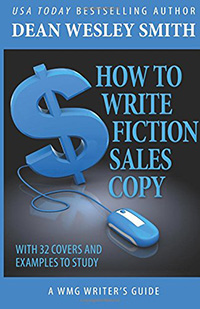 I recently read How to Write Fiction Sales Copy by Dean Wesley Smith, and it is excellent. Excellent! I can’t say enough good things about it.
In the course of writing “blurbs” or cover copy for my own stories, I’ve perused a lot of how-to advice for same. Some advice proved helpful. (And I needed a lot of help! Marketing does not come naturally to me.) Some of it sounded reasonable, but when I followed the instructions, I generated some of the worst copy of my life. And most of the advice available was geared toward non-fiction.
But Dean has succeeded in bottling lightning – or come very close to it, indeed.
In How to Write Fiction Sales Copy, he lays out two general guiding principles and then proceeds to describe seven patterns or “formulas” – the structural bones – for writing sales copy. He includes numerous examples (for real stories destined for the marketplace) illustrating each approach.
I learn best by example, so this was pure gold for me.
But the bottled lightning? After reading the 32 example blurbs, I wanted to go buy and read every single story they presented. Every single one! Now that’s successful sales copy!

So what are Dean’s two guiding principles? Because I’ve taken workshops taught by him, I’d heard them before, and blogged about them, too. But in the interests making this post about cover copy complete, I’ll restate them.
1 • Stay out of the story’s plot.
Readers read a book to experience the plot in all its magnificence, told with all the skill that the storyteller can manifest. Regurgitating the plot in the sales copy will do nothing but wipe the wonder from it. It certainly won’t sell the story. There are better ways.
How do you know you are down in the plot? Your copy will have a lot of what boils down to “and then this happened.”
If you see a lot of “and then this happened,” you’ve done it wrong. Delete and start over.
If you’ve got a little dash of “and then this happened,” figure out how to get rid of it. The rest of your copy might be good.
Writing blurbs that sink into the plot of my story is my great weakness. I cannot tell you how many times I solicited feedback in Dean’s first workshop, “Pitches and Blurbs,” only to be told: “Nope. You’re down in the plot again.”
I must always check my blurbs for this problem.
2 • Use active verbs; avoid the passive voice like the plague.
That means avoiding verb constructions that require “is,” was,” “had,” “have,” and the like.
I’m lucky enough to possess a knack for avoiding passive verbs when I write sales copy. Occasionally an “is” sneaks by me, but that’s rare. However, most fiction writers, when they start writing sales copy, fall into either the trap of focusing on the plot of their stories, or the trap of using passive verbs, or both.
And no matter how agile I am at avoiding passive verbs, my tendency to dive into the plot still kills my blurbs just as dead.
Those are Dean’s two principles, and they are critically important, but it was his “formulas” and examples that really brought my understanding to a new level.
In this blog post, I thought I’d talk about the first formula presented in How to Write Fiction Sales Copy and show…
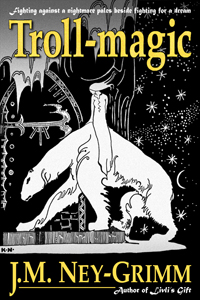 …not only how I used it to improve the sales copy for my novel Troll-magic, but the entire journey that particular blurb has traveled: from its first incarnation (when I knew exactly nothing about writing sales copy), through my poor first stabs at using copywriting principles, and on to my latest version, created after reading How to Write Fiction Sales Copy.
At the very least, you’ll get a good laugh at the absurdity of my student efforts. But I hope you’ll also learn a little something.
So what is the basic blurb pattern?
Paragraph 1: Introduce the protagonist and/or the world. Nail the genre, if at all possible.
Paragraph 2: Introduce the story problem. Limit yourself to the content of the first page of a short story, the first scene of a novella, or the first chapter of a novel.
Paragraph 3: Raise the stakes.
Paragraph 4: State why the reader wants to read the story, using largely genre tags or keywords.
Now, that is too abstract for me. I’m sure there are those of you who could go on swimmingly from there, but I am not among that lucky company, alas.
So, to use an example, let’s look at each paragraph of the most recent, updated blurb for Troll-magic.
North-land spellcasters who summon excessive power transform into trolls – potent, grotesque, and hungry for control.
This first paragraph introduces the world – a fantasy world featuring spellcasters and trolls and malevolent magic – and identifies the genre.
Prince Kellor, cursed by the troll-witch Mandine to live as a north-bear, wrestles with the challenges of his beast form. Pain wracks his body. Unpredictable rages blur his mind. And his thoughts spin out of all sense, confusing his search for the loopholes that every curse possesses.
This second paragraph introduces the protagonist and his problem. Prince Kellor suffers from a nasty curse. Some way of escaping from it exists, but Kellor doesn’t know what that might be.
His curse turns on the choices of his childhood friend Elle. She once shared Kellor’s idyllic rambles through the wilderlands. She now loves all things musical. Might Kellor persuade her to neglect her own life and save his? Should he?
Troll-magic is not only a novel, but a l-o-n-g novel, told with five point-of-view characters, although largely from the vantages of Kellor and Elle. So this paragraph is really just an extension of the blurb pattern’s “paragraph 2.” It introduces Elle as key to solving Kellor’s predicament.
But no troll-witch permits her prey to escape with ease. The illusory loopholes in Mandine’s curse all twist back to its entombing heart.
Paragraph 3 raises the stakes. In other words: Not so fast, Kellor! Most curses have loopholes, but not this one. Not really.
J.M. Ney Grimm tells a lyrical Beauty and the Beast tale, rife with moments of shining glory and dark magnificence, tumbling toward a lethal battle of wills and the impossible choices forced by clashing loyalties.
Paragraph 4 tells the reader that Troll-magic is a beauty-and-the-beast type story, that its events produce feelings of exaltation in the reader, that its theme deals with catch-22 choices and stubborn frenemies, and that its prose is well-crafted.
(Many of my readers comment on my “lyrical prose” and remark that certain events in my stories evoke such strong feelings of sheer joy that they’re transported and amazed. So I include phrases that touch on those elements. They are reasons to read my work.)
No doubt this is far from a perfect blurb. I’m still learning. But you can see Dean’s formula for his Basic Blurb Pattern at work. And, as you’ll discover when you read on, this is far better than any blurb for Troll-magic that I’d produced before.
Now let’s visit my first ghastly stab at a blurb for Troll-magic, which surely deserved better than I was able to give it at the time.
“In short, she was the friend from his childhood . . . and yet not his old friend: taller, hints of curves. Why had he never noticed she was beautiful before? All his planned introductions slipped away.”
Kellor’s a prince in trouble. Lorelin’s a musician trapped by bucolic traditions. Both must defy a troll-witch’s curse while navigating a maze of hidden secrets.
So what the heck was that?
It’s not really a blurb at all, but merely an excerpt from Chapter 6 of the novel!
I was so utterly clueless – and I knew I was clueless – that I didn’t even try to write sales copy. I picked a delightful moment on the story, quoted from the manuscript, and then added a brief gloss following the quote.
Which meant I spoiled that moment for the reader, because it won’t be fresh for him or her when those three sentences arrive. And I shirked the job that belongs squarely in the publisher’s court.
Many books that go through traditional publishing never receive the attention of the sales force, and thus the sales copy is written by a book’s acquiring editor or even the intern who read the manuscript. And sometimes that person does just what I did: quotes from the story and avoids writing any copy at all.
But that’s not the way to interest readers in a book. And I chose the indie publishing route because I wanted to do better than the mediocre job often done by traditional publishing for novels written by midlist authors.
Just because I’m bad at the marketing angle doesn’t excuse me from learning how to do it properly and giving my books the marketing support that all books need.
So let’s look at what I developed after my first class on writing sales copy for fiction.
Fighting against a nightmare pales beside fighting for a dream.
An accursed prince and her own longing for music challenge Lorelin to do both.
But tradition and a hidden foe stand squarely in her way. How do you make dreams real when vision fails, allies undermine you, and all roads toward hope twist awry?
Can courage, honor, and loyalty prevail against a troll-witch’s potent curse?
Set within her enchanted North-lands, J.M. Ney-Grimm’s new take on an old Norse folk tale pits distorted malice against inner wisdom and grit.
First off, it is an actual blurb, not a mere pretense at one. Score one for Ney-Grimm!
The first line is an excellent hook. Dreams and nightmares are emotion-laden words. Nearly everyone has awakened from a nightmare with pounding heart and sweat-drenched brow, because the monster had caught them, the villain had pulled the trigger, or the zombie’s teeth had sunk into their flesh.
And most of us have cherished heartfelt dreams that meant everything to us.
Pairing the two concepts – fighting against a nightmare, fighting for a dream – let’s just say that it pleases me, lest I toot my own horn too loudly. 😉
The last paragraph also heads in the right direction. It lets the potential reader know that I’ve written many stories set in my North-lands, which is a fanatsy milieu. It indicates that the story is a retelling of an old Norse folk tale. Although, a caveat: many more readers will be familiar with Beauty and the Beast than know of Norse folk tales. And the last phrases tell the reader that the theme treats of inner strengths pitted against fear-inducing malevolence.
The paragraph works, but it could be much stronger.
The rest of the blurb is hopelessly vague. Clearly I was reacting to my known tendency of drowning in plot by flying so far above it that no one can figure out anything at all about my story.
That was certainly the reaction of my writers group when I asked their feedback.
Beyond the fact that Troll-magic featured a cursed prince and a musical country girl, the only certainty was that the story possessed a villain. But most stories have a villain – or at least an antagonist – so what is special about this one?
This was a blurb that failed to deliver the goods.

In the winter of 2013, I helped form a writers group with other indies who were interested in focusing on the publishing side of indie pubbing one’s books. We looked at one another’s book covers and gave feedback. We assessed our story openings for reader appeal and gave feedback. We brainstormed ways to let readers know that our stories existed.
And – writer by writer – we worked on cover copy.
When it was my turn, my fellow writers were incredibly generous. Every single one of them was better at cover copy than I was, and they each not only read Troll-magic (you do remember I said it was l-o-n-g, right?), but they wrote their own version of cover copy for it. Some of them wrote two or three versions! Super wonderful folk!
I studied each version, learned from them all, and then tried to produce my own improved version.
The idea was not to lean on one another permanently, but to learn and get better at the various skills necessary to publish a book well.

North-land spellcasters who wield excessive power transform into trolls – potent, twisted, and hungry for dominance.
Prince Kellor, cursed by a troll-witch to live as a north-bear, wrestles with the challenges of a beast’s form. He sees his childhood friend Elle as the key to his escape.
But charming Elle will be no easy task. Traversing that delicate passage between adolescence and adulthood, she struggles to balance family loyalty against her passion for music.
In this epic adventure across a stunning landscape, from cool pine forests to an icy pinnacle of basalt so real it leaves you shivering, Elle and Kellor must summon essential wisdom and grit to prevail against a troll-witch’s malice in a lethal battle of wills.
Fighting against a nightmare pales beside fighting for a dream.
If you compare the first two sentences od this version to my latest version, you’ll see that they are the same. They introduce the world, Prince Kellor, and his dire problem well.
But Elle appears as a means to an end, rather than an important POV character in her own right. And we still don’t know – from content of this blurb – what sort of a story this is and what exactly Kellor and Elle are trying to do, other than defeat the villain. Or prevent the villain from winning.
There is no clear statement of the stakes, let alone a raising of them.
I kept that blurb for a long time, however, because it was better than what I’d managed before. My skills at blurb writing were improving, but I still had more to learn.
Finally, this August of 2015, Dean Wesley Smith wrote a series of detailed blog posts on the topic of writing sales copy for fiction, and it was as though the proverbial curtain were drawn back before my eyes. I read and re-read those blog posts. I took copious notes. When Dean turned those blog posts into a book, I bought it and reviewed the material.
And when I wrote the copy for my five new books – released November 12 – I followed the guidelines outlined in that book. I could see that they were much, much better than cover copy I’d developed before.
Then and there, I vowed to return to my backlist, once the new books were well launched.
Because the blurb for Troll-magic struck me as the worst of all the blurbs written B.C. (before How to Write Fiction Sales Copy), I tackled it first.
One thing I’ve learned through all my years of struggling with copy is that I have to wrestle a draft into shape first, using all my know-how (such as it is at the time), and then let that draft sit overnight. If I’ve done my work properly, a lot of that draft will be right on target.
And the next day, I’ll be able to see which parts are good, which parts need tweaking, and which parts should be ditched completely.
I cannot see any of this without a night’s sleep between draft and revision.
The following was my first draft for Troll-magic’s updated blurb.
Just to be clear, it’s not what first came from my pen. My working pages include copious “notes to self” about what I was aiming for, numerous sentences that I jot down to capture an idea and then cross out, even more paragraphs with lines drawn through phrases, other phrases inserted, and so on.
My blurb writing process is messy. It almost has to be.
So when I say, “first draft,” I mean what I hammered out over 6 hours of work!
Anyway, here it is!
North-land spellcasters who summon excessive power transform into trolls – potent, grotesque, and hungry for dominance.
Prince Kellor, cursed by the troll-witch Mandine to live as a north-bear, wrestles with the challenges of a beast’s form. Maddened by pain, his thoughts spin out of all sense. Rage shakes him unpredictably. And confusion dogs his search for one of the loopholes that every curse possesses.
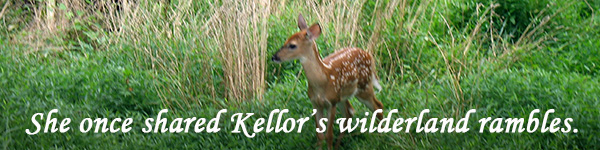
His curse turns on the choices of his childhood friend Elle. She once shared Kellor’s wilderland rambles. She now loves all things musical and struggles against the lack of opportunity in her bucolic surroundings.
But no troll-witch permits her prey to escape with ease. The illusory loopholes in Mandine’s curse twist back into its dark heart. Unless Kellor unravels a paradox. Unless Elle performs the impossible.
A lyrically told Beauty and the Beast story in which distorted malice tests inner wisdom and essential grit.
That felt almost right to me. Almost, but not quite.
After I’d slept, I knew what needed to change.
First issue: “hungry for dominance.” The phrase inched too close to what one might find in steamy romance. It strikes the wrong note for epic fantasy with a thread of sweet romance running through it. I’d wanted to avoid the word “control,” because it seemed too modern for my Steam Age setting, and I still wouldn’t use the term in just this way within the story.
But sales copy can stand to be a little less scrupulous about anachronisms than can the story itself. And the issue with many trolls in my North-lands is one of control, although they would not say it that way.
So “hungry for dominance” became “hungry for control.”
Second issue: the string of sentences starting with “Maddened by pain,” isn’t punchy enough.
I have to strike a careful balance with this. Marketing copy needs to have impact. It is usually punchy and short. I like to follow that recommendation, but I also need to present a hint of the lyricism that surfaces here and there within my stories and is a reason why readers read my books.
But the “Maddened by pain” sequence is not lyrical. It’s merely dragged out and inefficient. I changed it to: “Pain wracks his body. Unpredictable rages blur his mind. And his thoughts spin out of all sense, confusing his search for the loopholes that every curse possesses.”
Third issue: “…and struggles against the lack of opportunity in her bucolic surroundings.”
No. Just, no. We need to focus on what lies between Elle and Kellor, rather than haring off on Elle’s issues. Yes, she has them. But the blurb is not the place to explore them. Blurbs need to stay tightly focused.
Fourth issue: “Unless Kellor unravels a paradox. Unless Elle performs the impossible.”
I strayed into plot with those remarks. Or else I was gilding the lily in my raising of the stakes. Cut!
Fifth issue: “A lyrically told Beauty and the Beast story in which distorted malice tests inner wisdom and essential grit.”
The first phrase is right on target, but everything after “in which” is vague and doesn’t tell the prospective reader why he or she will enjoy the book. It needs to go further than it does.
We saw the fully updated blurb at the beginning of this post, with my commentary between each paragraph.
Let’s look at it without those interruptions.
North-land spellcasters who summon excessive power transform into trolls – potent, grotesque, and hungry for control.
Prince Kellor, cursed by the troll-witch Mandine to live as a north-bear, wrestles with the challenges of his beast form. Pain wracks his body. Unpredictable rages blur his mind. And his thoughts spin out of all sense, confusing his search for the loopholes that every curse possesses.
His curse turns on the choices of his childhood friend Elle. She once shared Kellor’s idyllic rambles through the wilderlands. She now loves all things musical. Might Kellor persuade her to neglect her own life and save his? Should he?
But no troll-witch permits her prey to escape with ease. The illusory loopholes in Mandine’s curse all twist back to its entombing heart.
J.M. Ney Grimm tells a lyrical Beauty and the Beast tale, rife with moments of shining glory and dark magnificence, tumbling toward a lethal battle of wills and the impossible choices forced by clashing loyalties.
Better, don’t you think?
What has your experience with cover copy been like? As a reader, have you ever bought a book because of its sales copy? As a writer, do you struggle with writing it? Or does it come naturally to you? (It does for some, just not me!)
I’d love to hear from you in the comments.
For more about cover copy, see:
Cover Copy Primer
Eyes Glaze Over? Never!
Be aware that these earlier posts will carry you back in time with me on my journey through writing sales copy. The principles I put forward are sound, but my ability to execute them grows ever less, the farther back in time you go. 😀
A few places to find How to Write Fiction Sales Copy:
Amazon I B&N I Kobo
And few places to find Troll-magic:
Amazon I B&N I iTunes I Kobo I Smashwords
 The Baltic Sea caused me all kinds of trouble in my writing of Fate’s Door.
First of all came the problem of what to call the dang thing.
I ran into this issue throughout the entire novel. The names from antiquity that get quoted everywhere are the ancient Roman names. There was the Mare Nostrum (Mediterranean) and the trireme (Greek trieres) and Karthago versus Karkhedon.
In some cases, I simply went with modern usage. Carthage. Why be unnecessarily obscure?
But Fate’s Door is set during the Hellenistic era when the ancient Greek world view dominated the Mediterranean. I found I often wanted the Hellene name for a thing. I usually had to dig for it. Lapadoússa, Európi, the Hyrcanian Sea, and so on.
But no matter how much digging I did, I could not find the Hellene name for the Baltic, if there even was one.
Reading about the etymology of “Baltic,” I could see that some version of “balt-” went back through many, many centuries. There was belt, used for two of the Danish Straits (The Belts). A legendary island (in the Baltic?) was named by Pliny (1st century AD) as Baltia. Pytheas (4th century BC – the time of Fate’s Door) named an island Basilia.
 Other scholars insist that the name originates from the Indo-European root bhel meaning “white” or “fair.” A few Swedish historians believe it derives from the god Balder of Norse mythology.
But I noticed that the etymology of Balder possesses as confused a history as does Baltic. Baldr, baldor, baltas, balths.
I read up on the religious beliefs of the ancient Scandinavian peoples.
They seem to have venerated a sun mother, a spear god, a sword god, and an axe god, who later became Ullin (Mother Holle), Othinn (Odin), Ingr (Freyr), and Thunrar (Thor). Who is to say that there might not have been a forerunner of Balder as well?
 I decided to go with Balder’s Sea.
But naming this northerly body of water was only the beginning of my tussle with the Baltic.
I’d estimated that my protagonist Nerine departed Mount Olympus around June 7. Her journey across Europe was roughly 1300 miles, which meant that it would take her 87 days. That is, she would arrive on the southern shore of the Baltic on September 2. Was that too late for her final push north?
When did the sun rise and set in Gdansk in September? What about Kemi in Finland? When did the Baltic Sea ice over?
 Why didn’t I ask these questions earlier? Aack!
Fortunately, my belated research gave me answers that meant I didn’t have to change the dates for Nerine’s departure.
In Gdansk, the sun rises at 5:54 AM on September 2 and sets at 7:35 PM. That’s 13.5 hours of daylight, plenty of time for travelling.
One more question bore on the answers to those above. Just how was Nerine getting from the southern shore to the northern one?
It’s clear that the people of ancient Scandinavia had already mastered boat building. The Gutones (the ancient Goths) in what would eventually become Poland came from either the island of Gotland or from Sweden by boat. All the coastal settlements traded extensively, and that trade arrived by sea. The mountainous terrain of Scandinavia made travel by land very difficult and chancy.
 The cultural emphasis of the ancient Scandinavians on ships is reflected in a preoccupation with sea vessels. Stones outlining the shape of a ship surrounded the old burial mounds, symbolic ships to carry the dead into the afterlife. Their religious images depict the sun mother helped into the morning ship by a magical fish, carried past noon by a powerful sun horse and delivered to the evening ship, where a serpent helps the sun settle.
So Nerine would be going north by boat. But what type of a boat?
The earliest archaeological evidence we have for the vessels of ancient Scandinavia are the ships of Nydam Mose. The site was a sacred lake in the Iron Age, but became a peat bog, an excellent environment for preserving ship timbers. Archaeological digs unearthed three ships there, the largest and oldest made of oak.

The oak ship has been dated to 310 or 320 AD, a good 600 years later than the time of Fate’s Door. But I suspected that this ship could provide clues about the earlier boats.
For one thing, it did not have a sail, but was propelled by 30 oarsmen. That seemed particularly significant, since the later Viking ships did have sails, and its contemporaneous ships of the Mediterranean also possessed sails.
 The Nydam Mose ship was clinker built. That is, the planks of the hull overlapped and were riveted together with woolen cloth to seal the seam. It would have been a significant innovation, if the Bronze Age vessels shared that design. Clinker ships are lighter and they can bend and flex, meaning that they withstand the battering of a storm-driven sea intact.
Interesting as I find these details, they weren’t directly pertinent to my story. How fast did the ship move, and how long would it take to row one from Gdansk, Poland to Kemi, Finland?
The oak ship of Nydam Mose was 75 feet long (23 meters) and 13 feet wide (4 meters). It was very close in size to the later Viking ships. And we know how fast the Viking ships were, both under sail and under oar. I would use the oar-driven speed for Nerine’s ship, the Saiwsgaitsa: between 5 and 6 knots (5.75 mph – 6.9 mph).

The Viking ships routinely travelled 75 miles per day, favorable winds or no.
At 6 mph, the Saiwsgaitsa would require 12.5 hours to go that far.
I couldn’t imagine the Gutonic oarsmen lingering in camp on shore. They were tough and phlegmatic. They’d be up before the dawn and on the water the moment the sky was light enough to see. And they’d make camp in the evening with just enough daylight remaining to permit the pegging of tents and the gathering of firewood. 12.5 hours was enough.
With 1100 miles to row, the sea journey would take 2 weeks. They’d make the northern shore by September 17.
On September 17, the sun rises in Kemi at 6:47 AM and sets at 7:44 PM. That’s just under 13 hours of daylight. The seafarers would be making a quick turnaround! They needed to get back south before the days grew too short.
 And before ice choked the water.
Ice begins to form in the northernmost reaches of the Baltic in mid-November. By late February, the entire northern half of the sea is frozen, with the peak of the ice falling in March. The thaw begins in April. By June, all of the ice has melted.
Just as experimental archaeologists made reconstructions of ancient Hellene merchant ships and ancient triremes, so did they create a reconstruction of the oak Nydam Mose ship. I wasn’t able to find a cool video of their venture, but in the course of my research on the ancient North, I discovered a wonderful video about Bronze Age Scandinavia.
At the time of Fate’s Door, the Bronze Age has just turned to the early Iron Age, but the dividing line between one era and the next is often much sharper in the history books than it is in the experience of the people who live through the change. I suspect that many facets of Bronze Age Scandinavia persisted into the first century of the Iron Age.
So take a look at these vignettes from the lands around the ancient Baltic Sea.
For more about Nerine’s world, see:
The Ancient Goths
Lugh and the Lunasad
Crossing the Danube
The Keltoi of Európi
Vertical Looms
Names in Ancient Greece
Warships of the Ancient Mediterranean
Calendar of the Ancient Mediterranean
Ground Looms
For more about the ships of Nydam Mose, see:
Nydam Mose on Flickr
Nydam Mose on Wikipedia
The Nydam Ships on NAVIS
The Nordic Bronze Age
