The Tally Master, Chapter 14 (scene 69)

Gael retraced his steps to the very first mural in the sequence, the one depicting the magus at work creating his lodestone. He directed his accompanying torchbearers to stand on each side of him, their flambeaus positioned to cancel out the shadows cast on the bas relief images. He scrutinized the energetic diagram of the stone at the start of its transformation.

The octahedral structure of the energea was fully present, with its eight facets connecting at twelve edges and six points. What created the difference Gael perceived between this vignette and the one at the end of the sequence of energetic manipulations?

He edged along to that last vignette, pulling his torchbearers along with him.

Ah. With his conviction that a difference existed, the details became obvious. The octahedral edges were no longer uniform in thickness. The middles of each short span were thin, while the ends—where they anchored at the corner vertices—were more substantial. Additionally, each vertex elongated into a short spike.

But how had the transformation been effected?

He returned his gaze to the intervening vignettes, then shook his head at the advanced magery they depicted. His teacher, back in Hadorgol, had begun attempting original magical research when he found time enough between his duties to the king and his duties to his students. This lodestone of ancient Navellys looked to be the original research project of a ferociously gifted virtuoso. It was far beyond Gael’s understanding.

His suspicion that he would require Nathiar’s assistance became a certainty. Breaking an artifact might be infinitely easier than making one, but he would still need to have a reasonably accurate idea of what in the north he was doing.

Tomorrow . . . he would begin sketching all these energetic diagrams. With excruciating accuracy.

Beckoning to his torchbearers, he swung toward the stairway that would return him above ground.

His tent awaited him on the terrace, and he crawled into it gratefully. Someone had fetched wash water for him, so he was able to cleanse his hands, face, and teeth before changing into his nightshirt. The thick fleece beneath his suede blankets felt very, very soft. He couldn’t help comparing the comfort of this camp to the precarious unease of his bed of leaves under sky, following his exile from Hadorgol.

This was better, unquestionably so. Or was it? On that trip through the Hamish wilds, with Morza at his side, his body had throbbed with the pain of the truldemagar while his heart ached with his losses, but he possessed no regrets for his choices. Now . . . ?

He rolled over and turned his thoughts to present matters, considering Nathiar, his unavoidable partner in diffusing the cursed gong.

Had Gael judged him too harshly, back in Hadorgol?

They’d both been very young—raw boys—immature and prone to error. Had Heiroc proved a prankster, like Erastys, mightn’t he have led Gael in just the paths followed by Nathiar? It was strange how the prank that resulted in Nathiar’s troll-disease resembled the years-earlier prank that prompted Nathiar to throw Gael under the chariot wheels. Illusion, switched keys, fooling the victim into entering the wrong bedchamber. Clearly Erastys liked variations on the theme of amatory misadventure. Did Nathiar?

Gael rather thought not.

Oh, Nathiar talked most convincingly. He’d convinced Gael. But no recent deeds matched his verbal innuendo. Pranks aplenty transpired in Belzetarn, especially amongst the scullions, but none bore roots in the doings of the magus. Why had Gael failed to notice this? Was he so caught up in the running of his tally room? Maybe. But he suspected that it was sheer intellectual sloth. And prejudice. Why bother noticing that an old acquaintance had changed, when one would prefer to continue disliking him.

That was part of it, yes. But the other part was Gael’s habitual avoidance of his past. If one never thought of the past, then noticing that the present was subtly different—or not-so-subtly different—would be difficult.

Was it just the thefts of tin and bronze that had so stirred up his memories? Or was there another cause? And had Nathiar actually changed? Didn’t that boyhood prank encapsulate the very essence of the troll-mage? Or was there a feature to that prank that Gael had never noticed until now?

Nathiar had not sacrificed Gael merely for his own advantage. He’d done it for Erastys, and fairly cleverly, too.

Had Nathiar claimed to King Pevarys that he and Gael were the authors of the prank from the beginning, the king would never have believed him. He’d have jumped to the correct conclusion immediately—that Nathiar and Erastys had tricked Lord Omory into entering the wrong bedchamber. Only by leading the train of logic across the patently ridiculous idea that Heiroc and Gael were the guilty parties had Nathiar caused the king to accept the improbable to be true, thus succeeding in shielding Erastys.

Gael had wanted to shield Erastys, but Nathiar had done it. And he had done it even though Heiroc’s favor—as heir apparent—was surely more valuable than that of Erastys. He’d done it even though he’d forfeited Heiroc’s and Gael’s goodwill.

Gael wondered abruptly if he had let Nathiar down, by never noticing this before. There was Nathiar’s inexplicable behavior on that final battlefield—the last battle between the brother kings—to consider as well.

Nathiar could have slain Gael as he lay helpless in the mud at Nathiar’s feet. And because Nathiar had refrained, Erastys had surrendered to Heiroc. Had Nathiar simply found himself unable to murder his old friend in cold blood? Or had he assessed Gael as being so wounded that he could play no further part in the struggle? If so, he’d been mistaken; disastrously mistaken.

Perhaps Nathiar had estimated the relationship between the two royal brothers more accurately than had Gael. Gael had felt a mingled bitterness and relief when Erastys and Heiroc reconciled. Perhaps Nathiar had foreseen—or even engineered—their reconciliation.

But all of this was old history. What of more recent events?

Nathiar had defied Carbraes—treasonously—to create enchanted weapons in secret; weapons which would be used by trolls to defeat the unafflicted. How could Gael even think of working with such a troll?

And yet, there were other possibilities to consider there as well. Might it not be said that Nathiar upheld Carbraes’ interests most truly by enabling his warriors to prevail on the field of battle? Was it not Gael’s desire to preserve the unafflicted that was disloyal?

But, whether treasonous or true, slyly conscientious or authentically crooked, Nathiar alone possessed the skills Gael required to reforge the gong pulled from Olluvarde’s crumbling stones.

*     *     *

Next scene:
The Tally Master, Chapter 14 (scene 70)

Previous scene:
The Tally Master, Chapter 14 (scene 68)

Need the beginning?
The Tally Master, Chapter 1 (scene 1)


Share

The Tally Master, Chapter 14 (scene 68)

Gael could point to the exact day, the exact moment, when his dislike for Nathiar had bloomed. True, it had grown and deepened since then. But before that instant, they’d been friends and comrades. Uneasy ones perhaps, but on the same side. After it, no longer, so far as Gael was concerned.

It was twenty-one years ago, when Heiroc’s father still reigned, soon after Gael had turned seventeen. Late at night, he’d been walking along one of the cedar-scented corridors of the palace in Hadorgol, soft carpeting underfoot. The wicks of the oil lamps placed on the wainscoting ledge had been lowered, and the lighting was dim. Shadows clustered within a wall niche sheltering a miniature living pine and hung with a three-part tapestry depicting a mountain landscape.

Muffled giggles sounded from a narrow corridor opening opposite the niche.

Gael paused, frowning. He’d thought he traversed the palace wing to the west of the main courtyard. Had he gotten turned around somehow? Many did, especially courtiers who visited the capital infrequently. But he lived in the place year round, or nearly so.

If this were the western wing, that niche should hold a miniature willow, its shallow tureen placed before a tapestry showing a lazy river flowing through placid water meadows.

Another burst of stifled chuckles emanated from the corridor opposite the niche.

Gael swung into the narrow passage, quickening his stride.

The ornaments were wrong there, too, enameled theatre masks—happy, sad, furious, grinning and on through the whole panoply of stylized emotion—instead of the gallery of metal owls, fashioned of brass and gold; as though, again, this were the eastern wing, not the western.

But Gael was not turned around. This was the western wing. He stopped altogether, slowing his breathing and allowing his inner sight to unfurl.

Tiamar on his holy throne! The theater masks, the miniature pine behind him, even the cherry blossom branches worked in the carpeting underfoot—which should have resembled a flowery meadow, not a branch-laced sky—were the product of manipulated energea. It was all illusion. To what end?

As Gael jerked his head up, Erastys stumbled around the corner ahead, bent over, his arms wrapped around his middle as he shook with laughter. The prince was sixteen, newly come to broader shoulders and more muscular limbs, although he had yet more growing to do to reach full manhood. His face was very flushed, a few strands of his dark hair plastered across his sweaty jaw.

“Oh! Oh! Oh!” gasped Erastys, holding in his chortles. He saw Gael. “Help me stop,” he pleaded in a whisper. “You have to see this! But we have to be quiet, or we’ll spoil it. I have to shut up!” The prince’s eyes streamed tears in his laughter.

A subdued series of thumps sounded beyond the corner just rounded by the prince, then a string of slurred curses, as though uttered by a drunk. Was that Lord Omory’s voice?

“What have you done?” demanded Gael, his own voice low. Lord Omory’s chambers lay off this very corridor—on the east of the palace, not the west. This was the west.

“S-switched the keys,” giggled Erastys. “He’ll trip over the quilt stand Myr Uram keeps just inside his door after nightfall and tumble into bed with the jester.” Erastys spouted another outpouring of suppressed giggles.

Gael’s lips pressed straight. He had to stop this. And there wasn’t time to explain—or argue about—why. He gripped the prince’s shoulder and yanked him along the corridor to a small door camouflaged by the ornate cedar paneling. Opening it, he bundled Erastys through, aiming him toward the servant’s stair located there, muttered “Go! Go!” urgently, and closed the door before Erastys could respond.

Then Gael leaped for the corner ahead, intent on stopping the prince’s prank before it reached its disastrous climax.

Erastys had always loved a joke. Hells! They all had, Gael included. But this joke was not likely to end the way Erastys—and Nathiar? Nathiar had to be involved, given the energea-created illusions—had envisioned. It was understandable that the prince had targeted Omory. The old lord traded on his long friendship with the royal family to scold the boy on every topic under the sun. If it was fun, Lord Omory disapproved. And his fondness for overmuch wine left him vulnerable to the prince’s pranks.

Gael hurtled around the corner just in time to see the door at the far end of the corridor swinging open under Omory’s shaking hand. The old man tottered through and tripped over the quilt stand, just as Erastys had predicted. Ankles wrapped in the jostled quilt, he lurched forward, arms flailing to avoid falling to the floor, and sprawled across the massive canopied bed beyond.

Nathiar—of course, Nathiar—burst from behind the great jade statue of a meditating saint that adorned the far end of the corridor. The apprentice magus pranced in glee, positively yelling his laughter.

An old lady’s piercing shriek interrupted Nathiar’s merriment.

“Wha’—wha’—wha’?” mumbled old Omory, thrashing about on the bed.

Gael halted in dismay.

And then the king’s great aunt arose from the cocoon of her sheets and blankets, thrusting Lord Omory violently from her person.

Gael started forward again, but it was too late, much too late.

“You!—you!—you!” screeched the dowager, breathless, her cheeks mottled.

A bustle of lordly authority approached behind Gael. He spun and bowed low. King Pevarys and his two highest ministers had arrived.

Silver-headed, all three, and garbed in heavy velvet robes, they made a somber trio. The king surveyed the scene, his astute gaze moving swiftly from Gael’s appalled face to Nathiar’s suddenly pale one, to his dowager aunt and Lord Omory, still entangled within the darkened bedchamber.

“See to it, Rikar” the king growled to his lefthand companion, jerking his head toward his great aunt.

Lord Rikar paced gravely forward, lifted Lord Omory smoothly to his feet, and bowed gracefully to the dowager, offering his arm. She took it, allowing the minister to support her out of the room altogether and down the hall. It might have been more suave still, if they’d managed to clear the doorway before Omory vomited messily on the carpet, instead of after, but Rikar gave no evidence of discomposure, murmuring as he guided the old lady around Gael, “I’ll conduct you to a fresh chamber, your grace, and send the lackeys to transfer your belongings.”

Meanwhile, the king and his remaining minister bent their attention to Nathiar, Gael, and Lord Omory.

“What is the meaning of this?” demanded King Pevarys.

Gael clutched after his straying wits. He’d gotten Erastys away in good time. The king had never even seen him, need never know his younger son was present, if only Gael could come up with a plausible story. Fast.

Nathiar’s wits had apparently never strayed, because he spoke up immediately. “Your majesty, I make my abject apology.” Even in youth—he was seventeen, like Gael—his voice was deep and mellifluous. “I tried to stop them, but was too tentative, too tardy in my prevention.”

“What mean you?” asked the king sharply.

“My fellow apprentice”—Nathiar nodded at Gael—“dreamed up a scheme to discomfit the learned Omory, and . . . Heiroc liked the scheme, I regret to say. He found the idea of the prudish lord climbing into bed with Myr Uram exquisitely funny.”

Gael’s mouth dropped open. Was he really hearing this? That he had initiated the prank? For Heiroc’s amusement? That Nathiar had attempted to stop them? The lie was bald.

Nathiar continued, “I’ll admit my sympathies lie with Prince Heiroc in this, and had your lady aunt not arrived so unexpectedly this afternoon, had her usual rooms not suffered from the burst pipe, had the jester kept his usual apartment, I would not have intervened. As it was, I intervened too late.”

“My eldest son never lent himself to this!” King Pevarys snapped.

“It is unlike him,” agreed Nathiar mildly.

“You were laughing sufficiently loudly, methinks,” the king observed, his tone skeptical.

Nathiar went down on one knee, dipping his head. “I was, my lord king, I plead guilty. My sense of humor is reprehensible, indeed. Pray forgive me, my king.”

The king’s lips flattened. He looked in exasperation at Nathiar, then turned aside to his minister. “For Tiamar’s sake, summon Lord Omory’s lackey to him.” Lord Omory had lost his balance after purging his stomach and was floundering amidst the floor skirts of the now-empty bed.

The minister exited the scene, no doubt in search of a page to run the necessary errands.

King Pevarys swung his attention back to the kneeling Nathiar.

“Get up!” the king ordered.

Nathiar rose smoothly to his feet.

The king glared at the apprentice magus, his royal eyes hard. “You’re lying.” The king’s voice matched his eyes. “You knew the dowager was given Myr Uram’s chamber. You knew, and you planned this disgraceful escapade accordingly. You and your fellow apprentice between you. My son”—the king corrected himself—“neither of my sons would distress my great aunt so foully.”

That was patently untrue, but it did not surprise Gael that Erastys’ father did not see the younger prince accurately.

“It’s despicable of you to palm off your misdeeds on another.” King Pevarys glared a moment longer at Nathiar. “You’ll report to the steward of the small chambers in the morning and clean latrines under his supervision for the next moon.”

Nathiar bent his head submissively, but his lips twisted in disgust when the king turned away from him.

Pevarys brought his vexed gaze to bear on Gael, saying nothing for an interminable interval.

Gael shut his mouth. It could all devolve into mutual finger-pointing at this stage: ‘but, he did it, not me’—‘no, he did it’—‘no, he did it,’ and so on. It could, but Gael declined to engage in such a pastime, especially since Erastys could still fall under suspicion.

Nathiar, behind the king, glanced mockingly at Gael.

“I’m disappointed,” said Pevarys. “I had expected better of you.” He held Gael’s gaze a long moment more. “You will attend upon the judge of the petty court for the next deichtain and then present an analysis of his rulings to me when the session closes.”

The king looked Gael sternly in the eyes for long enough to be sure of Gael’s obedience and then departed.

Gael looked equally long at Nathiar, who had the grace to blush.

“Really?” said Gael. He still found it hard to believe that his friend—however uneasy a friend he might be—had lied, and lied in creating a false accusation of his cohort. “Really?”

Nathiar shrugged. “I don’t want to hear it,” he said. “And you can afford his ill will more readily than I. You’ll win back his regard.”

It wasn’t Pevarys’ diminished opinion that rankled so strongly—although it did rankle—but Nathiar’s betrayal. “I . . . relied on you,” he said, after a brief fight for the right words.

“Oh, get over yourself, Gael,” said Nathiar. “Only milksops expect perfect fidelity.”

“Don’t you regret it?” asked Gael. “Wouldn’t loyalty feel better?”

“No,” laughed Nathiar, “and you don’t think so either or you wouldn’t be here now. Ha! C’mon, you know I’m more fun than prim and prissy Heiroc or even the unruly Erastys.”

Heiroc’s quiet steadfastness was hardly prunes and prisms, but never mind. Gael swallowed. ‘I do prefer Heiroc’ would make him a pruny prism. ‘I prefer you’ would make him a liar. “I agree with your expressed opinion of your humor,” he finally managed, and turned away, ignoring Nathiar’s chuckles at his back.

He’d intended never to speak of the incident again, but when Heiroc heard the varying tales via courtier rumors, the prince guessed the truth, knowing all concerned perfectly well. Heiroc didn’t say much, once he’d badgered Gael into confirming his guesses, for which Gael was grateful. Least said, soonest mended, although Gael’s trust in Nathiar would not mend. Nor had he wanted it to. ‘Fool me once, shame on you. Fool me twice, shame on me.’

Gael had retrieved himself fairly speedily in King Pevarys’ good graces. The king liked Gael, and favored his eldest son, who regarded Gael as his boon companion.

And on the surface, the doings between the four young men remained much the same. But beneath the surface, Gael and Heiroc grew apart from Erastys and Nathiar. So much so that thirteen years later, when Erastys, as king of Pirbrant, declared war on Heiroc, Gael was shocked, but unsurprised.

But now—now—Gael must consider trusting Nathiar to have his back in the smithy, when he tackled the defanging of the accursed gong.

*     *     *

Next scene:
The Tally Master, Chapter 14 (scene 69)

Previous scene:
The Tally Master, Chapter 14 (scene 67)

Need the beginning?
The Tally Master, Chapter 1 (scene 1)


Share

Whole House Purge

When my husband and I dropped our kids off at college in September, my first reaction was to miss them both dreadfully and feel sad.

My second response was to dive into decluttering and cleaning my home.

I’ll admit that I became that intrusive and annoying mom who invaded her kids’ rooms to tidy up. Just for the record, they both thanked me when they returned home at Thanksgiving.

My son settled comfortably into his space, glad to be able to simply throw his clothes into his drawers and wardrobe without having to clean them out first, and to be able to set his laptop on his desk without having to make space first.

My daughter had a similar reaction to her clear closet and tidy dresser drawers, although she was more effusively verbal with her thanks.

So, yeah, they would have had a right to be mad. Except they were not, in fact, mad. They were glad.

But I digress. My real point is that cleaning their rooms is what set me off on my latest decluttering quest. I was amazed at how effective I felt in the aftermath, and I felt empowered to tackle more. I decided that I would keep going until I’d done my entire house.

Am I done now?

Well, no. But I’ve made a lot of progress. The dining room was the space I tackled next, and in the course of my work there I discovered a new book on decluttering by Dana K. White.

Decluttering at the Speed of Life

I’m so glad I stumbled upon Dana’s book, because I suspect I’d have stalled out without it. With it, I’ve been powering forward: kitchen, living room, bedroom, and the ever-so-dreaded study.

Are these areas perfect? No. But they are ever so much better. And as Dana says, “Better is better.”

You may remember that a few years ago I was excited about Marie Kondo’s method. I still love her method for clothes. It really worked for me, and my wardrobe and dresser drawers have remained tidy and clutter-free ever since I konmaried them.

But her method for books stopped me in my tracks. And every time I tried to detour around my books to the other three categories—paper, miscellaneous, and sentimental—I felt overwhelmed and ground to a halt quickly.

Dana K. White has gotten me past the previous road blocks. Yay! Because her approach has proven so helpful, I want to tell you about it (as well as recommending Decluttering at the Speed of Life).

Your House is a Container

She starts by introducing some general concepts. Two especially stood out for me. The first is that your house is a hard limit. It has the number of rooms that it has. It has space for a certain amount and no more. If you try to keep more in it than will fit, things will get unmanageable.

The container concept also goes for smaller containers within your home. A closet or a cupboard will contain only so much. Ditto a shelf. Ditto a drawer.

If you want to be able to move freely in your home and to easily access the physical tools of living, you need to also value open space. And you must honor the limits of your containers.

Go for the Visible Areas First

I remember once thinking that I should declutter my storage areas first, so that when I tidied the living areas I would have places to put things I wanted to store. It made logical sense, but it didn’t work. I ran out of steam quickly.

Dana explains why.

If you put in three days decluttering a storage room, you’ve just worked very hard, but you don’t see any immediate benefit in your day-to-day life. In fact, you don’t even see that beautifully clean and organized storage room, because most of your time is spent elsewhere in still-chaotic spaces that sap your energy.

When you start with the most visible areas—the most visible surfaces of the most visible room—seeing the progress energizes you to do more.

5 Steps

Okay, those are two of the handful of concepts Dana introduces right up front: 1) the container principle, and 2) prioritize the visible.

From there, she presents the 5-step process that you will follow again and again in each space you tackle, whether it is a shelf, a surface, a cabinet, a drawer, a corner, or a room.

In the body of her book, she discusses some of the specific challenges posed by the different kinds of spaces. I found those specifics very helpful, but I am not going to try to summarize them here. Instead I’ll describe the process that is the core of Dana’s method.

1—Trash

At the start of a decluttering session, start with the easiest of the easy stuff: trash.

You may think that there isn’t any, but you will be wrong.

In a pile of paper, there will be expired sales offers or scraps. In the pantry, there will be empty or almost-empty bags or boxes of stale food. In the coat closet, there will be mittens missing a mate. In the living room, there will be packaging from the bird feeder you ordered and set up in the yard.

Throw the trash in the trash bin or the recycle bin. The space will feel better immediately, and you will get a little burst of energy from it.

2—Easy

Look for items that belong somewhere else and that have a home. Take them there straight away.

Yes, you can glance around to see if there is something else that belongs in the same place. No, don’t hunt. Just grab anything obvious and go. Yes, you will be getting a lot of exercise this way. But there is a reason to do the putting-away-of-easy-stuff in this less efficient way.

When you get interrupted, you don’t leave a mess behind. The trash has gone directly into the trash/recycle. These easy items have been put away. You leave the space better no matter what.

3—Donate

Next look for items that are obvious donatables.

These are the things that make you think, “Why on earth do I have that?” or “Why in the world did she give me that?” or “Yikes! I don’t want that in my home!”

Put them into a donatable box or bag.

If you fill up the box/bag, take it out to your car straight away and get a fresh container as you continue to declutter.

These first three steps will reduce the mass quite a bit. Sometimes that spot—shelf, surface, corner—will be done. All that remains there will be things that you want to live there. But if some problem items remain…

4—Ask the 2 Decluttering Questions

• If I needed this item, where would I look for it first?

Not: where would I or should I stash it? Not: where would this logically go. No.

Where would you actually look for it?

If you have an answer to this question, take it there straight away. If you have no automatic answer, ask the second decluttering question.

• If I needed this item, would I even remember I had one?

If you wouldn’t remember, if you’d assume you would have to buy or borrow one, put it in the donate box. It’s clutter if you wouldn’t pull it out to use it, and it does you no good at all to hang onto it.

5—Make It Fit

This is where the container principle comes to the fore. The shelf is the size that it is. The drawer is the size that it is. After steps 1 — 4, the items you have left all belong here. Do they fit?

If they do, you’re done with this space.

But if they don’t, you’ll need to decide which ones to keep and which ones to discard.

To help you decide, put like with like.

Put all the sauce pans together. Which ones are your favorites? Donate the one that is always too big for making the stir-fry sauce, but too small making tomato soup. Or, if you use and love all four, look for a frying pan or a stock pot that you never use to discard. Something has to go, because the space you have for pots is the space you have for pots.

One In, One Out

And there you have it.

I have found that going after trash breaks my log jam of overwhelm. Once I’m moving, it’s pretty easy to identify things to donate.

I have a little more difficulty with easy things that have a home, because I tend to be good at putting things away. If I encounter something that is not put away, it’s usually because the place it goes is too full.

Dana says that when this happens, identify something in the home-spot that is less worthy of keeping than the item you are trying to put away. This is logical, and clearly works for her.

But I have found that the home-spot usually is a decluttering project all on its own. And I know that abandoning the spot where I’m decluttering to tackle this new spot is a recipe for disaster. Luckily I haven’t encountered this situation too often.

Sometimes I can do the one-in-one-out dance. Otherwise I place the loose item on top of the shelf unit or cabinet where it goes. Obviously, if this happened a lot, I’d be making a bigger mess or else just shifting the mess.

But, so far, I’m generating huge piles of bags containing donations and recycling, and getting them out of the house.

Using Things Versus Useableness

Using Dana’s process has generated an attitude shift in me.

I’m no longer asking myself, “Is this a useful item?”

As she points out, creative people can always come up with a good way to use most things. So anything can look useful to me.

The better consideration for me is: Do I have a specific plan to use this? Or a specific occasion or a specific time?

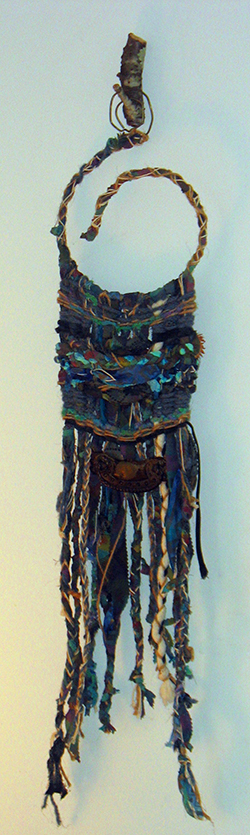
So when I encountered a “tapestry” art project in my study, I considered. Was I really going to finish it? Did I still love it or was I over it? When would I finish it?

Well, I did still love it. I couldn’t bear the idea of throwing it out. But I didn’t want to let it sit on top of the project shelves gathering dust. So I scrutinized it with an eye to making a definite plan to finishing it.

I was astonished to discover that I needed only to fasten three remaining horizontal stands and attach the bronze piece I intended to place at the top of the fringe. So little! How had I let it sit unfinished for 13 years?!

I put the task on my immediate to-do list, and had it done within the week. Now it is hanging on my wall and I feel happy every time I set eyes upon it.

I used the same mindset when I tackled the box of kids’ art that I’d saved with the intention of framing some of it and hanging it. With each piece, I considered whether I really intended to frame and hang that one. Most of the art went into the recycle bin. But I did save a dozen. And I ordered framing materials for four of them immediately.

Not everyone will have art as the category of things that will acquire greater clarity through action. But I suspect many of us have something.

If it is clothes, make yourself wear the items your usually don’t wear. If it is cooking gear, make some meals using the unused stuff. If it is coffee mugs, drink from them. If it is books, start reading your way through the books you haven’t read in years.

It will soon become clear which items you really do want to keep and which items you really don’t want to keep.

There’s More

Dana has lots of tips regarding specific spaces in your home. The kitchen has some challenges unique to it. Ditto hobby rooms. Ditto closets. If you want new energy and inspiration to do some decluttering, I highly recommend you get her book, Decluttering at the Speed of Life.

In the meantime, I’ll report in with my own progress in decluttering from time to time. I’d love to hear about yours, if you feel inclined to share. 😀

*     *     *

For more on decluttering, see:
Getting Started with the KonMari Technique


Share

The Tally Master, Chapter 14 (scene 67)

As the sun was setting on their ninth day out from Belzetarn, the lead scout reported that Olluvarde lay within reach, if Gael cared to order the torches lit. The moon would not rise until half the night was gone, and starshine would provide light too scant for safe travel.

Gael and his escort of twelve had taken advantage of the long days, getting underway with the early dawn and continuing on through the bright evenings, stopping to make camp only with the late sundown.

Their pace had been easy, but trolls and horses both showed signs of weariness. It would be sensible to rest now at the usual time. They’d reach their destination before mid-morning on the morrow.

“Have you a preference?” Gael asked the decanen in charge of his accompanying guard.

The troll—a grizzled veteran—sniffed the air, scrutinized the sky through the tree branches, and spat. “Rain on the way,” he grunted. “You aim to set at the ruins some days, don’t you?”

Gael nodded.

“I’d ruther be under tent hide when the storm blows than either breaking camp or making camp in it.”

And so they lit torches.

Belzetarn’s chandlery fashioned magnificent flambeaus, each one featuring six wax or tallow rods as long as a troll’s arm and an inch thick, with a strand of braided thistlesilk at its heart as a wick. The rods were arrayed around the upper end of a wooden stave, tied securely at the base, middle, and upper ends, and welded together with yet more hot wax or tallow. When lit, they cast a brilliant globe of illumination.

The pack animals in Gael’s cortege carried an oversupply of the superior wax kind, as he would need many in Olluvarde’s underground precincts; and it would not be proper to employ magelight so profligately and publicly.

But surely he could spare a few to get them all under cover before the rain. The harness straps that buckled their fleece sheepskins around the barrels of the horses each bore clever bronze brackets in which two torch handles could be seated, one on each side.

One pair of flambeaus on every third mount proved adequate for lighting their way.

Gael rode tenth in the column, and his view of the flaring spheres of flame, pacing the contours of the darkening land ahead, evoked a strange wonder in his breast, as though he processed toward the ruin of a goddess’ tomb, from which they would draw forth her figure undefiled and raise her to new light and life.

The soft sound of the horses’ hooves, the squeak of their leather harness, the occasional snapping spark from a torch, and the low murmur of the trolls’ voices coalesced into an otherworldly music in Gael’s hearing. The movement of his horse under him, shifting balance and sliding muscles beneath the cushioning fleece, served as a rhythm to the mingled sounds. Each element stroking his senses—the glimmer of torch flames on the branches above, the fresh scent of the cooling air, the music of ordinary noises—seemed fraught with significance. He entered an exaltation utterly unfamiliar to him, riding unmindful of the passage of time.

When they wound their way up a broad hill and passed under a colossal marble arch adorned with statues of toga-draped warriors, he was surprised to realize they’d arrived at Olluvarde.

The troll guards unloaded the pack horses on a terrace beyond the arch and erected the tents. A few others gathered firewood from the surrounding woods. Another two dug latrines in an adjacent courtyard missing all its flagstones. The bustle yanked Gael from his fugue.

He halted a pair of torchbearers before they extinguished the last two flambeaus. “Come with me,” he instructed them.

Keir had described the location of the passage with the murals precisely. Gael led the way through a broken portico, tumbled columns, and ragged courtyards to where a curving stairway descended into a sunken square chamber. The treads were guarded by a heavy marble balustrade and curled around to debouch at the very center of the marble floor, just where a crack extending from one corner marred the stone.

A ponderous arch in the wall opposite the stairway had fallen, blocking any passage. Another to the left gave onto packed rubble. But the arch on the right wall lay open. Gael paced through it, his two torchbearers in his wake. He turned left, following the broad passage that seemed straight for an interval, then gradually curved to the right.

The first mural came into view. Gael’s breath caught. The artistry was beautiful, beautiful.

The magus depicted at his work seemed so lifelike that he might—at any moment—step out of his bas relief rendition to explain his methods to Gael in conversation. The vignettes surrounding the mural featured equally delicate detail, a mix of energetic diagrams and scenes of island living. Gael noted a spinner whose wheel was propelled by a small stone similar to that the magus crafted. In another, a laundress hung her washing on a line strung before a diminutive windmill, its sails also turned by a stone to waft a breeze across the wet linens. A healer clutched a stone in a third vignette, although her patient seemed uninjured and hale.

Gael pried himself away—he was not here to admire the ancient masons’ skill. He passed swiftly along the sequel murals: the tsunami threatening, the magnificent airship garnished with lodestones, the storm in the sky, the airship’s safe arrival, the ruined mooring tower, and—finally—the panel that Gael sought, the forging of the cursed gong.

One of the surrounding vignettes depicted the energetic structure of the lodestone, presumably before it was incorporated into the central boss of the gong. The lattice formed tightly packed octohedrons, with each edge of the eight-sided volumes marked by a heavy line of energea.

Gael frowned. Was this meteoric iron? Legend held that ancient Navellys had once been a much larger land mass, shattered and drowned by a falling star.

The next several vignettes showed a smith magus heating the great bronze disk that would become the gong with his energea, molding its shape, then floating a globe of molten iron into a central void in the glowing bronze.

Next the smith held the gong and its iron boss stable—suspended in midair; the bronze soft, but not molten; the iron fully liquid. Gael almost forgot to breathe, awed by the tremendous skill exhibited by the ancient man.

Two magi eased the lodestone into the molten boss, sustaining the configuration of the stone’s lattice of energea even while its metal dissolved.

The smith allowed the boss to cool a touch, transforming from liquid to a pliant solid that kept its shape, but could be molded. The two magi plucked the edges of the energea octohedrons from opposite sides, their vibration generating curling arcs, which they laced through the encircling bronze, forming rays that fanned outward.

The magi returned to the lattice of the central node to pluck the corner intersections of the energea octohedrons, drawing out yet another set of arcs that curled from boss to gong edge.

The main panel, large and impressive, depicted the instant when the energea array was complete, a sun emanating two separate sets of intertwining arabesques. More vignettes showed the smith’s further cooling of the metals while the magi supported the energea array.

So. This was how the cursed gong that now lay in his storeroom in Belzetarn had been created. It had required not merely two magi, but three, that third a smith as well.

Gael would not be creating a magical artifact. He would be ruining one. But could he do so alone? Or would he need a partner? He suspected he would need a partner. And there was only one candidate possessing suitable skills. A most unwelcome candidate, indeed.

*     *     *

Next scene:
The Tally Master, Chapter 14 (scene 68)

Previous scene:
The Tally Master, Chapter 14 (scene 66)

Need the beginning?
The Tally Master, Chapter 1 (scene 1)

 

Share

The Tally Master, Chapter 14 (scene 66)

Gael’s cavalcade of thirteen trolls and sixteen horses made good progress en route to Olluvarde. None of their mounts or pack animals fell lame, the weather stayed fine, and such luck as persisted among trolls permitted them to set up camp each evening without petty hindrance and to break camp in the dawning as swiftly.

The woodlands held the seasonal beauty of early summer, delicate and fresh. The pine groves at the start of their journey swished in the variable breezes, dispersing a resinous perfume. The glades of birch and alder farther south appealed even more to Gael’s inclinations.

Trees had been scarce in the riverine plain of Hadorgol, while these Hamish wilds featured nothing but hill after forested hill, laced by swift streams and dotted with frequent springs and lakes.

The white columns of the birch trunks stretched gracefully tall into the fluttering green coins of their leaves, the moving foliage spraying glints of sunlight and dapples of shadow across the forest floor below. The spicy scent of ferns mingled with the more elusive fragrances of shy flowers.

Gael drank the natural loveliness in, as much a medicine for his soul as Keir’s treatment of energea had been for his injured body.

Yet, all the while, as he rode and imbibed the land’s balm, he puzzled over the mystery of the thefts from his tally room: what he knew, and what he did not.

The first theft—not the first that occurred, but the first that Gael had noticed—would have been one of the ten Barris had confessed to, a theft ordered by Castellanum Theron.

The cook had claimed Theron had lately increased the frequency with which he demanded an ingot stolen. Three days before Gael had departed for Olluvarde, Barris had finagled an ingot out of the privy scullion’s carry sack. And Gael had discovered it the following day, when his tallies did not match. Or had he?

Why had his tallies matched after all the other—earlier—thefts by the cook, and only failed to match recently?

He knew a part of the answer. And could deduce the rest.

Barris’ thefts were accomplished in the morning. And, because the privy smith Martell grew especially impatient with his notary in the evenings, the poor scribe just made sure that his evening tallies matched his morning ones. Which told Gael something right there.

A yet-unknown thief—the one who must have caused the discrepancy that tipped Gael off—operated in the evening. After the privy notary finished his own tally.

No doubt that unknown peculator had acted just as had Arnoll, lurking, awaiting an opening, and then moving quickly to seize an unguarded ingot. Except . . . surely someone in the other smithies would have noticed him. Ravin, a tin smeltery scullion, had witnessed Arnoll’s theft, after all. And Arnoll, the most senior of the smithy opteons, possessed the right to intrude on any of the forges. Surely the mystery thief could not have moved unseen. Unless—

Gael remembered abruptly that Martell had lingered exceptionally late over his work for two nights running. Once when he himself had overslept extraordinarily. And again when the privy smithy scullion had been delayed by a long scolding—a very long scolding—from the castellanum.

A bird fluted on the hillside of birches through which Gael rode, and another answered. The wilds seemed so innocent, so untrammeled, in comparison to Belzetarn’s tower and Gael’s thoughts of the doings there.

The exchange he’d overheard at the hospital, while attending the burned sweep, returned unexpectedly to his memory. The castellanum had required a posset of sleeping herbs. And the castellanum had required Martell’s company at the evening feast, pouring wine into the smith’s cup again and again. Martell had complained of it and refused to accept the castellanum’s second invitation.

Could Theron have drugged the privy smith’s drink? Thus ensuring the smith would sleep late and provide another of the castellanum’s subalterns with opportunity? It fit what Gael knew of Theron that the castellanum would advance his aims—whatever they might be—via multiple prongs. What Gael wanted to know was: had Theron ordered his thief to steal tin? Or bronze? Or both? And why?

Gael’s mount stumbled on a thick root winding across the narrow path they followed. He exerted a slight tension on his rein, supporting the beast’s recovery. The sound of rushing water filtered up from a brook below, soothing to Gael’s ears.

Arnoll’s theft seemed a small misdemeanor when viewed against Barris’ more concerted and prolonged series of the same. It dwindled to complete insignificance when set beside the deliberate campaign prosecuted by Theron through Barris and—perhaps—another unknown troll.

In any case, Gael knew all the story of Arnoll’s doings and why. They were irrelevant to what mystery remained. As were the much more subtle purloinings practiced by the magus irrelevant. Nathiar, too, had explained what he’d done and why.

It was the castellanum—and his other minion or minions; there could be more than one—who Gael sought now.

And yet . . . he had a sense he was missing something, that some other agency was at work in the muddle of thievery and deceit and guile, some other villain who might yet escape retribution, were Gael to pin the remaining guilt on the castellanum alone.

Frowning, he withdrew his attention from circling his unsolved mystery, preferring to enjoy the fresh landscape through which he rode unshadowed by dark thoughts.

*     *     *

Next scene:
The Tally Master, Chapter 14 (scene 67)

Previous scene:
The Tally Master, Chapter 14 (scene 65)

Need the beginning?
The Tally Master, Chapter 1 (scene 1)
 

Share

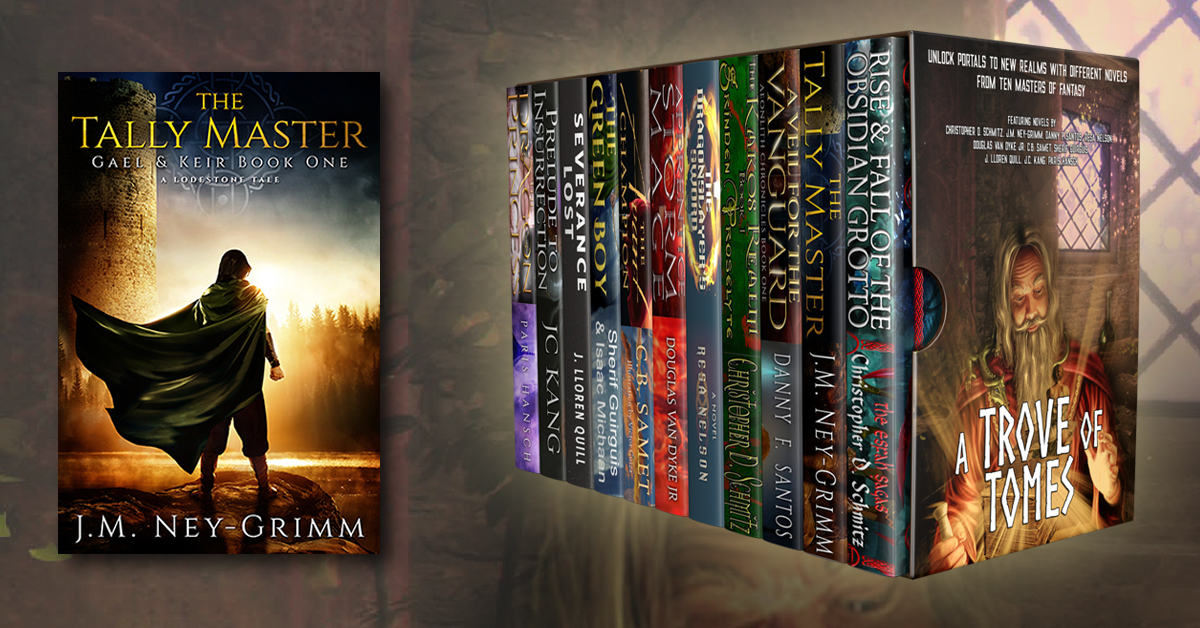
New Bundle! A Trove of Tomes

A new curator has appeared on BundleRabbit—Christopher Schmitz—and he invited me to contribute The Tally Master to his new bundle of epic fantasy.

So I did!

I’m excited about it, because this bundle includes books by a whole new set of authors, writers I’ve never encountered before. Maybe I’ll discover a new favorite. (Maybe you will, too!)

I’m also excited because Christopher is doing a bunch of effective marketing for this bundle. In just a week, it’s already sold 173 copies! I hope some more readers will discover my work and find it to their taste.

So, what about A Trove of Tomes?

That’s the title of the bundle, and it’s comprised of 10 novels plus one novella, the collection forming a mix of epic fantasy and sword & sorcery.

For all of December, it’s on sale for a discount price—$1.99.

The price will go back up to list—$7.99—in January. Now’s the time to get it, if you’re interested. At the very least, you’ll acquire my Tally Master for $1.99 instead of $4.99. And you might discover something(s) you like from one of the other nine authors.

Three of the other novels especially caught my attention—they’re the ones I’ll try reading first. Let me tell you a bit about them.

*     *     *

The Dragon Princess by Paris Hansch

The dragon princess is missing.

War is imminent.

And someone pulls the strings behind the scenes…

Can a fractured family of angry brothers and sisters pull together to awaken their forgotten spirit arts and defeat “The Mistress”?


*


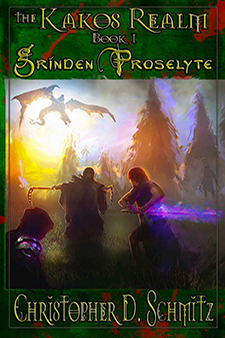
Grinden Proselyte by Christopher D. Schmitz

They took everything from him.

They branded his hands and killed the girl he loves.

Revenge is all Rashnir has left…

But when revenge suddenly looms imminent, the former ranger wonders…what comes after?


*


The Dragonslayer’s Sword by Resa Nelson

Astrid has a dark secret. A dragon once chewed her up and spat her out.

She hides the old scars covering her body through shapeshifting.

But the time for hiding is over…


*


And here’s a little about my own contribution to the bundle.

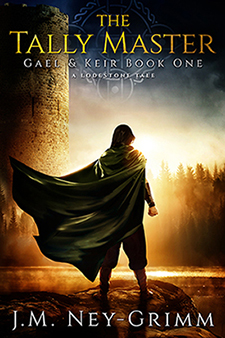
The Tally Master by J.M. Ney-Grimm

Managing supplies for a warlord’s arsenal, an accursed mage purposefully ignores the fact that he’s enabling the destruction of his former people.

But when he discovers the precious metal needed to craft the weapons is being stolen from under his nose, he resolves to find the culprit at any cost.


*


Dragons. Elves. Curses. Blood pacts and orcs. . . and a few Chosen Ones.
Unlock portals to adventure for less than a dollar a book!

Rise & Fall of the Obsidian Grotto
    by Christopher D. Schmitz
The Tally Master
    by J.M. Ney-Grimm
A Veil for the Vanguard
    by Danny F. Santos
Kakos Realm: Grinden Proselyte
    by Christopher D. Schmitz
The Dragonslayer’s Sword
    by Resa Nelson
Apprentice Storm Mage
    by Douglas Van Dyke, Jr
The Avant Champion: Rising
    by C.B. Samet
The Chronicles of Agartha:
    The Green Boy
    by Sherif Guirguis & Isaac Michaan
Severance Lost by J. Lloren Quill
Prelude to Insurrection by JC Kang
The Dragon Princess by Paris Hansch

The A Trove of Tomes bundle is available at Amazon, Barnes & Noble, Kobo, iTunes, or direct from the BundleRabbit site.

*     *     *

For more bundles with my stories in them, see:
Here Be Trolls
Here Be Elves
Here Be Magic
Eclectica
Here Be Unicorns
Here Be Merfolk
Here Be Fairies
Here Be Dragons
Immortals


Share

The Tally Master, Chapter 14 (scene 65)

Keiran’s very first sight ever of the truldemagar had come as a shock.

In Olluvarde’s broad underground passage of bas relief murals, she’d just finished scrutinizing the last panel, her silvery blue magelight glowing about her, when the trolls burst around the far corner by the stairs. They saw her at once and gave a great shout, charging.

She stood paralyzed a moment—in horror. She’d planned to await their approach, but her plans were not what held her motionless.

The truldemagar’s war gear was famous. All the north-land peoples spoke of its beauty and excellence. Keiran had heard the tales, of course, and knew bronze to be superior to the leather coats and flint knives of Fiors’ warriors. But the ferocious glint and clink of shining scale mail surmounted by gleaming helms gave these trolls a presence more alarming than anything she’d imagined. With their forearms and shins encased in bronze greaves, they seemed monsters of metal, alien and terrifying, as they stormed forward.

Heart in her throat—pounding, pounding, like the trolls’ booted feet hammering Olluvarde’s marble floor—she stared.

The tales waxed eloquent on the grotesque faces and warped bodies of the afflicted. She’d known to expect the curving and elongated noses, usually strangely blunt, sometimes cruelly pointed; the enlarged, cupped ears; and the sallow, sagging skin framing watery, bloodshot eyes. She’d imagined the hunched shoulders and crooked arms. But the reality of their deformities combined with the vast power in their muscled limbs and the battle rage twisting their faces unnerved her wholly.

The oncoming scent of their sweat rolled over her.

She turned and ran.

Her pursuers gave another mighty shout, their voices deep and growling.

And her feet responded with a burst of speed.

What are you doing? What are you doing? she asked herself. You meant to stand and await them. You meant to turn yourself over to them.

But she could not make herself stop. Not here underground, hidden from the sight of the sky, where unspeakable things might be done to her, unwitnessed. And how foolish was that? Thinking the presence of the day eye over her might offer any protection.

No matter her panicked logic, she raced along the curving passage like a hare fleeing before hounds, darting around a piece of fallen wall like a startled minnow, vaulting over clumped rubble like a leaping deer, her magelight still illuminating her way, the troll horde pounding at her heels.

Sias! Oh, Sias! she prayed as she panted.

What in Cayim’s hells did she think she was doing? Where in Gaelan’s grief did she think she was going? She’d entered this passage by the stairs far behind her, the stairs behind her troll pursuers. Did she think to burst out through some crack in the earth to feel the free air on her skin along with warm sunshine? Almost certainly she’d be cornered instead in some caved-in dead end, severed from any escape to daylight and freedom.

But she ran, and ran, the passage curving always to her right.

Were the trolls farther in her wake? Was she faster in her sandals and suede tunic with its fringed hem? Were they slower in their mail and boots, with their terrible swords out and weighing their arms?

The passage turned an abrupt corner, slamming into a smaller hallway, on the left a tunnel plunging down narrow stairs into darkness, to the right—oh, blessings! oh, blessings!—a level scrap of corridor running toward a ragged opening in the hillside and cool sunlight.

Keiran whirled right, diving for the light like a seal caught too long underwater and diving up for air.

Six pounding steps later and she was out, carried by her momentum across cracked flagstones to the edge of the terrace, where a tree-studded slope slanted down toward the woodlands.

She doubled back, hurtling up broken steps before the truldemagar could emerge. Fleet as a mountain goat, up and up, she fled out of sight through the forest of columns at the top of the steps, and then ducked behind a crumbling statue into its niche in a fragment of wall.

She crouched there panting and panting, heart slowing from its frantic beat, and knowing she was safe.

The trolls roared, angry and puzzled, as they stumbled onto the empty terrace and saw their quarry nowhere in sight.

She was safe. They’d never find her. She was safe!

And her plans had all gone wrong.

She’d hacked her hair short with the flint knife tucked into her belt. She’d bound her breasts tight, thanking Iona that she was slight, that her facial features were clean cut, not soft, and that she could pass for a boy.

She’d been ready to be taken peaceably. But that mob had been no sane scouting party. They’d have hacked her to pieces, not taken her prisoner. She’d had to run, as her body had known, even while her head argued.

But how could she retrieve her—not lost—her never-offered moment?

Gazing out at the courtyard on which her hiding place fronted, she had an idea. Most of the ring of columns surrounding the space were toppled or become jagged stumps, but one remained whole, towering to thrice her height. She did not think the truldemagar would be good climbers, heavy in all their war panoply. But she—she who had climbed the sea cliffs at home in search of gulls’ eggs—could surely reach the flat capital of that lone stalk of still-standing marble.

She would have to be fast. She could hear the trolls spreading out from that lower terrace, searching as they moved uphill.

Prying herself out of her hiding place—which was not safe, despite her earlier assurances to herself, but which felt so—was impossibly difficult, but she did it. How ludicrous that she’d hunkered there for even a moment. The trolls would have smelled her fear, even if they’d not glimpsed a protruding elbow. And they would not have given up until they found her.

She hustled across the courtyard on cat feet—she must not be heard—and thrust her fingers into a horizontal crack circling the column just above her head, while wedging her toes into another at waist height. Could she climb in her sandals? She must. There was no time to take them off.

The column had been fashioned in great barrel-like segments, and—luckily—time had weathered and widened the joints where they came together.

Up she went, like the climbing monkeys of the south. Just as she pulled herself over the slight outward slant of the capital to stand on its level top, the first troll appeared from below. He was not looking up, but around him, and he did not see her.

Iona’s breath! If she crouched down and made herself small, they might never see her. They could search and search every piece of this ruined hilltop, every niche, every cranny, and never find her.

Her mouth went dry. The scent of pine from the trees ringing the ruins floated up to her, resinous and bracing, prodding her ingenuity alive. She had to get herself taken—alive, not dead—or her plan for her people, for her pater especially, would fail.

Why had that plan seemed so easy in conception? Why did it seem so hard, now? She made herself stand tall, with her arms outstretched.

“Oiyez! Oiyez!” she called in her loudest voice.

The lone troll spotted her instantly.

“To me! Come to me!” he yelled, and his fellows boiled up the slope, while he unshipped his bow and nocked an arrow.

“Stop! Stop!” she screamed, working to keep her voice from a woman’s higher register. “I am truldemagar. I am one of you!”

“You look human enough,” growled the marksman, aiming his arrow.

She got ready to duck low, if he should let that arrow fly.

“But I’m not!” she insisted. “Look with your inner sight. My nodes are ripped from their moorings!”

“Lord Carbraes forbids the inner sight,” answered the troll.

“Then take me to him, and let him check,” she yelled.

Slowly, he lowered his arm. “I suppose we could do that,” he allowed.

The other trolls had gathered around him. After some muttering among themselves and more shouted conversation with Keiran, still atop her column, they agreed to let her down unharmed.

For all that, the moment she came within reach, they plucked her from her handholds, yanked her arms up behind her, and dealt her three swift belly blows.

As she doubled over, retching, one said, “Why he’s nobut a boy!” in astonished tones. “What’s your name boy?”

“Keir—” not Keiran, that was a girl’s name, and she must be a boy “—my name is Keir,” she choked.

“From Fiors, huh?” her questioner said, and then fetched her a thunderous blow to her head.

Her senses reeled into darkness.

“Whups! Didn’t mean to get his pate. That was a welcome, a slap to the back,” said her assailant, as consciousness passed from her.

She was glad he’d sheathed his sword, before he’d attempted his gesture of greeting.

*     *     *

Next scene:
The Tally Master, Chapter 14 (scene 66)

Previous scene:
The Tally Master, Chapter 14 (scene 64)

Need the beginning?
The Tally Master, Chapter 1 (scene 1)

 

Share