A Castle That Might Be Amber

No, I’m not talking about Roger Zelazny’s Nine Princes n Amber. Although maybe I should be! If ever there were an archetype for castle, Zelazny’s Amber would surely be it: occupying a mountain peak, crowned with ranbows, so vast that it’s a city in castle form. Yes.

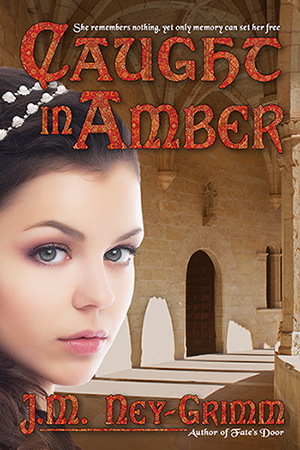
But I’m talking about the castle in my own Caught in Amber.

It, too, is vast. It’s part castle, part palace. It was built through the ages, so one wing is medieval, another renaissance, one classical, and yet another eighteenth century romantic.

When I went looking for images that captured the place, I found many that seemed to represent elements of the massive pile that Fae explores, but there was nothing close to the whole.

Instead of giving up in despair, I decided to share a handful of the images along with either my commentary or excerpts from the novel.

The first painting I found, “Two Owls” by Thomas Moran, could easily be a portion of the medieval wing. In Fae’s thoughts:
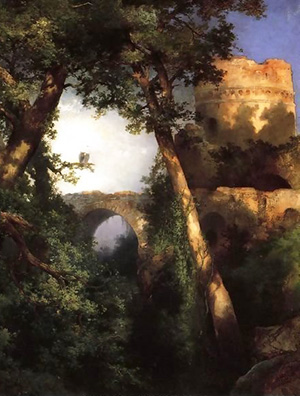
Windows were smaller with round arches at their tops. The thick walls were half-timbered – heavy beams filled in with wattle and daub – or else formed of huge rough gray stones. Massive piers supported the ceilings of large spaces such as the great hall and the place of arms where the knights would have assembled.

Almost, she wished she could see them, in their bright polished armor with their vivid plumes on the helmets. They’d be magnificent.

The central portion of the castle consists of tall white towers with pointed red roofs, the quintessential fairy tale castle. The castle in Disney World is the right shape, but it’s not nearly big enough. However, Křivoklát Castle (photographed here by Svobodat) in the Czech Republic has the red roofs!

…she noticed a painting on their immediate left, a landscape showing a many-towered castle with pointed red roofs and flapping blue-and-gold pennants. Pleasure gardens, lawns, and an orchard surrounded it. A carriage drawn by four horses approached along the splendid esplanade before the castle’s entrance.

I suspect Fae’s bed chamber might be located in a wing resembling Ardencaple Castle (Scotland) as rendered by James Whitelaw Hamilton. Certainly the gardens have the right feeling.
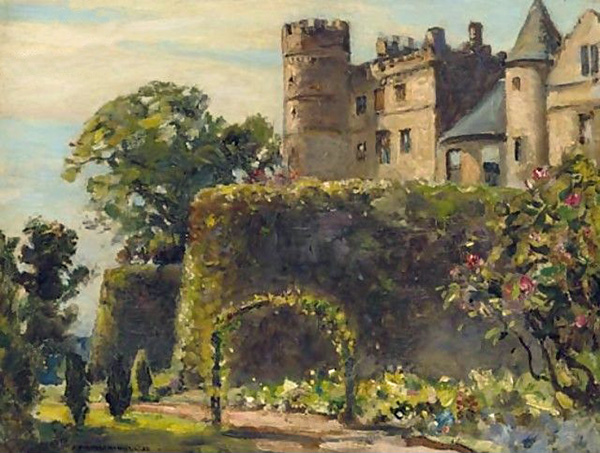
…the doorway of a gazebo with honeysuckle twining up its pillars and massing on its roof. The tan pea gravel stretched away to a low hedge at the courtyard’s border. Beyond the hedge, hollyhocks reached for the sky, their flower-dotted spires waving gently in the still air.

The plume of a fountain splashed in another direction, and two topiary elephants gamboled in another. These were the gardens…

Here’s another view of Ardencaple Castle with a different mood, one more in keeping with the shooting gallery that Fae discovers.

Instead of the white stone typical of so many of the castle’s passageways, this one featured walnut panelling and a parquet floor, combining in its geometric design the dark brown of walnut with red mahogany and blond beech.

Substantial walnut doors studded the walls at regular intervals. Light from the window at the far end of the hall didn’t penetrate far, but the lamp globes – supported on walnut falcon wings – were lit.

Fae could feel the heft of the first door as she opened it. The hinges were solid and well-oiled; it swung easily.

Of course, the complex is as much palace as it is castle. Windsor, as depicted by Alfred Vickers, has a little bit of that palace feel.
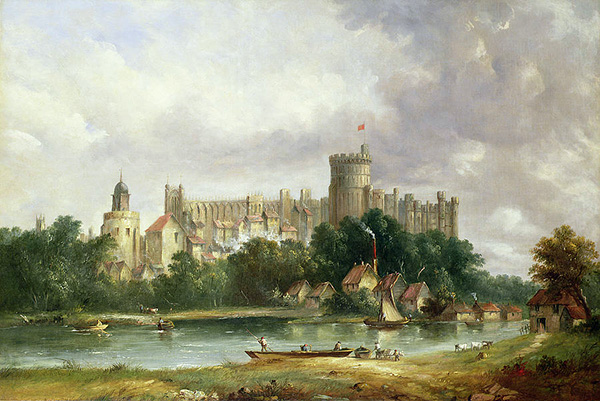
She found the great chamber where the lady of the castle would have slept. Her canopied bed, with massive dark pillars at the corners, was curtained in a rich red brocade, the pattern showing a unicorn cavorting in a flowery mead.

Such a stately private space.

But the Palace of Coudenberg embodies more of the magnificence that I have in mind.

All the spaces beyond the concealed door were very grand: vast in size with tall coffered ceilings and impressive colonnades, connected by broad halls and impressive stairways. These rooms were for show, not use. Receptions for heads of state, audiences for ambassadors, award ceremonies to honor heroes.

The capitals of the columns, far overhead, dripped with crystal and gold ornament. Enormous fresco murals depicted…

Yet most palaces and castles are, in the end, simply palaces and castles. You can walk from one end to other in five minutes. The castle in Caught in Amber is more like a small city in size, something like the fortified French city of Carcassone. Imagine that Carcassonne’s center has as many towers as its guarding walls, and you’re getting close.

I can see the castle Fae explores so clearly in my mind’s eye. Perhaps one day I’ll commission a modern painter to translate my vision onto canvas.

In the meantime, I hope you’ve enjoyed this virtual tour of my Amber’s castle. 😀

For more about Caught in Amber, see:
Amber’s Suns
Amber’s Inspiration
Character Interview


Share

Amber’s Inspiration

The fairy tale in which a curious lassie opens forbidden doors has always been one of my favorites.

I remember wanting to write a novel inspired by it back in 1997 or 1998. I got so far as an outline, realized that my outline did not really match the story I wanted to tell, and then didn’t know how to proceed.

So I was delighted when the beginning for Caught in Amber burst into my imagination one evening in 2014, when I was trying to go to sleep for the night.

I got up out of my bed, grabbed my journal, and went into the living room to start scribbling. The scene came pouring out.

Even once I went back to bed, I didn’t get much sleep. I was too excited about my story to drift off into slumber. 😀

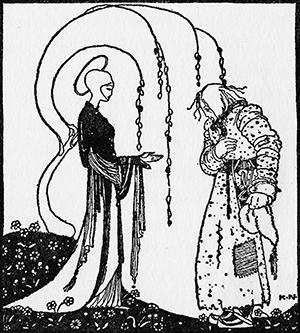
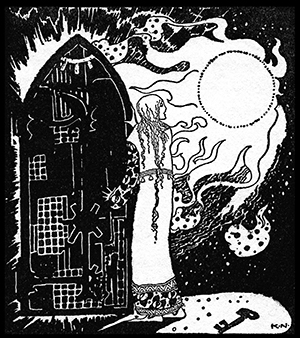
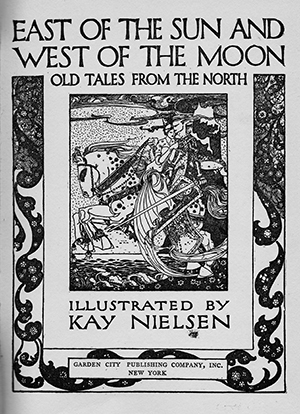
So, what was the fairy tale that started it all? It’s called “The Lassie and Her Godmother,” and it is one of fifteen Norse folk tales collected in East of the Sun and West of the Moon.

Because the book was published in 1914, its stories and illustrations are in the public domain, which means I am free to share them with you. I thought it would be fun give you the portion of the fairy tale that inspired Caught in Amber. So, read on!

The Lassie and Her Godmother

Once upon a time a poor couple lived far, far away in a great wood. The wife was brought to bed, and had a pretty girl, but they were so poor they did not know how to get the babe christened, for they had no money to pay the parson’s fees. So one day the father went out to see if he could find any one who was willing to stand for the child and pay the fees; but though he walked about the whole day from one house to another, and though all said they were willing enough to stand, no one thought himself bound to pay the fees. Now, when he was going home again, a lovely lady, dressed so fine, and she looked so thoroughly good and kind; she offered to get the babe christened, but after that, she said, she must keep it for her own. The husband answered, he must first ask his wife what she wished to do; but when he got home and told his story, the wife said, right out, “No!”

Next day, the man went out again, but no one would stand if they had to pay the fees; and though he begged and prayed, he could get no help. And again as he went home, towards evening the same lovely lady met him, who looked so sweet and good, and she made him the same offer. So he told his wife again how he had fared, and this time she said, if he couldn’t get any one to stand for his babe next day, they must just let the lady have her way, since she seemed so kind and good.

The third day, the man went about, but he couldn’t get any one to stand; and so when, towards evening, he met the kind lady again, he gave his word that she should have the babe if she would only get it christened at the font. So next morning she came to the place where the man lived, followed by two men to stand godfathers, took the babe and carried it to church, and there it was christened. After that she took it to her own house, and there the little girl lived with her for several years, and her Foster-mother was always kind and friendly to her.

Now, when the Lassie had grown big enough to know right and wrong, her Foster-mother got ready to go on a journey.

“You have my leave,” she said, “to go all over the house, except those rooms which I shew you;” and when she had said that, away she went.

But the Lassie could not forebear just to open one of the doors a little bit, when—Pop! out flew a Star.

When her Foster-mother came back, she was very vexed to find that the star had flown out, and she got very angry with her Foster-daughter, and threatened to send her away; but the child cried and begged so hard that she got leave to stay.

Now, after a while, the Foster-mother had to go on another journey; and, before she went, she forbade the Lassie to go into those two rooms into which she had never been. She promised to beware; but when she was left alone, she began to think and to wonder what there could be in the second room, and at last she could not help setting the door a little ajar, just to peep in, when—Pop! out flew the Moon.

When her Foster-mother came home and found the moon let out, she was very downcast, and said to the Lassie she must go away, she could not stay with her any longer. But the Lassie wept so bitterly, and prayed so heartily for forgiveness, that this time, too, she got leave to stay.

Some time after, the Foster-mother had to go away again, and she charged the Lassie, who was by this time half grown up, most earnestly that she mustn’t try to go into, or peep into, the third room. But when her Foster-mother had been gone some time, and the Lassie was weary of walking about alone, all at once she thought, “Dear me, what fun it would be just to peep a little into that third room.” Then she thought she mustn’t do it for her Foster-mother’s sake; but when the bad thought came a second time she could hold out no longer; come what might, she must and would look into the room; so she just opened the door a tiny bit, when—POP! out flew the Sun.

But when her Foster-mother came back and saw that the sun had flown away, she was cut to the heart, and said, “Now, there was no help for it, the Lassie must and should go away; she couldn’t hear of her staying any longer.” Now the Lassie cried her eyes out, and begged and prayed so prettily; but it was all no good.

“Nay! but I must punish you!” said her Foster-mother…”and away from me you must go.”

*   *   *

The fairy tale then goes in an entirely different direction from Caught in Amber.

Caught in Amber explores the bond between the lassie and her godmother, whereas the fairy tale follows the lassie as she reaches full maturity and learns that her choices have real consequences.

I must say that as I typed, “and away from me you must go,” I found myself bursting with commentary. I could barely bring myself to remark that my story and the fairy tale diverge radically from that point. I wanted to rush into impassioned speech without pause.

How could these parents, no matter how poor, give away their child? In our modern day and age, pastors don’t charge a fee for baptism. And, furthermore, if no pastor is available anyone can baptize a child (or an adult) in an emergency.

But, of course, the lassie’s christening is meant to symbolize something so precious and essential that no child should have to do without it. Perhaps something so urgently important that no child could thrive without it. What then might a parent do? What if your beloved child required an expensive medical procedure in order to be able to breathe? What if you didn’t have either the money or the insurance for it? Then, indeed, you might do what this couple did.

But if the adoptive mother was so good and kind, how could she banish the lassie from her presence? Wouldn’t she have done better to impose a consequence the first time the lassie disobeyed, rather than just scolding and threatening?

But there are my modern sensibilities rising up again.

Modern child rearing techniques were entirely absent two hundred and three hundred (or more) years ago when this fairy tale evolved. Punishments were severe. Criminals had a hand cut off, were stoned or hanged. Children were deprived of food, were given solitary confinement for days, or were beaten. The concept that much smaller consequences can be very effective in teaching a child was entirely unthought of.

If the lassie had been my daughter, I might have required that she thoroughly clean the chamber from which the star had flown. And I would have blamed myself for assessing her maturity level so incorrectly when I left her alone at home. I certainly would not have made the same mistake a second time!

Consider, however, what the lassie did! The sun, the moon, and the stars…more symbols for things infinitely precious. It is understandable that her mother was upset! But mom needed to manage a bit better.

But let’s say mom had managed better, and still the lassie had been recalcitrant. It does happen that way sometimes. What then? Should mom have sent daughter away?

The thing that occurs to me is that in medieval times, children often were sent elsewhere at roughly age thirteen. Nobly born boys went to another castle to serve as a page there, and then to become squire to one of the knights. Nobly born girls went to serve as maid-in-waiting to the lady of the castle.

Children born to artisans went to be apprenticed to another artisan. Or went to live with an aunt and uncle to help out in the house and on the farm.

There was a recognized societal mechanism whereby someone other than mom and dad handled the child during those challenging teen years. The child received some of the independence they were craving, but still had the safety net of adult supervision.

Perhaps the lassie really did need to get away from mom in order to grow and thrive.

But the old fairy tales are certainly blunt! They don’t soften the darker aspects of human nature.

As for my own story…well, it was inspired by the fairy tale, but at heart it is very different, because I am exploring love and hope and courage far more than anger or vengeance. And, honestly, I remain to this day as fascinated by those forbidden doors as ever the lassie was. Really, how could she refuse to explore them when confronted by their closed panels day after day!

At least, that’s my view on the matter. 😀 What do you think?

For more about Caught in Amber, see:
Amber’s Suns
A Castle That Might be Amber
Character Interview


Share

Amber’s Suns

At the start of Caught in Amber, young Fae awakens without any memory of who she is or where she comes from.

The glad sun streamed in through four point-arched windows, filling her bedchamber with light.

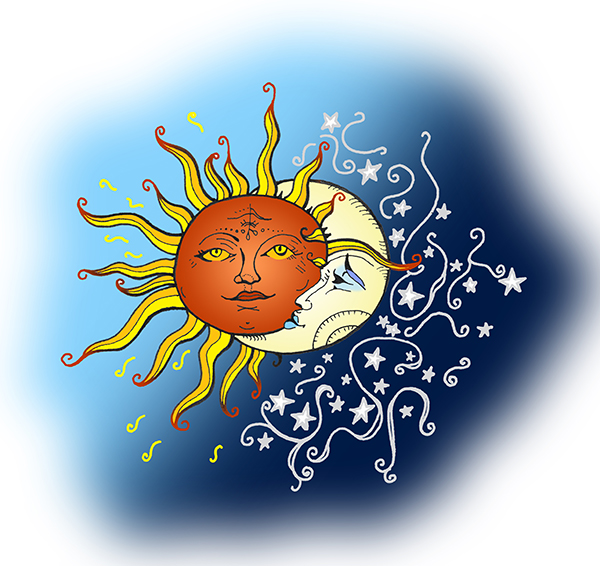
She stretched and blinked and rejoiced. Then fell back against her banked pillows, grinning and studying the rollicking cornice molding that stretched around her room where the walls met the ceiling. Small carved suns with curling rays and merry faces somersaulted along the frieze as though they couldn’t keep still. That was the way they should be: energy-filled, laughing, and replete.

Of course, underneath Fae’s happy mood is a sense that something awful has been done to her. (Which it has.) Nor does she stay joyful long. The evil spirit haunting the castle where she finds herself attacks her in the very first chapter.

I’ve always loved imagery featuring the sun, the moon, and the stars. The castle, as Fae explores it, features these heavenly bodies both in the architectural detail of significant structures and in its underlying essence.

The illustration below reminds me of what I see in my mind’s eye when I imagine the cornice in Fae’s bed chamber.

For more about Caught in Amber, see:
A Castle That Might be Amber
Amber’s Inspiration
Character Interview
 

Share

New Design for My Landing Page

I’ve felt a growing unease about the content of the landing page for my website. Something just wasn’t right.

What is a landing page?

It’s the page where weary wanderers of the web arrive after a search yields up jmney-grimm.com as the answer to their question. 😀

And my landing page felt static, maybe even dull. It seemed to conceal, rather than reveal, all the riches I’ve gathered here over the years.

What to do?

For a while, I was really enamored of putting a slider on my landing page.

What is a slider? It’s a slideshow that plays automatically.

I love the slider on the BundleRabbit site. It’s so clean, so big, and features some eye-catching images. I went so far as to ask Chuck Heintzelman, the proprietor of BundleRabbit, if his slider was generated by a plug-in, and if so which one. He answered me most kindly, and if I were to use a slider, I’d use that one (the Revolution Slider).

But in my search to identify the best slider, I encountered several articles about the pros and cons of using them at all.

Some situations are clearly tailor-made for a slider. I think the BundleRabbit site is one of them. It’s got a ton of great bundles available for purchase, and the slider gives the browsing reader a fun taste of what’s on offer.

You can check out the BundleRabbit slider here.

But many people use sliders because they lack a sense of the priorities for the content on their site. They just can’t decide, so they throw a little bit of everything into a slider, and then they don’t have to decide.

I suspected my desire for a slider might well be due to my own confusion. Not good.

Even more pertinent: there’s a fair bit of data indicating that visitors to a site rarely click on any of the images served up by a slider.

That decided me. My idea for a slider on my landing page was that visitors would be intrigued by the images and want to go check them out. If that was unlikely to happen, there was no point in having a slider.

So I did some thinking about what I really wanted for my landing page.

1 • I’m in a lot of bundles, and some of them are pretty cool. I’d like my visitors to know that these bundles are available.

2 • When I release a new book, I definitely want to shout from the rooftops about it. That’s an exciting moment for me, and I want to tell everyone. 😀

3 • But I have a lot of books out at this stage in my career, and I think my backlist tends to get buried on my website. Few people go digging through all 20 book pages. So I’d like to draw attention to my backlist.

4 • Speaking of backlist, I also have a lot of “backlist” posts on my blog, and most of them are of the evergreen variety. They’re not news posts that go stale. They’re maps and lore from my book worlds. They’re book recs. They’re health tips, design tips, and favorite recipes.

But there are 346 of them as I write this post, which will be number 347. How would a visitor ever find any one post among so many?

My landing page felt like an opportunity to address all of that.

Nor did I have to devise how I would go about it from scratch. In my own browsing of the web, I’ve seen plenty of landing pages. And amongst them all, there was one design that consistently pleased me. It featured four images arranged in a foursquare.

That was just enough to give a good sense of what was on the site, just enough to intrigue me, but not so much that I felt overwhelmed. I tended to then happily explore. Perfect!

So I’ve adopted the foursquare presentation for my own website, and I’ll change its individual components every week or so, showcasing different elements from my site over time.

Go check out what I’ve got there now! Here’s the link.

I’ll show you what is there (below) as I write this post. But by next week, the array will already have changed! (Plus the images on my landing page are clickable, while the copy below isn’t.)

I’m happy and excited about this ever-changing array. I think I’m going to have some fun with it. And I hope that my visitors will find it fun, too. 😀

For more about websites and blogging, see:
Slow Blogging and Other Variations
Why Create a Site Map?
SPAM Deluge
Copyright Statement for My Website
Your Data Is Protected


Share

Free Ebook

THE ADVENTURES BEGIN
“The bridge was old, the leached stones worn by weather and time, a structure of ancient Silmaren.”
For a limited time,
you can get a free copy of

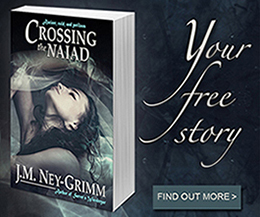
Crossing the Naiad
Accompany young Sarvet as she confronts
the first perils of her wanderyar.


Share

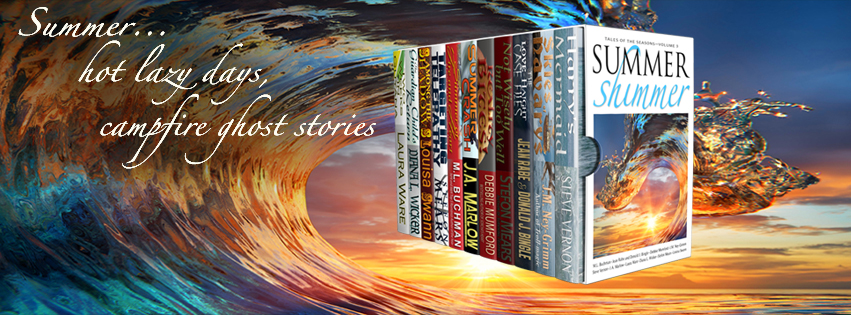
Summer Shimmer

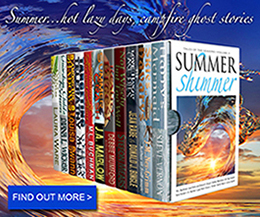
The latest seasonal story bundle curated by A. L. Butcher is out!

I’ve not had a chance to read it yet—super busy with design work on the paperback of my upcoming novella Blood Silver—but there are several titles that especially catch my eye.

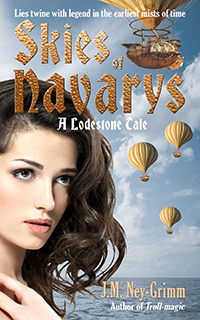
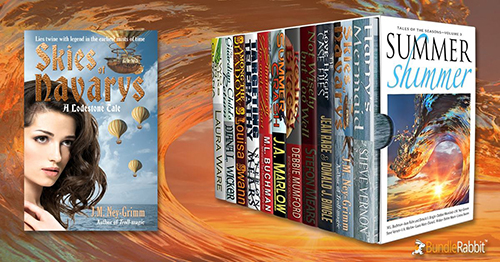
I’ll list them below, along with my own novella, Skies of Navarys, also included in the collection.

*

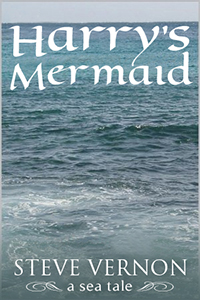
IT HAPPENED in early September, the time of year when the city does its damndest to remember what heat was, just one more time before winter rocks on in…

This is a story of horror and haunting regret.

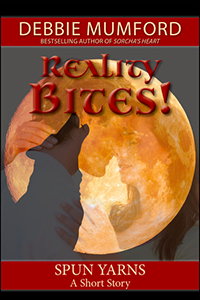
A group of homeless men—fishing for a little fun and folly—latch onto something that MIGHT be a mermaid.

Regret lives on and lingers—long after the last tear drop has fallen.

“If Harlan Ellison, Richard Matheson and Robert Bloch had a three-way sex romp in a hot tub and then a team of scientists came in and filtered out the water and mixed the leftover DNA into a test tube, the resulting genetic experiment would most likely grow up into Steve Vernon.” —BOOKGASM

“Steve Vernon was born to write. He’s the real deal and we are lucky to have him.” —Richard Chizmar, CEMETERY DANCE

*

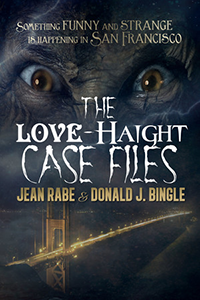
SAN FRANCISCO. Haight-Ashbury. It is midnight in the Summer of Love. Thomas Brock and Evelyn Love are attorneys who crusade for the rights of OTs—Other-Than-Humans. Their clients include ghosts, gargoyles, vampires, and things that have not yet been given names. The city’s OT element is sometimes malevolent, sometimes misunderstood, and often discriminated against. Brock and Love represent them, whatever the case, whatever the species.

Magic hangs heavy in San Francisco, and danger and intrigue is as thick as the fog around the Golden Gate Bridge.

*

WHEN ETHAN RILEY earned a summer internship in Yellowstone National Park, he thought he’d won the world’s best lottery, but that was before he met the girl of his dreams, Jenny Leigh.

Jenny’s family had lived and worked in Yellowstone for generations, and the beautiful and fascinating young woman knew all its secrets.

Including a few that might just be the death of Ethan!


*

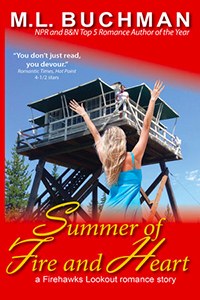
QUITE HOW Ashley Mason made the journey from rural Kansas to working atop a lookout tower in the Montana wilderness eludes her. This summer’s challenge: coping with isolation.

Brent Tucker dedicates every summer to learning something new. In the past he pursued competitive swimming and ballroom dancing. This summer’s goal: to master hang gliding.

This year they both will learn more than they bargained for during the Summer of Fire and Heart.

~a Firehawks Lookouts romance story~

*

WHEN THE KING’S GEOMANCER announces that a tidal wave threatens Navarys—the Atlantis of the North-lands—every citizen on the island springs to action. Amidst the uproar, the aeromancer Palujon steals unique and magical lodestones.

Mago, son of the lodestones’ creator, vows to retrieve his father’s precious artifacts. But Mago’s friend Liliyah questions Palujon’s motives.

Why would a man of his stature break the law? Is he truly a dastard?

Life and death hang on her answers.

*

Hot lazy days, cracking thunderstorms, paddling a canoe upriver, long twilights filled with chasing fireflies, picnics under shady oak trees, overnights with friends and ghost stories. The days of summer carry us back to memories of the delights from childhood.

But summertime offers abundance even when we leave the realm of innocence—perhaps especially then. It’s a season of warmth, growth, and strength, embodying the powerful move from inspirations and ideas into reality: action, decision, and works we can touch and use.

This mixed-genre bundle of summery sensations features romance in the wilds of Montana, an alien invasion, revelation in a tropical and buggy third-world country, paranormal adventures during the Summer of Love, a serial killer who targets telepaths, and more.

Available for 3 months only—June, July, and August.

The Summer Shimmer bundle (with 11 titles) is available at Amazon, Barnes & Noble, Kobo, iTunes, or direct from the BundleRabbit site.


Share