The Tally Master, Chapter 2 (scene 8)

The sky had been overcast, that summer noon two years ago, but the air moved less wildly than was usual on the island of Fiors, a mere warm breeze ruffling the shore grasses instead of whipping the knee-high strands.

Keiran—she’d been Keiran, not Keir, before she came to Belzetarn—stopped walking, turned her face up with closed eyes, and stretched her arms. The heat of the sun coming through the thin cloud cover felt good, as did the waffling of her light wool tunic against her midriff. Her long blond braid touched gently against her back. The hanging strings of her suede skirt had slapped her thighs as she strode, a happy rhythm lacking in colder seasons. But the soft leather of her right shoe—cut low and secured with two thongs across the bridge of her foot—had rubbed a blister on her smallest toe.

She didn’t care. She felt so free—free of constraint and free of care—on these warm days, with the salt scent of the sea in her nose and its salt taste on her lips.

“Keiran?” came the amused voice of her pater.

Keiran opened her eyes and grinned at him.

Engis stood some paces ahead of her, a big man with powerful shoulders and a craggy face—formidable in repose, but approachable when his eyes smiled as they did now. He wore an ankle-length robe of green wool, rather than the short tunic and trews preferred by most tribesmen. It camouflaged the peg leg that tended to disturb his neighbors.

“If magery could make me fly,” said Keiran, “I’d leave the ground right now, soaring.”

Pater’s laugh rumbled. “You did good work, back in Gullins, on little Peadar.”

The toddler had been her most complicated use of magery yet. He’d fallen in the estuary and been fished out unbreathing. Keiran had gotten his lungs clear of water, heart beating again, and then nursed him through a waning moon of lung fever, all under her pater’s supervision. He’d insisted she was ready when she’d attempted to hand little Peadar off to him in the crisis. And he’d been right. She’d just told the boy’s mother that Peadar was fully recovered and needed no more of Keiran’s attendance.

“Pater, why have you emphasized healing so much in my training?” she asked. “You spend more time strengthening the warriors’ knives and bucklers than anything else.”

His face hardened a moment, then relaxed. His lips quirked. “Come.” He beckoned. “This afternoon’s lesson will not be midwifery or chirurgery or even herbal preparation.” He turned away to follow the sandy path toward the dunes ahead. Step, thump. Step, thump.

Keiran studied his gait. Was it just a bit more uneven than usual? A little halting?

“Pater!” she called.

He kept walking.

She trotted to catch up to him. “Your stump is bothering you, isn’t it?”

She was close enough to hear his answering sigh. “It’ll keep.”

Keiran nibbled her lip. He wouldn’t thank her for coddling him, but she wished he were less stoic sometimes. She’d never noticed it when she was younger—taking his strength for granted—but all her healing knowledge informed her that he would fare better with more breaks for rest than he generally took.

The path widened, and Engis let her come alongside him.

“Aren’t you curious about what I’ll be teaching you?” he asked.

Keiran nodded.

“You’ll be summoning fishes and then sending them back to the deeps again when they come.”

“Why?” She could imagine such might be useful, if she fished for her living. But for a mage?

“If you can summon a fish and then dismiss it, you can learn to dismiss beings of greater power.” His voice grew edged. “I would have you strong enough to dismiss the afflicted, if need be.”

Keiran swallowed her annoyance and sympathy both. So many things came back to this, but how could they not? Engis had lost his lower leg to the attack of renegade trolls, and his hatred for the truldemagar was a personal thing, far sharper than that felt by the tribe as a whole.

Engis prepared for the next renegade band who would threaten him or his family, while the tribe prepared for the next time the troll horde migrated over the sea, inundating Fiors en route as it had done in Keiran’s grandmother’s youth.

Keiran stayed silent. There was nothing useful she could say that she hadn’t said before.

Her forbearance had its reward.

Engis sighed again. “I suppose we could stop at home first. Rub some goose grease into the scar before we go shoreward.”

The sea breeze, the rustling grasses, and the faint cry of a gull faded.

The shores of Fiors would never be her home again. She stood in the claustrophobic tin vault of Belzetarn, oppressed by its heavy stones, and counting tin.

She’d just tallied the last ingot, and there were eighty-two. Not eighty-three.

Who had stolen that eighty-third? And why? And—more importantly—how could she and Gael catch him, whoever he was?

These were questions currently without answers.

But Keir had an idea for what to do next.

* * *

Next scene:
The Tally Master, Chapter 2 (scene 9)

Previous scene:
The Tally Master, Chapter 2 (scene 7)

Need the beginning?
The Tally Master, Chapter 1 (scene 1)


Share

Two Giralliyan Folk Heroes

“The Hermit and the Smith” is the first of two new stories I’m writing for Tales of Old Giralliya.

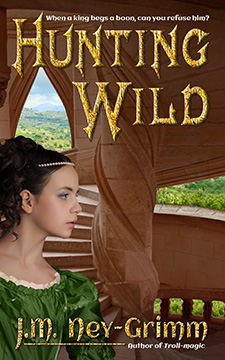
I was inspired by a passage from the appendices of Hunting Wild.

The Holy Hermit Cathal was born into the social unrest and turbulence of this time. As a young man he pursued the course of an ascetic, withdrawing from human contact to pursue a life of simplicity and meditation. Later in life, one of the destined human sacrifices escaped to Cathal’s lonely hut in the hills and changed Cathal’s outlook.

Cathal realized that withdrawing from tumult was cowardly, and he emerged to challenge the disgusting practice of human sacrifice, speaking nearly every day to crowds in the realms of Istria, Eirdry, and Ennecy.

I wanted to write about Cathal. Not his full story, but that moment when he was confronted by the fugitive running for his life.

If I could just capture that scene, it would satisfy some longing in my writer’s heart.

But a story is more than just a vignette or cameo. The scene I was longing to paint with words needed more than one man fleeing and another offering him refuge.

So I put on my thinking cap.

Who was the fugitive? What was important to him? How did he come to be destined for blood sacrifice?

As I pondered these and other questions, I found myself wondering if I could connect my holy hermit with some of the events forming the backstory of The Tally Master.

That proved to be the concept that would ignite my creative fire.

I imagined the dry hills and the olive orchards around the city of Castarre. I discovered the name of the man—a metal smith—outracing the hounds. It all became very real in my mind’s eye.

And then I started writing!

For more about Tales of Old Giralliya, see:
Rebirth of Four Fairy Tales
Caught Between Two Armies
Tales in a New Bundle


Share

The Tally Master, Chapter 2 (scene 7)

Keir disliked the tin vault.

It was narrower than either the copper or the bronze vaults, more like a corridor than a chamber. Only one arrowslit lit the space, and its casement possessed panes of translucent horn, not glass, making the light very dim. The flat smell of the tin hung in the air. The heavy stone groins holding up the arched ceiling were oppressive, the cramped space was oppressive, and Keir felt oppressed.

She could imagine herself buried deep beneath the earth in a blood wyrm’s cavern. The tin repository seemed more like a monster’s lair than a treasure vault located high in a fortified tower.

It was the very opposite to everything she’d known until two years ago: the flat salt marshes under a wide sky of clear blue, swept by gauzy clouds; the round reed huts clustered on the strand between marsh and ocean; the vast stretch of tossing waves, all the way to the distant horizon. Her home.

But she had a job to do here. Both the immediate one—the re-tallying of tin assigned by Gael—and the more comprehensive, longer term one she’d assigned herself.

Standing before the stone ledge that formed the base of the vault wall, she lifted the peaked lid of the first in a row of wooden caskets. Each casket was square and small—less than a foot in length, width, and height—and its lid echoed the shape of the ingots within it, slanting up on all four sides toward a flat, square top.

The ingots themselves, arranged in four nested stacks, had flat rims around their square bases, and one would fit in the palm of her hand.

There should be sixteen in this casket, four in each of the four stacks. She counted them out onto the ledge, each one weighing sixteen ounces—light individually, heavy when you stacked enough together. Heavy when you considered what they did: forming the weapons with which the troll horde had once—before she was born—assailed her people on their island home of Fiors. Her people, armed only with flint knives and flint-tipped spears, had stood no chance against the bronze-wielding truldemagar.

Without tin, the truldemagar would not have bronze. And tin was rare. So rare that even a small pebble of it was precious, while an entire ingot . . . an entire ingot might make a man—or a troll—wealthy.

Sixteen ingots of tin.

She counted four of them back into the casket. Clink. Clink. Clink. Clink.

She marked four tallies on her parchment with her quill. Scratch. Scratch. Scratch. Scratch.

She counted the next four ingots into the casket, tallied them, and did the same for the next four and the last four.

Sixteen ingots. Sixteen tallies. There was no way error could explain the missing ingot. Keir was surprised Gael had even mentioned the possibility. His control of the tin—and the copper and the bronze—flowing through Belzetarn was absolute. That had been clear from the moment he’d taken her as his assistant and trained her in the systems he’d devised.

Each morning, Keir counted nine ingots of copper from the copper vault into the rucksack of the blade scullion sent to fetch metal for the blade smithy, while Gael tallied them. Then Keir put one tin ingot from the tin vault into that rucksack, and Gael tallied it.

When the scullion delivered the ingots to the blade smith, the blade notary tallied them. And, in the evening, when the scullion delivered the forged blades back to the bronze vault—ready for grinding and polishing the next day—Keir weighed them, and Gael tallied them. Then he tallied the one bronze ingot always poured—from excess metal—after the forging of eight blades, except on days when the blade smithy made arrowheads and spearheads and created no excess.

Similar checks and tallies controlled the metals flowing through the other smithies: the grinding smithy; the annealing smithy; the hilt maker; the armor smithy, where the scales and wire were forged for scale armor, as well as the greaves and helmets; and the privy smithy, where tools for the kitchens and the tannery and all the other offices were made. Every ounce of metal was tallied by Gael and Keir together.

Keir knit her brows.

Gael’s systems were flawless. But the trolls who used them . . .

The blade smith would never make an error, nor would he ever steal. Smithing was his calling, and bladesmithing was sacred. Keir found his obsession a little scary, but it meant he was trustworthy.

The grinding smith was a practical sort, matter-of-fact and phlegmatic. The annealing smith was precise. The armor smith . . . was kind. He and Gael were close friends.

All the smiths were reliable, except the privy smith. Martell was artistic and flamboyant, exploring the ornamental possibilities in household items, especially those used at the regenen’s table and in the regenen’s chambers or the castellanum’s. He tried varying mixtures of copper and tin. And his tallies were always in arrears.

But never by an entire ingot’s worth.

Well, that wasn’t true. Martell had been in arrears by as much as an ingot. Several times. But the tally chamber had always been able to track down the error.

And the privy smith was honest, despite his inexactitude. Martell would not have stolen an ingot, but he might have provided the opportunity for another troll to do so.

Keir locked the first casket of tin. She moved to the next, counting and tallying the ingots.

Sixteen.

Perhaps Gael had been thinking of Martell, when he spoke of error as the reason for the missing ingot. The privy smith had been caught in error before. Keir had caught him just in the last waxing moon. The weight of the ingots going into the privy smith had been less than the weight of implements and ingots coming out, and by more than the usual few ounces.

Why couldn’t Martell simply put the beakers and knives and nails he made on the blasted scale? But, no. He persisted in having his notary write the number of ounces each item should weigh next to that item on the list. Which had undoubtedly worked fine when he adhered to the standard designs. Since he’d begun pursuing his art—soon after Keir arrived at Belzetarn—the weights changed with his changing innovations.

His error last waxing moon?

Keir had noticed a ladle in the carry sack of the privy scullion headed to the kitchens, said ladle failing to appear on the list at all. She’d added it, along with its standard weight, and the privy smithy’s input and output had then matched, as much as they ever did.

If the privy smith had managed to use an entire ingot of tin without recording it—unlikely, given that Martell was experimenting with copper-rich mixtures far more than tin-rich ones—the tally room would never learn where that tin had gone. The products from the privy smithy dispersed too widely.

But Keir didn’t think it was error.

And she didn’t think Gael thought so either. Why was he pretending he did? Because he wanted to keep Keir out of the ugliness? To protect Keir?

She suspected that was it.

What in the North would Gael do if he learned Keir was not the boy he thought her, but a young woman? Or did he know already? He might. He was subtle enough to penetrate her secret and never let on that he knew it, even to Keir herself. And he was protective enough—claiming Keir’s youth as his reason—that knowing her gender might occasion no change in either his behavior or his demeanor.

In that respect—if in no other—Gael reminded her of her father.

Keir removed the tin ingots from the third casket and swallowed hard against the sudden tightness in her throat. Would she always miss her pater—her father? Their interchange had been such a mix of irritation and affection on her last day at home.

*     *     *

Next scene:
The Tally Master, Chapter 2 (scene 8)

Previous scene:
The Tally Master, Chapter 2 (scene 6)

Need the beginning?
The Tally Master, Chapter 1 (scene 1)


Share

Rebirth of Four Fairy Tales

You may have noticed a new progress bar over there in the sidebar of my website. Yes, the one entitled Tales of Old Giralliya. That’s the one.

Where did it come from, and what’s it all about?

It all started back in 2012.

In 2012, I wrote several North-lands fairy tales for my blog.

I had a lot of fun with them, and at least one of my readers told me that she was really enjoying the flash fiction. (The fairy tales were short, under 1,000 words.)

I remember brainstorming a bunch of ideas for future fairy tale blog posts, and I developed a list of a dozen possibilities. I imagined myself checking the list at intervals, writing and posting the next story from it, and eventually writing all of them.

The fourth story on the list went long—to 1,500 words instead of the usual 700 or so.

I was okay with that. Really, anything up to 3,000 words seemed a manageable length for a blog post.

The fifth story was 8,000 words long.

That was a problem.

Oh, I had fun writing it. And I think my readers enjoyed reading it. But 8,000 words deserves to be published as more than a blog post. This one was, eventually. In the ramp-up to publication, it grew, because I discovered as I worked that the story needed a bit more development, which added scenes and word count.

When the draft was complete, it had reached 20,000 words. I named it Hunting Wild. 😀

So far, so good.

But what about fairy tale #6, Fairest Trickery?

I never wrote it, because it is a more complex tale than Hunting Wild, and since Hunting Wild required 20,000 words, Fairest Trickery would probably require at least 50,000 words. It would be a novel.

Obviously, I like writing novels! I love writing novels. But Fairest Trickery would have to get in line behind the ten other novels I wanted to write first!

Aegis and Mage and Mirage—the stories following after Fairest Trickery—are probably novellas, but this whole sequence—Blood Falchion, Hunting Wild, Fairest Trickery, Aegis, and Mage and Mirage—forms a series telling of the events occurring around a cursed blade as it passes down through history. And I would need to write the books in order. I still think I might one day; we’ll see.

But the Blood Blade series brought my fairy tale telling to an end, back in 2012.

Occasionally I toyed with reviving my list. I could skip past the Blood Blade series and tell some of the other, unrelated fairy tales.

I could, but somehow I never did. Until now!

What happened?

A. L. Butcher, bundle curator extraordinaire, invited me to contribute to a fairy tale themed bundle that she plans to release this November.

Oh, how I wanted to be part of it!

But I had a problem.

Troll-magic, a re-telling of East of the Sun and West of the Moon, is already in the Here Be Magic bundle.

Crossing Naiad, a re-telling of The Three Billy Goats Gruff, is in the Here Be Ghosts bundle.

The Troll’s Belt, a re-telling of Hansel and Gretel, is in the Here Be Fairies bundle.

Some of the earliest bundles to which I contributed are no longer in print. But these three are. I didn’t have any new fairy tales for the new bundle. That made me sad.

Then I remembered the fairy tales from my blog! They are not re-tellings of fairy tales from our own Earth’s cultures, no. They are brand new fairy tales emerging from the cultures of my North-lands. But they are fairy tales.

I could collect them together and contribute the collection to the bundle!

I emailed A. L. about the possibility, and she liked it. So I set to work.

The first part was simple. I copied-and-pasted from those old blog posts. Then I ran through the files with a light edit. And that should have been enough. Legend of the Beggar’s Son, Ravessa’s Ride, and The Thricely Odd Troll, when gathered together form a nice little trio.

But, but, but!

Re-reading the stories inspired me. Wouldn’t it be fun to tell a few more of the stories from my old list? I was sure I could make the November deadline. Oh, oh, oh! It was irresistible.

Last week I finished The Hermit and the Smith. This week I finished The Kite Climber.

I also re-visited my decision not to include Blood Falchion. Why had I decided that? I re-read it. Wouldn’t it be nice to give the story the visibility the bundle would confer on it? Yes, it would. So what if it’s the beginning of a series. The story is complete in itself. It stands alone. I would include it!

So Tales of Old Giralliya will have seven stories in it: four from my blog plus three new ones. I’ve loved working on the project, and I’m excited about the next story I’ll write for it.

I’ve done the brainstorming and taken a bunch of notes. I want to do a little outlining and a little thinking, and then I’ll dive in!

I plan to blog a bit more about the process of creating this collection. In the meantime, watch the progress bar to see the words piling up! 😀

For more about Tales of Old Giralliya, see:
Two Giralliyan Folk Heroes
Caught Between Two Armies
Tales in a New Bundle

Edited to Add: The seventh story, when I actually sat down to write it, proved to be too long for this collection and told in a different style. It’s not right for Tales of Old Giralliya, but you will get to read it. I plan to release it as a standalone novelette.

Edited 24 October 2022 to Add: I did release that novelette! It’s called “To Haunt the Daring Place” and you can find out more about it here.


Share

The Tally Master, Chapter 2 (scene 6)

Later, sitting before his desk in his tally room once again, he thought about what he’d observed.

Sounding the gong impelled its living energea to action, draining energea from—all who heard it?—funneling that energea into the gong’s heart, and then sending it out into the world to . . . where? Or whom? And why? He didn’t know, but he had to find out.

In the meantime, he’d checked the balcony outside his chambers, and no one had fallen from that height to the floor of the great hall below it. Thank Tiamar. He’d sent a messenger to the privy smithy, requesting a bronze padlock for his storeroom door to be ready immediately. Meaning tonight, before the privy smith put the forge to bed. And he still had this morning’s tallies to format for tomorrow’s review, as well as the rumor about sword breakage to follow up. (Was it really true that the breakage rate was up? He doubted it.)

In other words, he had his normal work to do.

It was almost automatic, after seven years of tallying and preparing compiled reports of his tallies. Dividing his attention, he could keep his quill sharp and filled with ink, transfer the rough tallies from their parchments to the comparison compilations without error, and sand the wet ink so it did not smudge, while another part of his mind entertained thoughts altogether unrelated to his tallying tasks.

His quill scratched, and the parchments rustled. Faint shouts drifted up from the artisans’ yard below, barely heard through the glass of his casements and the wood louvers of the inner shutters. Footsteps sounded in the stairwell outside the closed door—normal traffic—swift and pattering messengers, slow and tramping porters carrying heavy loads, decisive magnos climbing to attend the march. The tallow dips burned steadily in the still air.

Gael found himself considering again the matter of loyalty and how accurately any one man—or troll—could assess another’s loyalty. Carbraes had assessed Gael’s loyalty well. But who could match Carbraes’ acuity? Could Gael do so?

How well did Gael know even his friends, here in Belzetarn?

Take Arnoll, the armor smith. Gael had known him longest, right from the moment of his arrival in Belzetarn’s bailey. He’d never forget that moment, as he lay bleeding in the snow, more dead than alive and uncertain if he even wished for life.

The scouts of the First Cohort in the Second Legion had dragged him in—although he’d not known their status at the time—tossed him down, and summoned the regenen.

Gael had figured he was done for.

Certainly his wanderings in the wild—starving, cold, and lost—were over. Either the regenen would take him in (Gael didn’t think he wanted that) or the regenen would kill him. (Gael knew he didn’t want that. But what choice did he have?)

Carbraes’ icy blue gaze had felt as piercing as the scouts’ spears when they had captured him. “Check him,” the regenen ordered the troll standing beside him. Arnoll.

Ah, Arnoll.

Gael had barely noticed the smith’s burly shoulders, his curling iron gray hair, or the small char marks on his buff apron of calfskin, burned by sparks flying from his forge. Arnoll’s blue eyes were warm, where Carbraes’ were cold, and Arnoll’s tanned and leathery face was kind.

He’d knelt beside Gael, saying, “Fear naught, lad. You’ve come home, given I see what I expect to see.”

Arnoll’s gaze went distant as he consulted his inner sight. Then he nodded and rose. “Troll,” he said to Lord Carbraes.

“Get him up,” commanded Carbraes.

The scouts hauled Gael to his feet.

Carbraes faced him square, quite close. “Belzetarn is my citadel. All who dwell here obey me. Without exception. In return, I grant shelter, food, clothing, and my unshakeable defense. While you reside under me, none of my enemies shall strike you down unopposed.” The regenen paused, studying Gael a moment before he continued. “The unafflicted are my enemies. Every single one free of the truldemagar. Is that clear?” The regenen’s voice was crisp. His authority emanated from him like heat from the sun.

Gael shook his head, confused and in pain, but Carbraes seemed to take his ‘no’ for a ‘yes.’

“Swear loyalty to me now, and you will live and heal. Deny me, and you die.”

Gael wondered if he dreamed. The scene—a snowy bailey bounded by stone fortifications and paced by troll warriors, his own blood spotting the ice crystals, a tall black tower farther up the slope reaching toward the overcast sky—seemed unreal. And yet Carbraes’ words were real. Gael knew, deep in his gut, that Carbraes meant them.

“No,” he choked.

Carbraes nodded, unoffended by Gael’s refusal. The regenen lifted a hand, about to order Gael’s execution.

“Wait!” Arnoll caught his regenen’s arm. “Let the physician see to his wounds. Let me make cogent argument to him. This is a man who responds to reason, where he will not respond to bare force. My lord.”

How had Arnoll known?

Carbraes met Arnoll’s entreating gaze, his own stern. He turned to scrutinize Gael. “Very well. Summon me when you deem him ready to make that reasoned choice.” Had there been sarcasm in that word ‘reasoned’? Gael still didn’t know.

But Arnoll had convinced Gael. Not through reason, as things fell out, but through Arnoll’s almost fatherly care for the trolls for whom he forged armor in the smithy at Belzetarn’s roots. Arnoll was no enemy to the unafflicted ones, but he was a staunch partisan to the trolls.

“Would you exile a man because he contracted lung fever?” Arnoll argued. “Or because a blow to his head stole his wits? The afflicted deserve care and healing, not exile and death.”

Gael wasn’t convinced that was a fair comparison. He himself had contracted the truldemagar while dragging men into the earth by magery, there to suffocate. No innocence gilded his past. Surely many of Carbraes’ trolls had performed deeds equally foul to bring the disease upon them.

Not that Gael regretted his choice. He would protect his king, Heiroc, all over again in just the same way, had he to do the past over. But he was not innocent in the way a man sickened by plague or maimed by an accident was innocent.

Despite his lack of innocence, when Gael’s wounds had healed and Arnoll brought Carbraes to hear Gael’s oath, Gael had sworn fealty to the regenen. And, thus far, had not regretted it. Carbraes was . . . worthy of loyalty.

Gael shook his head, smiling, and pulled his thoughts away from the past. How was it that memory had claimed him so thoroughly? Twice, now. Was it the gong? Or something else that prompted him to visit what he normally avoided? Every troll learned that there was little profit to gain from remembering one’s losses. For every troll had lost his former life, the one he led before his vile transformation.

Enough.

The morning’s routine tallies were ready for the morrow. He shook the sand from the final parchment, laid it atop the stack, and set that stack in the low pigeonhole he reserved for the most recent records.

Where was Keir? Surely the boy should have finished re-tallying the tin.

Gael wanted to check that re-tally against the original before he visited the quartermaster about sword breakage and before he consulted the various smiths about melting down that injurious gong. Should he go in search of Keir? Or assume Keir would catch up with him when the re-tally was complete?

Gael brought his assistant before his mind’s eye: ash blond; gray-eyed; slim and slight, still more a child than a young man, and yet with the cool control and the cool logic of one fully grown. Coolly observant, too. Keir missed little.

Cool.

The word might have been coined to describe Keir. And yet Gael did not find the boy cold or heartless. He would swear that hidden beneath Keir’s collected demeanor lay the potential for heat, passion, and anger. Even vengeance.

Although . . . just as Gael knew nothing of Arnoll’s past—genial, protective Arnoll—so Gael knew nothing of Keir’s either. Just how well did he know Keir? How accurate were his perceptions of the boy?

Gael snorted in irritation with himself. Nothing wrong with thinking and assessing, but he was doing altogether too much of it this day. Enough of pondering hidden realities and secrets.

Keir was quick, focused, and diligent. And it was not like him to be late.

*     *     *

Next scene:
The Tally Master, Chapter 2 (scene 7)

Previous scene:
The Tally Master, Chapter 2 (scene 5)

Need the beginning?
The Tally Master, Chapter 1 (scene 1)


Share

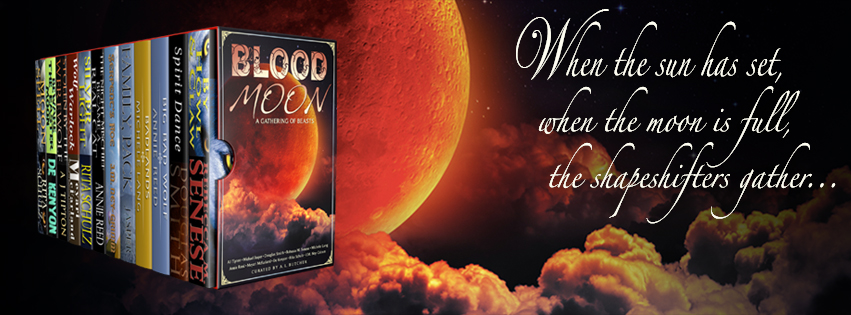
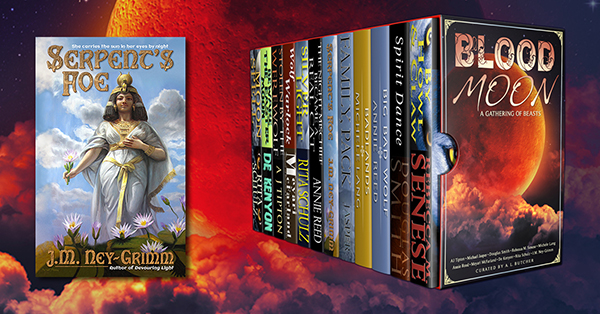
New Bundle! Blood Moon

I’ve been invited to participate in a bundle featuring shapeshifters!

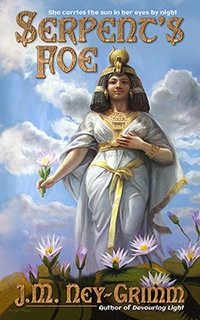
Many of the stories showcase traditional were creatures turned by the power of moonlight, while mine involves the ancient Egyptians and the mutable forms of their gods. But several of the authors put unusual spins on the trope, including the adventures of a feline fey, the call of the Wild Hunt, and the spiritual heart of the First People.

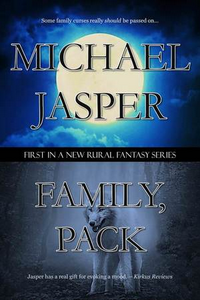
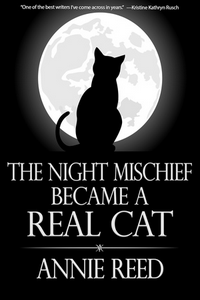
Among those that especially caught my attention were By Howl & Claw by Rebecca Senese (a collection of 5 stories), “Big Bad Wolf” and “The Night Mischief Became a Real Cat” by Annie Reed, Family, Pack by Michael Jasper, and “Wolf Warlock” by Meyari McFarland. Here’s a little bit about them…

*     *     *

What kills and leaves a strange, elongated print?

What howls in the dark Yukon night?

What stalks these burglars in an empty house?

What follows an old woman in the woods?

What chases squirrels in the full moon?

By howl and claw, monsters roam the wilds.


*     *     *

Carla hated blind dates.

Hard enough just living in the city and trying to fit in with a bunch of regular people who didn’t know she was a werewolf.

Why didn’t everyone believe her when she told them she liked being single? No attachments? No commitments? No one to accidentally disembowel when the moon was at its fullest and she wolfed out during a particularly vivid dream?

This particular blind date, though, might be too good to be true.

Right up until the lights go out, and everything goes to hell.

*     *     *

Some family curses really should be passed on…

Tommy Roling does everything humanly possible to raise his infant daughter Corinne the right way. But a half year out of high school, Tommy finds himself a single parent as well as flat broke.

And, with every full moon, he can’t fight the urge to strip off his clothes and run wild through the pastures outside town.


*     *     *

Once she stalked the duat by Ra’s side, carrying his light in her eyes and battling the monsters that assailed them.

Now, tormented by confusion and her own fury, she longs to regain the unique powers which—inexplicably—elude her in captivity.

In this mythic tale of pride and revelation, a fight beyond death delivers one last chance at redemption.


*     *     *

Mischief never expected to encounter a shadow creature.

Especially not on the night her wings fell off and she became a real cat.

She just wants to find a home where she belongs. Instead, Mischief runs into the biggest shadow creature she’s ever seen. A creature that can transform itself under the light of the full moon into something solid and dangerous and hungry.

Mischief comes from a long line of feline fey. Proud hunters who protect the world from shadow creatures who stalk the unwary. But Mischief’s no longer fey—she’s just a cat.

One very determined cat.

*     *     *

The new Lady of the Wild Hunt called.

Tamara, Etelka and Dax answered the call even though they were barely more than pups.

They slipped into the physical world, running to the Lady’s call. Only to find that she hadn’t called them, not exactly.

Call or not, the Lady needed them, needed their support and their training and their ability to channel her anger into something useful.

Unfortunately, only one of them could be Chosen to stand by the Lady’s side.

*     *     *

When the sun has set, when the moon is full, the shapeshifters gather—wolves, cats and totemic creatures, nightmares and revelations.

Seeking answers, seeking revenge, seeking a cure to affliction, seeking blood, seeking answers or seeking love—a gathering of beasts abounds. Dare you walk beneath the moonlight?

By Howl & Claw by Rebecca Senese
“Spirit Dance” by Douglas Smith
“Big Bad Wolf” by Annie Reed
“Badlands” by Michele Lang
Family, Pack by Michael Jasper
“Serpent’s Foe” by J.M. Ney-Grimm
“The Night Mischief Became a Real Cat” by Annie Reed
“Silver Light” by Rita Schulz
“Wolf Warlock” by Meyari McFarland
Stolen by the Werewolf by AJ Tipton
“Beware the Easter Moon” by De Kenyon
“Moon Spell” by Rita Schulz

The Blood Moon bundle is available at Amazon, Barnes & Noble, Kobo, iTunes, or direct from the BundleRabbit site.


Share

The Tally Master, Chapter 2 (scene 5)

Chapter 2

Gael let the warriors lugging the artifact precede him, although he followed close.

It was a long, hot climb from the tower’s main gate to his chambers over the tally room. The stones of the walls and steps held their chill, welcome in summer, but the air flowing in through the arrowslits was too warm.

Gael pushed past the burn in his tiring leg muscles, ignoring the fierce click in his ankle, thinking. Was he as loyal as he’d assured the regenen?

Carbraes was right that Gael didn’t covet more power than he currently possessed. His position of secretarius was an exalted one, no question. But with more power would only come increased obligation to use it. The more powerful castellanum—Theron—governed all of Belzetarn: the kitchens and the cooks, the artisans and their yard, the messengers, the provisioners, the hunters, and more. It must be a tedious business, overseeing every last detail and all the disciplinary proceedings that were surely required to get the work done.

Theron seemed to enjoy it, and he certainly ranked above Gael in the hierarchy, but Gael shuddered at any possibility of stepping into his shoes.

Belzetarn’s march, Dreas, possessed power close to that of the regenen’s, commanding the regenen’s legions. But Dreas and Carbraes were like the fingers on one hand. They went back, way back, comrades before ever they came to Belzetarn, and comrades under the regenen who’d held the citadel before Carbraes.

The march would never betray Carbraes. Nor did Gael covet his job. It came too close to the realities of the troll stronghold that troubled Gael.

He was grateful to have this safe haven, grateful for Carbraes’ protection, grateful to have come to rest in peaceful waters after the turbulence of war under Heiroc, and then exile in a denuded wilderness when the truldemagar claimed him.

But although his tally room was peaceful, Belzetarn as a whole was not.

The citadel harbored warriors—troll warriors—and all the paraphernalia of war. It gave birth to war, standing opposed to near the entire North. As Carbraes once said: unless we carry the war to them, they will bring it to us. And what they bring will be defeat. Utter defeat. Annihilation.

The ‘they’ he referred to were the unafflicted, the healthy, those free of troll-disease.

There was no lawful place in all the world for the truldemagar. Only exile to the more inhospitable reaches that no one else wanted. The deserts of sand, rock, or ice that required magery to survive.

Trolls who hoped to survive more than mere months banded together under the strongest of their number they could find. The stronger, the better.

Carbraes was strong. He had to be.

But the unafflicted ones, the unmarked ones—

When Gael brought the faces of the undiseased into memory, he thought not of the king who had banished him, nor of the knights who backed that king. No. He remembered his littlest sister, with her mop of curly black hair and her trilling laughter. He remembered his mother, sweet-faced and low-voiced. He remembered his older brother patiently explaining the proper way to sharpen a quill pen. He remembered the innocent ones.

And the knowledge that Carbraes—and Belzetarn—brought blood and death to those who deserved protection bothered him.

There lay the weakness in Gael’s loyalty.

So long as he could ignore the reality that underpinned Belzetarn, Gael was loyal. Unshakably so. But if ever he had to choose between Carbraes and an innocent . . .

Gael frowned.

He’d arrived at the door to his chambers, a heavy bronze-bound affair, like all the doors in the citadel, and padlocked. The warriors, weighed down by the gong, were waiting for him to unlock it.

He did so and steered them through his sitting room—a dim, comfortable space with cushioned divans, wall hangings, and shelves packed with scrolls of ballads, epics, and legends—to the small storeroom off it. He would need to order a bronze padlock for the storeroom door. Tonight.

In the meantime, the outer door must suffice. At least every troll and his brother wouldn’t parade past the cursed gong as they would if he’d secreted it in some more frequented spot—the armory, where warriors were issued new weapons; the armor vestry, from which they were issued leather cuirasses or scale mail; or the oxhide vault, where the mule teamsters carried the large copper ingots from the mines.

These warriors used appropriate care in setting their burden down—flat on the floor—apparently as wary as he of the dreadful effects of sounding the resonant bronze.

Gael barred his outer door behind them, lit two tallow dips, and returned to scrutinize his unwanted prize. He’d promised Carbraes that.

No, he’d promised much more than that, but inspection was where he would begin. First he would look with his eyes, again, paying attention to detail, because outer form often hinted at inner structure. And then he would deploy the inner looking that Carbraes desired.

The metal disk was large. Were he to suspend it from straps or chains—using the pierced and beaded holes at its rim—and stand before it, touching one edge with his right fingertips, the other edge would reach his left shoulder. It was not flat, but curved like a great shallow bowl upended on the floor, the center rising three handspans from the flagstones with the central iron boss another handspan above that, and the bronze edges also furling up a handspan.

Its polished surface gleamed, bouncing the light of the tallow dips around the storeroom, creating strange patterns of shadow over the oddments stacked on the shelves and hanging from the wall hooks. The bronze possessed a warm, rosy tint—almost as though it were made of pure copper—but with a film over it, like frost.

Gael wondered if it were the arsenic in the bronze producing that effect or the forging technique used. His friend Arnoll would know.

He resisted the urge to descend to the smithies right now and fetch Arnoll out of his deep refuge to view this thing. That must come later, after Gael had done his duty by it.

Did he feel such repugnance because of the nature of the artifact itself? Or because of what it might require: the use of Gael’s magery?

Etched into the metal, abstract curves sprawled from rim to iron boss, creating a crisscrossing lattice that reminded Gael of the energea patterns that accompanied magery. Near the center, the design came together to depict a phoenix nesting in flames, its wings upraised to encircle the boss.

Was there significance to the image? Resurrection via ultimate loss and suffering? He’d not registered its presence during his first encounter below.

He crouched to study the composition. Did flames emanate from the boss, as though it were the sun? Or did the boss represent the egg from which the phoenix would be reborn? The latter, he thought. For within the thumb-sized dimples covering the black iron swirled deliberately irregular whorls, similar to those on peregrine eggs.

Gael’s ankle creaked as he straightened, and the flames of the tallow dips wavered, making the shadows dance. His next observance would take longer, and Gael refused to complete it with the aching joints that would follow poor posture.

He stepped out to his sitting room, noting the angle of the sunlight on the stones of the arrowslits beyond the glass casements. The day was passing, and he had still his regular work to do—counting this morning’s tallies and issuing orders to the various offices, plus hearing Keir’s report from the re-tally of the tin ingots and reviewing the discrepant tallies from yesterday.

He selected the thick fleece carpeting the floor in front of his favorite divan and hauled it into the storeroom, laying it next to the gong. Sitting crosslegged upon it, the wool cushioned and warmed his haunches. He leaned forward a little, then back, seeking that upright position that would let his tailbone drop while his crown rose. As unwelcome as this inner scrutiny of the gong might be—approaching close to the source of its enweakening groan—done properly, his body could benefit from breath linked to posture.

Ah! His shoulders lowered that last smidgeon as the old discipline claimed him. It felt good, even though it shouldn’t have.

He fell into the slow rhythm of breathing in while focusing on the lift in his crown and breathing out while noticing the relaxation at his root. In, for seven beats. Out, for seven beats.

The silver scrolls of his arcs unfurled in his mind’s eye, and his nodes—drifting—flushed with color. He directed his attention away from his own familiar lattice of energea to the gong that lay before him. He hissed. It, too, possessed a pattern of energea, but not the quiescent and linear lattice of normal bronze, like a board for the game of draughts, no. This bronze was active.

Curving scrolls of silver—distinctive of living organisms, not inert metals—followed the etchings in the bronze, flowing into and then out of a glowing green node at the central boss.

Tiamar on high! Did this artifact possess a heart node just like that of a man? Or a troll?

Gael focused his inner sight on that green lambency, wanting to discern its inner structure. The corona held a soft diffuseness, just as did the corona of a human node. The mantle within intensified, shining with greater brilliance. And, at the core, the light solidified around a faint pattern of closed diamonds—anchorage.

Tiamar’s throne! It was a human node.

Gael wasn’t sure if he beheld miracle or abomination.

So. He’d studied this thing, inside and out. He could report his findings to Lord Carbraes. And then . . . ?

Why did he hesitate? He longed to close his inner sight and get away from this curiously disturbing energea. But he had the sense that there was . . . One. More. Thing. One more thing he should do before he called his scrutiny complete.

Reluctantly, inner sight still open, he reached toward the furled bronze and tapped it with his forefinger.

A soft humming shivered on the air, pulsing in and out.

The scrolling arcs of the gong, leading from its edge to its center, brightened and quickened, sparks traveling inward along their curves. The gong’s heart node throbbed—incandescent, mellower, incandescent, mellower. Then the arcs flowing away from the gong’s center came to life, generating scrolls of blue energea that radiated off the metal into the world.

Gael’s own energea dimmed. His legs felt like lead, heavy and immovable. His spine slumped like a jelly, while his head alternated between painful density and dizzying dispersion. Crushing, expanding, crushing. He swallowed down nausea. Swallowed again.

Then the resonance ceased, and the gong’s energea quieted.

Gael’s strength returned. He heaved to his feet, tottered out to his sitting room, and closed the storeroom door firmly behind him.

Gaelan’s tears!

He didn’t think that draining hum had escaped his chambers. He hoped not. There was a balcony just the other side of the storeroom’s back wall. Cayim’s hell!

He half-fell half-sat on his favorite divan, leaning against its slanted arm. He could feel the suede buttons through the thistlesilk of his sleeve.

The warriors must have dropped the gong to produce the groan that had echoed through Belzetarn’s stairwell earlier, but the resonance from a finger tap was equally bad at close proximity.

He should check that balcony. Be sure no one had fallen. He really should.

And he would, as soon as he could gather his scattered . . . self.

*     *     *

Next scene:
The Tally Master, Chapter 2 (scene 6)

Previous scene:
The Tally Master, Chapter 1 (scene 4)

Need the beginning?
The Tally Master, Chapter 1 (scene 1)

 

Share

Kombucha in Large Batches

My SCOBY is healthy!

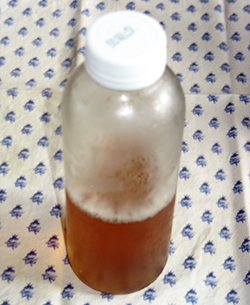
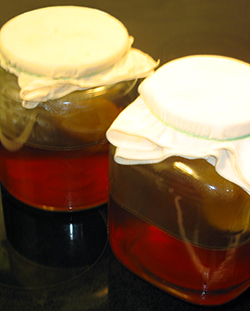
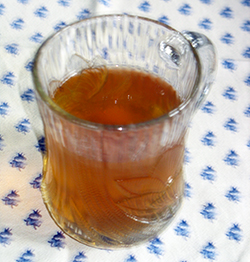
How do I know? Because it keeps making babies. The workhorse SCOBY nestles down in the bosom of the rich brown tea, turning it into kombucha, while a new SCOBY forms on the surface of the batch.

When my first SCOBY made a baby in its brewing jar, I made two jars of kombucha for my second batch. Now I’m increasing my batch size.

From my reading, I learned that one shouldn’t increase the size of the batch too rapidly. The amount of liquid needs to be matched to the strength of the SCOBY.

My first batch was 1 quart. My next batch, because I had two SCOBYs, was two 1-quart jars. Now I’m tackling two 2-quart jars. (I put one workhorse SCOBY and one baby SCOBY in each jar, because four jars with one SCOBY each just seemed too complicated.)

I plan to do another two 2-quart jars next, and then…more!

I’d hoped to try a full gallon, figuring that the jars currently holding 2 quarts each would easily hold double that. But when I poured 2 quarts into each, I saw that I was wrong. Because the jars need to breathe—there’s no lid to prevent spills when I carry the jar from its brewing spot to the kitchen counter for bottling—I can’t fill the vessel to its brim.

So I’ll do two 3-quart batches when I’m ready to increase.

As the volume of liquid increases, the amount of the other ingredients must increase also. I’ll set out the measurements here, in case you are accompanying me with your own kombucha adventure. 😀

Kombucha—1 quart

2 tea bags
1/4 cup evaporated cane juice
3 cups filtered water
1/2 cup kombucha from previous batch

Kombucha—2 quarts

4 tea bags
1/2 cup evaporated cane juice
7 cups filtered water
1 cup kombucha from previous batch

Kombucha—3 quarts

6 tea bags
3/4 cup evaporated cane juice
10-1/2 cups filtered water
1-1/2 cups kombucha from previous batch

Kombucha—1 gallon

8 tea bags
1 cup evaporated cane juice
14 cups filtered water
2 cups kombucha from previous batch

I’m looking forward to the larger batches! The first 1-quart batch disappeared almost instantaneously, especially since I had to reserve 1/2 cup for the next batch. I can see that the second batch isn’t going to last very long either. I may have to see about finding larger vessels, so that I can go for that full gallon!

For the full process of brewing kombucha, see:
Make Your Own SCOBY


Share

The Tally Master, Chapter 1 (scene 4)

With effort, Gael wrenched his thoughts from the old, painful memories.

Where he stood right now—in a dusty and cluttered storeroom full of wooden practice weapons, cutting butts, pillars, and mats—was a direct result of the events in those memories, but his attention needed to be on the present. Not the past.

One of the page boys in the cluster behind him murmured.

Gael’s gaze fell to the bronze gong resting on the stone floor between the two warriors. Its metal gleamed in the dim light, beckoning, inviting Gael’s scrutiny as his regenen had requested.

Lord Carbraes awaited Gael’s response, his stance relaxed within his aura of command, and his eyes steady. “Secretarius?”

Gael sighed. “Surely the magus is better qualified, Regenen. I renounced my magery when I entered your service. As you requested. As you request of all who dwell under your command.”

“You did.” Carbraes’ face did not change—composed. Waiting.

Almost did Gael submit. He valued his place here in Belzetarn. It was his home. He valued the reason and firm control Carbraes exerted over Belzetarn’s denizens. This refuge existed only because of Carbraes’ power and sanity. Gael had always been content—or almost always so—to give whatever Carbraes required of him.

But not now. Not this. Of all the trolls gathered in Belzetarn—who renounced magery at Carbraes’ command—there was one who still performed it. Also at Carbraes’ command.

“The magus would resent my usurpation of his prerogative,” Gael suggested.

A slight warmth entered Carbraes’ ice blue eyes. “No. He will resent my insistence that another share his privilege.” That was true. “Which is my privilege.”

Also true. But the magus of Belzetarn would add yet another grudge to those he already held against Gael, for the two were old acquaintances. Enemies? Maybe even enemies. At this juncture.

For the magus of Belzetarn had been the magus of Pirbrant, serving Erastys seven years ago.

Nathiar would yield no forbearance to Gael even when it was commanded by their mutual lord. Although . . . it was not Nathiar’s animosity that concerned Gael.

Many of the trolls seeking refuge under Carbraes renounced their magery reluctantly. Its power and convenience were seductive. Why hone one’s sword with whetstone and oil and labor, when magery would do it faster and better? Why fight with that sword on the battlefield, when magery could deliver far more devastating attacks?

But every troll in Belzetarn—or anywhere else—suffered the truldemagar because of magery gone wrong. They’d wielded magery too ambitious, too extreme, or too powerful for unafflicted arcs and nodes to withstand it and yet keep their healthy anchoring. And each time a troll pulled energea through his drifting nodes, those nodes drifted a little farther from true, farther from health, closer to deformity and madness.

Gael had renounced his magery willingly.

This artifact of Olluvarde threatened a return to his relinquished power. Why would Carbraes have Gael examine the sinister metal unless Carbraes intended Gael to meddle further with the gong? And Gael suspected that such meddling would require . . . magery. Not trivial magery either, but skilled and potent magery. The kind of magery that turned safe blue energea to lethal gold. There was a reason that Nathiar’s straight, shoulder-length hair shone silver now, while Gael’s black locks remained merely threaded with gray.

Abstinence from magery possessed great benefits, and Gael was not anxious to forego them.

“My skills are rusty,” he persisted. “The results will be more certain, if the more practiced magus—if Nathiar investigates this cursed thing and disposes of it.”

“Nathiar believes me wrong to eschew troll magery,” said Carbraes. “Would you believe me wise to tempt him to it, beyond strict necessity?”

Gael widened his stance and stood taller.

He would be blunt. Carbraes never faulted a man for stating his position, even when that position differed from his own. Just as Nathiar could be quite frank about his preference that Carbraes use more magery in his operations, so Gael would now be frank about his own distaste for it. “No, you would not be wise to give Nathiar more cause to do magery than he already possesses. But just as Nathiar craves magery, so do I detest it. And just as you request that I take responsibility for this gong, so do I request that you give it to someone else.”

He jerked his chin in an abrupt nod.

One corner of Carbraes’ mouth quirked up, and he relaxed his stance further, which surprised Gael. He’d expected the regenen to match his own tension with a ramping up of power, not a diminution of it. But the regenen often departed from one’s expectations. That was a good part of why he remained regenen over the aggressive and prone-to-rage trolls who obeyed him.

Carbraes gestured to the pages—standing very quietly, no doubt shocked—behind Gael. “Leave us,” he said. “Await me at the west stair.”

The pages shuffled off, and then Carbraes turned to the warriors standing guard over the gong. “I would speak with the secretarius alone. Restrain the pages from too much horseplay and return to me when I call.”

Both bowed and departed.

Carbraes stepped closer to Gael, placed an arm over his shoulders, and drew him away from the gong to a front corner of the storeroom. “There is another matter in question, Gael,” he murmured. “I trust you. But I have reason to doubt your old friend.”

Gael sometimes wondered at Carbraes’ ability to hold the loyalty of his troll followers. It was true that their lack of welcome elsewhere might compel them to remain true. But the very problem that drew them close—their disease—made them quarrelsome, unruly, and drawn to violence. Yet Carbraes mastered them.

Gael wouldn’t have expected a traitor amongst the most privileged, however. “Wherein lies your lack of trust?” he inquired.

“Nathiar remains in Belzetarn purely for his own advantage. And I can use him so. But only if I do not give him too much.” Carbraes gripped Gael’s shoulder. “Surely you see this? You were never a fool.”

“Mm.” Gael conceded the point reluctantly.

“But I think it is different with you,” continued Carbraes. “You are here, because . . . where else should you be? But you would not betray me for mere gain, even substantial gain. Is it not so?”

How in Cayim’s hell did one answer a question like that? Yes, I would betray you for substantial gain? Although he wouldn’t. Carbraes was right about that. No, I would never betray you? Gael couldn’t be sure of that.

“I am loyal, Regenen,” he said, his tone even, hiding his irritation.

Carbraes touched his shoulder again. “I know it. I think you might betray me to preserve your own life, but not for less cause, and maybe not even then. Is it not so?”

“Should your warriors rise against you, I suspect I would be better served defending you than seeking to save my own skin by joining them,” he answered dryly. “I doubt I should like such a regime as rebel trolls would create.”

Carbraes chuckled. “I press you unreasonably. But, Gael”—he straightened—“I trust you. And I must not trust Nathiar. Help me with this foul artifact of Olluvarde. It bears an evil taint, and you were a skilled magus before you came here.”

Gael stifled another sigh. He’d known it would come to this in the end. Command, guile, persuasion. Carbraes had them all and knew when to use each.

Gael glared at the gong—so like a shield, but not one—glimmering in the dimness.

“Bid the warriors carry it up to my chambers. I want the hellish thing behind double locks.”

*     *     *

Next scene:
The Tally Master, Chapter 2 (scene 5)

Previous scene:
The Tally Master, Chapter 1 (scene 3)

Need the beginning?
The Tally Master, Chapter 1 (scene 1)

*     *     *

Buy the book:
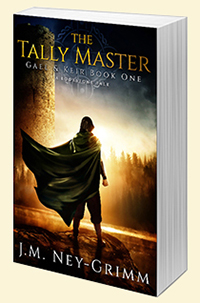
The Tally Master


Share