Running Mushrooms

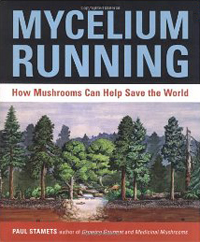
image depicting old growth forestFirst, a confession: I didn’t read every page of Mycelium Running. I didn’t even read most of them! So why am I telling you about this book? The half of it I did read was amazing. But let me explain.

Mycelium Running is a manual geared toward practicalities, toward getting out there and getting your hands dirty. If you need to know how to heal an ailing forest under your care, how to purify bacteria-laden water running off your land, or how to restore your compacted and abused back yard, then Paul Stamets’ book will tell you exactly what you need to know.

But I’m not quite ready for action. I do hope to tackle my clay-imbued and weed-strewn garden over the next few years, but I’ve got other projects ahead of that one on my to-do list. Mostly I’m gathering facts, seeking to understand the big picture. And Mycelium Running is good for that too – especially the earlier chapters. Thus I dare bring it to your attention.

The basic facts of mycelium are fascinating. And the scope of its influence and potential are far beyond anything I might have imagined. Frankly, before I read Mycelium Running, I hadn’t thought much about mushrooms. I loved eating them sautéed in butter. I enjoyed spotting them during August nature walks. And I took pleasure in whimsical paintings featuring fey dancers amidst mushroom circles. Essentially, I was ignorant!

Which meant I loved the experience of having my eyes opened. (Yes, nothing like tickling my curiosity!)

But what is mycelium anyway? The dictionary names it the vegetative part of a fungus. It consists of a mass of branching, thread-like filaments called hyphae. Healthy soils harbor colonies of mycelia, but tree bark or fallen leaves or your compost heap (if, cool) also feed mycelial or fungal mats.

Fungi eat by secreting acids and enzymes into their surroundings and then absorbing the created nutrients through the cells of their mycelia.

The mushrooms we notice springing from a forest floor or among the grass blades of a lawn are almost a side show of the drama hidden below ground. That’s where the real action transpires. Spores released from a mushroom (the fruiting body of the fungus) germinate like plant seeds when they encounter the right moisture, temperature, and nutrients. From microscopic grains, they grow and branch, and grow and branch, creating a mycelial mat. Mycelial mats vary in size. The one supporting the health of a birch tree in your front yard might be just a few feet across. But one mycelium in eastern Oregon – Armillaria or honey mushroom – once covered 2,400 acres!

But more than just odd trivia make mycelia cool. In fact, I can’t confine myself to just three cool things. Here are six!

Mycelia Partner Plants

Most plants – from grasses to Douglas firs – have mycorrhizal mycelia as partners. These mycelia form sheaths around the plant roots and bring nutrients and moisture to the host plant, spreading a net far wider than the roots alone could do. And actively creating nutrients with the action of its enzymes and acids.

Plants with mycorrhizal partners thrive, growing faster and stronger than those without, and resisting diseases better. Their root masses are larger and denser. Their stems or trunks are thicker and taller. Their branches are leafier. The difference is dramatic. And some plants won’t grow at all without their attendant mycelia.

Mycellium is Nature’s Internet

The physical structure of mycelia shares the branching architecture of neural pathways in the mammalian brain. It also mirrors diagrams of the internet’s information-sharing systems. Mycelia might very well be the feedback loop by which planet Earth regulates its ecosystems. They certainly respond in complex ways to complex environments.

In one experiment, researchers mapped the flow of nutrients via mycellium between a Douglas fir, a paper birch, and a western red cedar. The researchers covered the fir, simulating deep shade. The mycellium responded by channeling sugars from the root zone of the birch to the root zone of the fir (which was unable to photosynthesize the sugars it needed).

Outside the lab, mycelia build soil, remove contaminants such as spilled diesel fuel, and filter bacteria out of polluted water.

Could mycelia possess a form of intelligence never envisioned by humans? Impossible to say at this point in history, but the biochemical connections formed by mycelia surpass those of supercomputers. And the organisms display nuanced responses to the world around them. Perhaps our next generation of computers will use fungi instead of copper micro-wire for hardware.

Even Parasites Bring Benefit

The most famous parasitic mushroom, Armillaria or the honey mushroom, is stigmatized as a blight. It can destroy thousands of acres of forest and is banned in many areas. But look again, and look longer. Parasitic fungi may serve to select the strongest plants for survival and to repair damaged habitats. Each time Armillaria swept through that 2,400-acre spot in Oregon, it created nurse logs for more directly benign fungi, it increased soil depth, and it covered barren rock with rich humus. The stage was set for a vibrant revival of habitats and ecosystems.

Mushrooms Lead Eco-restoration

Consider forest fires. The first species to appear amidst the ash and cinders are mushrooms – typically morels and cup fungi. They’re fast-growing and quick to decompose. As they mature and release spores, they also emit fragrances that attract insects and mammals. The insects attract birds, and all these newcomers bring seeds with them. Soon the wasteland burgeons with life – all starting with fungi.

Timber Is Not a Renewable Resource

The old growth forests of the Pacific Northwest accessible to loggers are largely gone. The first two replantings of logged areas are gone as well. Logging companies are now harvesting the third. But no one is making plans for a fourth replanting. Why? With each clear cut, the mycelia of the forest is damaged and the soil grows both thinner and poorer. You can’t get good wood from trees growing in exhausted soils, so many logging companies are selling their land.

Mushrooms Are Renewable

Now consider another patch of forest, this one in south central Oregon. Imagine harvesting timber from it. You’d get a substantial financial return, but eventually you’d reach the end of what you could profitably extract. When you were done, the land would be effectively barren.

But what if you harvested matsutake mushrooms – tasty and desirable – instead? The economic benefit would equal that of the timber (actual calculations have been done), but each year you’d also get thicker soils, reduced erosion, increased stream health, greater biodiversity, improving air quality, and increased regional cooling. And it can go on forever.

I’ll take it!


And do I recommend this book?

I do.

Just don’t try to read it from cover to cover. Begin with part one, where the big picture info is dense. As technicalities creep in, start skipping a bit. Part two held my interest. Part three is where I touched down lightly. (I’m not ready for mushrooms species specifics yet!)

I’m normally a cover-to-cover reader, but this book was worth adjusting my reading style for. It changed my world view. Again! Give it a try. It might change yours!

Mycelium Running at Amazon

Mycelium Running at B&N

For more green living concepts, see:
Permaculture Gardening
Green Housekeeping
Grass Green

For more cool science trivia, see:
Water


Share

Eyes Glaze Over? Never!

I love it when one of my favorite authors releases a new book. The instant a title by Robin McKinley or Lois McMaster Bujold hits the shelves, I′m there with my wallet open!

But how do I choose a book when McKinley and Bujold are between releases? Usually the process goes like this. I′m browsing – at the library or online – and I′m looking at book covers. My reactions vary. Sometimes I say eeuw! Other times: huh. And often: oh! nice!

Cover designers know what they′re doing these days. I see a lot of attractive covers. Covers which prompt me to go to the next step: reading the cover copy. There the results are more mixed. Lots of ick! More of huh? Or huh. Very few oh, interesting! Only my interesting! responses send me inside the front cover to the first page. By then, depending on how the whole progression felt, I′m thinking either m-a-y-b-e or this is good!

The opening paragraphs then grab me. Or they don′t! If I abruptly find myself seven pages in, it′s a keeper!

That′s my experience as a reader. As a writer and publisher, my own reading experience catches my attention from a different angle.

How do I create covers and cover copy that will accurately and attractively signal the contents of my stories? That will connect the right readers – the ones with a taste for my work – to what′s inside the books?

Hoping to answer those questions more skillfully, I took two workshops this summer. I′d like to show you the results from the first one.

I knew going in that I didn′t understand how to write cover copy, but I didn′t realize just how clueless I truly was. (Utterly clueless!)

Writing superb cover copy is a skill that takes years to master, but there are two fundamental rules underlying the niceties:

• use active verbs
(avoid all forms of to be)

• convey the essence of the story
(do not describe the plot: what happens next and what happens after that)

The first of these two basics felt natural. As long as I paid attention, choosing verbs that added energy was fun.

The second basic . . . oh my! I continually descend into plot – the series of linked events – in my attempts to describe its essence.

″Pull up! Pull up!″ exhorted my teacher. Eventually I did get it. In fact, my teacher pronounced my class exceptional, because everyone got it! (Usually a few straggling students struggle.) But I discovered that the more useful instruction for me is: dive down! Go deeper! Go below the plot to theme.

So, is my cover copy better? I think so. But I′ll let you be the judge. Here′s a batch of BEFORE′s and AFTER′s. What do you think?


Rainbow′s Lodestone

BEFORE

″She leapt across the sky in the wake of a thunderstorm, glorying in the energy of wind and lightning, exulting in the rush of the earth beneath. Her rainbow splashed amidst mountains, and she slid down the curve of light.″

The rainbow’s child was eager to enjoy the delights of earth, but this visit to the realm below the sky might be her last. Gefnen, a cruel troll-herald, would see to it.

portrait of the rainbow (web size)AND AFTER

A lost birthright and unending agony.

On a whim, the rainbow’s child falls to earth, where a cruel adversary takes advantage of her innocence.

Can she reclaim her thunder-swept heavens? Must she dwindle and die?

This transcendent short story of J.M. Ney-Grimm’s troll-ridden North-lands explores how inner freedom creates outer opportunities.

Earth trumps heaven until ancient music plays.


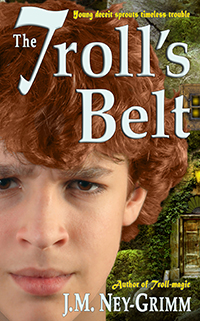
The Troll′s Belt

BEFORE

″The stranger was short, but he wasn’t a boy . . . hair grizzled gray in a wild mane around his face, beard equally wild, but thin. His voice sounded genial, almost friendly, but his pale, watery eyes held a mad glitter. Was he a troll?″

Grounded for sneaking and sassing, Brys finds a magical belt in the woods. But his good luck is about to turn bad. Trolls never mean well: this one pursues a grudge.

web imageAND AFTER

Young Brys Arnsson digs himself into trouble.

Bad trouble.

Tricked by a troll in J.M. Ney-Grimm’s richly imagined North-lands, Brys must dig himself and his best friend back out of danger. But that requires courage . . . and self-honesty. Traits Brys lacks at depth.

A twist on a classic, The Troll’s Belt builds from humor-threaded conflict to white-knuckle suspense.


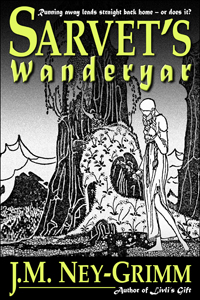
Sarvet′s Wanderyar

BEFORE

Sarvet is lame, and her culture keeps girls close to home. Worse, her mother emphasizes all the things that Sarvet can’t do. But Sarvet dreams of traveling outside her small, mountain enclave to explore the big world with all its strangeness and wonder. How can she transcend her injured leg, her confining lodge-home, and her over-protective mother?

Kay Nielsen art depicting a lassie wandering the mountainsAND AFTER

Running away leads straight back home – or does it?

Sarvet walks with a grinding limp, and her mountain culture keeps girls close to home. Worse, her mother emphasizes all the things Sarvet can’t do. How do you escape, when you hold none of the resources you need?

Sometimes big dreams and inner certainty transform impossible barricades into a way out. J.M. Ney-Grimm’s inspiring fantasy novella explores this cusp of miracle.


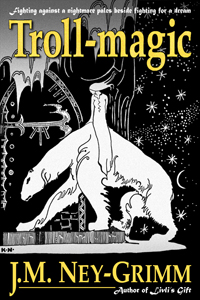
Troll-magic

BEFORE

“In short, she was the friend from his childhood . . . and yet not his old friend: taller, hints of curves. Why had he never noticed she was beautiful before? All his planned introductions slipped away.”

Kellor’s a prince in trouble. Lorelin’s a musician trapped by bucolic traditions. Both must defy a troll-witch’s curse while navigating a maze of hidden secrets.

Kay Nielsen art depicting a lassie aback a north-bearAND AFTER

Fighting against a nightmare pales beside fighting for a dream.

An accursed prince and her own longing for music challenge Lorelin to do both.

But tradition and a hidden foe stand squarely in her way. How do you make dreams real when vision fails, allies undermine you, and all roads toward hope twist awry?

Can courage, honor, and loyalty prevail against a troll-witch’s potent curse?

Set within her enchanted North-lands, J.M. Ney-Grimm’s new take on an old Norse folk tale pits distorted malice against inner wisdom and grit.


Better? What′s your vote?


For further discussion of cover copy, see my later post – Cover Copy Primer – on the subject.


Share

Yogurt & Kefir & Koumiss, Oh My!

My nutritional education began under the aegis of my mother. Judged against the backdrop of the sixties, she was a pioneer, actively pursuing the benefits of serving whole grain breads, breastfeeding her babies, eating multiple servings of raw vegetables, and curtailing sugar intake. Compared to Wonder® bread, bottle feeding, miniscule portions of frozen corn-carrots-peas mix, and dessert every night after dinner, her choices represented a miracle of enlightenment. (Yay, Mom! Thank you!)

But she was also influenced by her time. Who isn′t? She gave up butter for margarine. (Transfats, anyone?) She remained unaware of the dangers of improperly prepared grains (those unfermented or unsprouted). She drifted toward a high-carb, low-fat diet. (As an adult, I did, too.)

So my own nutritional knowledge had a better foundation than that of my contemporaries, but it also featured serious deficits.

My first inkling that I′d gone astray arrived gradually and confusingly as health issues. It seemed there were more and more foods I could not eat without feeling really ill in the hours after my meal. Doctors had no real answers, other than telling me to keep a food diary. I did this, and the list of DO-NOT-EAT grew and grew. It was discouraging and inconvenient. I felt ill too often. And when my friends invited me over for dinner, they faced a Herculean task, if they wanted me to actually eat the foods they′d prepared.

Then I met a local dairywoman with a small family farm. She clued me into the fact that conventional dairy cows receive a soy-based feed. The soy proteins come through in their milk. Maybe it wasn′t cow milk that made me sick after all! Maybe it was the soy proteins.

Kathryn also knew that soy is added as filler to many foods, and not only the obvious candidates such as canned soup. It′s in canned tunafish. It′s in pizza (the tomato sauce and the cheese). It′s in conventional roast chicken, injected under the skin to add moisture to the breast meat. If you have trouble digesting soy . . . watch out! It′s a soy world out there.

I grew vigilant in detecting (and avoiding) soy. My health problems cleared up. Wow! I was thrilled.

But Kathryn had more to teach me. She recommended the book Pasture Perfect (which I shared with you a few weeks ago, here). That was the start of the real revolution in my thinking. Obviously there were a lot of things my mother never told me. And, like most of us, I′d been listening to the media and the mainstream medical establishment about what was healthy to eat and what was not. (Doctors are not taught nutrition, by the way. They′re reading the same newspapers and magazines as their patients!)

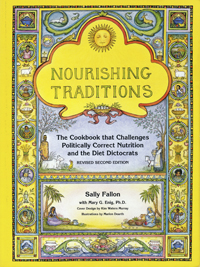
images depicting traditional peoples from around the worldThe next book featured in my continuing education was a doozie: Nourishing Traditions by Sally Fallon and Mary G. Enig. Kathryn followed its precepts, but never recommended it to me. I suspect she thought it would be too challenging for my PC thinking! She didn′t know me well enough to realize that the sheer novelty of the concepts (novel to me, millenia-old to humankind) would ignite my curiosity.

The tale of how I discovered that Nourishing Traditions held an honored place on Kathryn′s shelves is convoluted enough (and rather beside the point) that I won′t spend the paragraphs to recount it. Suffice it to say, I did discover the book, checked it out from the library, and was blown away by its contents. It′s a cookbook with hundreds of recipes, but it′s also a nutritional manual, packed with the wisdom accumulated by traditional peoples over the ages. Their food ways kept them healthy and strong, generation after generation, before doctors and medical science achieved modern power.

Nourishing Traditions is so dense with amazing information, my customary sharing of ″3 cool things″ not only can′t do it justice, but risks serious misrepresentation. I′ll be sharing 3 cool things from the first chapter today. (With more chapters following at intervals across the next half year.)

The Ancient Art of Culturing Milk

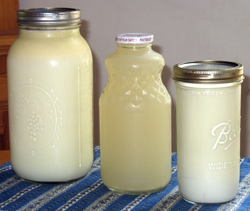
photo of fresh milk, homemade whey, homemade yogurtDrinking unfermented milk from dairy animals is a new and modern development. Without pasteurization and refrigeration, milk sours and separates quickly. Before the age of industry, traditional people harnessed this property for their advantage. During the process of lacto-fermentation, friendly bacteria that produce lactic acid (think yogurt) break down both milk sugar (lactose) and milk protein (casein). Over time, they produce enough lactic acid to inactivate all putrefying bacteria. The milk reaches a state in which it is safely preserved for days or even weeks. (Longer for cheeses.)

Different cultures had different methods and produced different end products. Europeans once consumed clabber and curds and whey, as well as the more familiar yogurt and cheese. In Russia, one found kefir and koumiss. In Scandinavia, there were longfil and kjaeldermelk. In the Middle East: laban. India: dahi. France: crème fraîche (still popular). Germany: cultured butter. All over the globe, shaped by their unique climate, terrain, and history, traditional people cultured milk. It′s a practice worth reviving more fully today.

Fight Osteoporosis and Lactose Intolerance

The fermenting of milk creates many benefits. Casein, the milk protein, is one of the most difficult to digest. Breaking it down via fermentation renders it digestible. Culturing also restores or multiplies the helpful enzymes in milk. One of them, lactase, aids the digestion of lactose (milk sugar). Other enzymes help the body absorb calcium and other minerals. Plus vitamins B and C both increase during fermentation. A ″witch′s brew″ of fermented milk is significantly more nutritious than the basic, conventional white stuff!

Viruses & Germs, Take That!

Most of us know that eating yogurt after a round of antibiotics restores the proper functioning of the gut. What I didn′t understand was that the benefits of healthy gut fauna are both more essential and more comprehensive than bouncing back from a sinus infection.

Friendly lacto-bacilli and the lactic acid they produce are just as much a part of moving nutrients from our food into our bodies′ cells as the actual structures and organs of digestion: mouth, stomach, pancreas, etc. Could we assimilate our food well without our intestines? Well, the friendly bacteria are just as necessary. In addition, these friendly bacteria keep unfriendly intruders at bay. There′s a reason traditional peoples fed fermented milk to the sick, the aged, and to nursing mothers. These vulnerable individuals needed all the bolstering they could get.

Strong bones, fewer stomach aches, more complete transfer of nutrients, less illness. What′s not to like?!

* * *

The chapter on cultured dairy products continues with recipes for piima, buttermilk, crème fraîche, kefir, and other tasty comestibles along with the foundational whey needed by the cook to make many of the dishes featured in later chapters. Margin notes provide vignettes into the kitchens of traditional peoples and the wonders they worked there. It′s an intriguing read, but it also turned many of my own mistaken notions upside down.

Education, entertainment, and health-saving practice all in one package. I couldn′t resist, and I′m glad I didn′t.

Nourishing Traditions at Amazon

Nourishing Traditions at B&N

For more Nourishing Traditions posts, see:
Amazing Lactobacilli
Handle with Care
Beet Kvass

For more on books important to continuing nutritional education, see:
Thinner and Healthier
Test first, then conclude!
Butter and Cream and Coconut, Oh My!
Why Seed Oils Are Dangerous


Share

Green Housekeeping

There′s a lot of ″green″ advice in books, in magazines, and online. Too much of it describes what we should do, or what might be good to do, or what somebody plans to do. We all know what happens when theory gets practical: the bugs jump out.

house-shaped windows of green texturesGreen Housekeeping by Ellen Sandbeck is a different animal altogether. Too quirky to be anything but real, the book describes her actual experience and why her practice is effective.

I′ll follow my ″three cool things″ format of recommendation, starting with the method that won my own housekeeping-averse heart.

Cleaning Simplicity

There are two magic ingredients: vinegar and hydrogen peroxide. Both are safe, natural substances produced by living organisms. (Our own bodies actually create hydrogen peroxide – H2O2 – as a byproduct of our metabolism.)

When hydrogen peroxide encounters organic material (think germs) it releases its extra oxygen atom, becoming mere water (H2O) in the process. That′s what all that foaming and bubbling is when you spray: the extra oxygen is popping off and killing bacteria.

Vinegar kills a lot of bacteria on its own, but hydrogen peroxide kills 100 times as many. When you give a squirt of both, you get another tenfold increase.

Let′s look at some numbers. Say a splash of vinegar from your spray bottle kills 1000 bacteria. A misting of hydrogen peroxide alone would zap 100,000 bacteria. While a spray of both gets 1 million. But all that′s left after spraying is harmless water. No chemical residue. I like it!

photo of safe cleaning solutionsAll you need is a spray bottle of vinegar and an original bottle of hydrogen peroxide with a sprayer cap screwed onto it. Put one pair in your kitchen and another in each bathroom. You′re set to keep those critical places safely clean.

Why the original bottle? Hydrogen peroxide loses its extra oxygen very easily. Just decanting it into another container can make that happen, as can light shining through a translucent spray bottle. You want water as an end product after cleaning, not as a starter!

Once I placed my paired solutions on location, I found myself using them frequently. Not running to fetch them was just as magical as the solutions themselves. (Needing to fetch often leads to not fetching at all, for me.) Just: squirt! squirt! done! (Or add a quick swipe with the microfiber rag kept by the bottles, if adhering toothpaste or avocado needs a scrub.) Cleaner sinks!

Laundry Boost

photo of laundry product named BerryPlusI use Berry+ and soap ″nuts″ to launder clothes and household linens. Soap ″nuts″ (or soapberries) are fruits of the tree sapindus mukorossi. The fruits can be used dried or to create a liquid extract (Berry+).

Why don′t I choose one or the other?

Convenience.

We do a lot of cold water laundry loads. I love being able to pop open a capsule of Berry+, pour it into the washer, close the lid, start the cycle, and go.

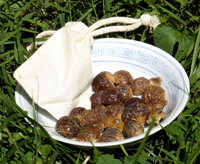
photo of soap nuts loose in a dish plus a laundry bag full of themSoap nuts must either be soaked for 5 minutes in warm water (then dumped along with the soak water into the washer) or tossed into a washer destined for a warm or hot water wash. Since my husband and I are both allergic to dust mites, our sheets, pillowcases, blankets, and towels must be laundered in water over 130°F. (The high temp gets rid of the allergens.) Soap nuts are perfect for that job.

The advantage of both soap nuts and Berry+ is that the outflow spilling from my washer to the water treatment plant is non-toxic. Soapberries have been used by the peoples of Asia and by Native Americans for thousands of years. That′s time tested!

I fell in love with soapberries when I found that my berry-laundered clothes developed almost zero static cling in the dryer and emerged from it smelling faintly of freshly ironed cotton. Yum!

(Alas, yes, I do use a dryer. Although our drying rack is usually equally full once I′ve emptied the washer.)

But what to do when the grass stains or the clay stains or whatever need extra cleaning? Sometimes spot treatment with Berry+ will do the trick. Sometimes it won′t.

Ellen Sandbeck′s chapter on laundry educated me about an old-fashioned product that′s never truly left the cleaning lexicon and is now enjoying a resurgence of use: 20 Mule Team Borax, around since 1891.

photo of box of 20 Mule Team BoraxBorax is a naturally occurring mineral salt composed of boron, sodium, oxygen, and water. It functions as a water softener, fabric softener, deodorant, and mild bleach. I add 2 – 4 tablespoons of it to a load when I face especially challenging laundry. (Or apply a paste of it to the stubborn spot.)

Is it perfect?

No.

But it′s helpful to have a stronger benign option in my tool kit.

The Well-Tempered Clavier

Sandbeck compares a happy home to J.S. Bach′s harpsichord after it has been tuned by the method he invented. No one key is perfectly in tune, but all are sufficiently so to sound good. Compromises must be made. (The method before Bach′s invention resulted in one key perfectly in tune and the rest decidedly out of tune.)

Sandbeck says: ″Most people are happiest and at ease in homes that are moderately clean and neat. Both extremes . . . tend to make people unhappy and uncomfortable.″ Also: ″The well-tempered house should be just neat and clean enough to make both the neatest person and the sloppiest person in the household just a tiny bit dissatisfied.″

Sounds fair to me!

* * *

Those are my three favorite snippets from Green Housekeeping, but the book′s packed with tips. Your favorites will likely be different than mine, since homes vary as much as their inhabitants. I invite you to find yours!

Green Housekeeping at Amazon

Green Housekeeping at B&N

Berry+ at reuseit.com

Soap Nuts at NaturOli

For more on green living, see:
Grass Green
Great Soap & Etcetera Quest
Wrapping with Cloth


Share

Beauty, Charm, Cyril & Montmorency

I′ve shared many of my favorite non-fiction reads with you. I thing it′s long past time that I share favorite fiction! Here are four of the best.

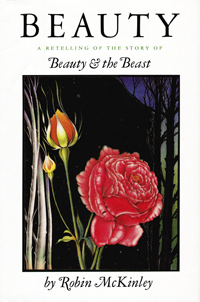
illustration of rosesBeauty′s given name is Honour. Her nickname comes of a child′s childlike error, but the name chosen by her parents is no mistake. That quality will get her into trouble and out again in the course of this fabulous retelling of Beauty and the Beast.

Beauty at Amazon

Beauty at B&N


illustration showing Cat and Gwendolyn ChantYoung Cat Chant endures great changes and great losses, all the while clinging to his big sister Gwendolyn. But Cat must learn to stand on his own two feet and to make his own decisions. The safety of his world depends on it.

The Chronicles of Chrestomancy I:
Charmed Life
& The Lives of Christopher Chant
at Amazon

The Chronicles of Chrestomancy I:
Charmed Life
& The Lives of Christopher Chant
at B&N


montage image of cathedral, cat, Ned, VerityA romp through miscommunication, cross purposes, and the Victorian era turns serious when time travel creates a paradox. Ned Henry sets off to correct the anomaly with the goal of doctor-prescribed recuperation from time lag after he restores the space-time continuum, but said restoration grows more complex by the minute.

To Say Nothing of the Dog at Amazon

To Say Nothing of the Dog at B&N


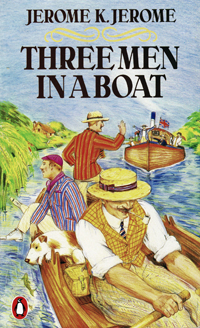
illustration of men boating on the ThamesGeorge, Harris, J, and J′s dog embark on a boat trip up the Thames River in search of rest, recuperation, and recreation. The three men agree that their livers or other organs are out of order and office work is the cause. Rest and recuperation receive short shrift, but humorous adventure ensues.

Three Men in a Boat at Amazon

Three Men in a Boat at B&N


For more of my favorite reads, check these posts:
Duplicity, Diplomacy, Secrets & Ciphers
Mistakes, Missteps, Shady Dealing & Synchronicity
Courtship and Conspiracy, Mayhem and Magic
Gods & Guilt, Scandals & Skeptics


Share

We Are Readers!

Some of my favorite reads have stolen upon me unawares. I remember my first encounter with the story: sheer magic! But how did I come to pull that book off the shelf? Select that particular author? I have no idea. The frame surrounding other discoveries grabs more memory.

I’ll never forget the how and why for one such blissful moment – a two-in-one, really, because the adventure brought two books, two authors my way.

I was in New York City with the entire fourth year class of the Architecture School. The two days of touring architectural highlights under the aegis of our professors were interesting and entertaining. I’d seen a lot of those buildings via slide projector in lecture class. Meeting them up-close-and-personal was satisfying. But the field trip came with an unavoidable challenge.

Most of my sister students had at least one friend in the A-school; some, many. I had none. My friends were among the RPG crowd, and they were grad students, or a year older than me, or a year younger, and all were in the College of Arts and Sciences.

So I came to New York friendless. This was no problem during the day while touring. I did have acquaintances with whom to trade commentary on the sights. It was the one night we would all spend in a hotel that provoked my uneasiness.

I’d been assigned to a room with three young women intent on enjoying the night clubs. They were nice enough to me. They were more than nice, actually, urging me to come with them and have some fun, exhibiting none of the social brutality common in high schools. (Who knew college would bring such civility?)

The rub was . . . I wasn’t keen on bar hopping. Yet saying, “thank you, but no,” seemed . . . so anti-social, so boorish, so unappreciative of their willingness to include. I wanted to say no, but I also wanted them to think well of me. And I wasn’t sure which choice would result in a greater sense of loneliness: out with a three friends who weren’t my friends? or skulking alone in a hotel room? Ugh! What a choice!

While I dithered, I got ready for clubbing: gauze peasant blouse in blues and greens with a tassel tie at the neck, woven leather shoes with a low heel (comfortable for dancing), and very tight jeans.

It looked like I was going out with my room mates willy nilly, borne along on the tide of their persuasion. They were sure: of course I’d have a better time with them.

I checked my pockets. Hard to do. Did I say those jeans were tight? I’d stored my money – a fifty dollar bill – in a pocket in the jeans in a dresser drawer in the hotel. Now was the time I would need it.

My pockets were empty.

One of the hotel maids must have done some rummaging while we were sightseeing.

Oh, there was a fuss! The hotel management was summoned. We got no change from them. Silly Virginia girl! Why did you leave your money in your hotel room? My room mates insisted on lending me money – enough for a night on the town. (They’d brought hundreds!)

I declined. There I felt no ambivalence. My college budget was tighter than my jeans. I’d borrowed $10 from each month to have some cash for this trip. I would need the sum remaining to get through the semester. If I borrowed money from my generous companions, I wouldn’t be able to pay them back. Or else I’d be unable to pay my share of the pizza order when I returned to my RPG mates.

The field trip ladies were regretful about my choice, clearly worried I’d be miserable. (I did say they were nice, right? They were nice.) But I was resolute, and they went off to their evening’s delight. I felt . . . relieved.

So, there I was, alone in a hotel room with nothing to do. (I was never a big TV watcher.) But I knew I’d figure it out. What next?

Surely dinner of some sort. My $50 was gone; luckily I had a few smaller bills, change left over from the day’s expenses. I’d noticed two deli’s in the same block as the hotel. And . . . there’d been a bookstore in the next block over! Abruptly my plans for the evening gelled. I was set! Why had I dithered and worried? A reader always has options.

One of the deli’s supplied me with a sandwich in a paper bag, and then I trundled off to the bookstore.

These were the days when bookstores still displayed their wares on wire racks with the book covers facing out. This bookstore, being in New York, had five segments (or more) devoted to SF&F. I was in heaven, browsing and browsing and browsing. Here was happy indecision. Which book would I chose?

After perhaps half an hour, it came down to two. Which should I carry away with me? Beauty by Robin McKinley? Or Charmed Life by Diana Wynne Jones? I dithered just as much as when faced with bar hopping, but this was a better choice: between two good’s, not two bad’s.

A startling idea popped into my head. Why not buy both? As a cash-strapped college student, I bought my books one at a time. But – I did some quick math – I had just enough money to splurge with a few pennies left over. Why not? I went home tomorrow.

You know how I answered that one.

Which book did I read first? That I don’t remember. But memory is vivid regarding the gestalt. I lounged on my hotel bed, well propped with pillows, munching my sandwich, and devouring the stories. I entered . . . not heaven (this was better than that), but a fairy tale city where three sisters grappled with loosing all their fortune and confronted the adventure that came to them in the cool forested land where they settled. I followed a young witch-boy struggling with betrayal and greatness in the steampunk world of Chrestomancy.

That night alone in a New York hotel room still ranks as one of the best in my life. I’m a reader, and I’m guessing you might be too. Have you ever had an unpleasantness (or a disaster) rescued by a good read?

I was grateful my room mates stayed out til one! I had time to savor both my treasures in peace and solitude. And was happy to greet the returning trio (not drunk, thank you) with good cheer and assurances that I’d passed an enjoyable evening.

In justice to the hotel maids, I must report that they had not stolen my $50. Remember those tight jeans? (I did say they were tight, right?) Apparently I didn’t push my fingers deep enough into my pinched pocket. The money was there all along.

Share

The Old Armory, Part I

The Old Armory in Bazinthiad was originally built as a lord’s keep in the days of Giralliya’s early history. Giralliya as an empire did not yet exist. Three kingdoms that would become its heart – Eirdry, Ennecy, and Istria – comprised the region, and Castellum Balazoron was a minor seat above Lake Argead, guarding the back way into the court of the Istrian king.

Blood Falchion

The lord’s heir, Caelan, was the second to see the blade.

It arrived amidst a pile of carpets from far Bethpaarean, and Sathon the carpet merchant’s son discovered it when he unpacked the bale and arranged the carpets in his father’s stall in the bailey.

Lord Jekis’ son sought his friend the instant he received word the carpet merchant was passing through Balazoron’s gates. It was a hike from his high chambers down through the donjon to the courtyard and out the barbican to the bailey, and Caelan suffered palsied limbs, the result of a fever in his infancy. He could not move fast, but he was just fast enough to see the sword—a falchion—a moment after Sathon uncovered it.

The weapon exuded an aura of dread. Caelan’s in-breath hissed. “What do you see?” he demanded.

Sathon turned in surprise—not that Caelan was there; the boys were always immediate in seeking one another—but in surprise at his friend’s tone: one of warning.

He answered: “The blade is broad and heavy after the nature of a falchion and fashioned of a bronze-hued metal that holds an edge far finer than ordinary metals. I should think it would split the bones of even a blood dragon, and a champion’s armor would part like water beneath its blow.”

Sathon nodded and continued. “Its hilts are fashioned of the same, but encrusted with opal and jade, and the scabbard matches them. The sap of the hevea tree covers the grip. The pommel is an emerald entire.” Sathon paused. “I wish I knew the way to wield a blade.” Envy and longing tinged his words.

“That’s not what I see.” Caelan swallowed. “I see shadow, a roiling darkness threaded by blood and despair.” His whisper strengthened to a command. “Hide it! Now! Or destroy it!”

That might have been the wiser course, but Caelan’s father came to greet the carpet merchant, the two men friends like their sons, and Lord Jekis saw what Sathon had seen: a fair weapon, rich, well-made, destined for the hand of a peer. And Jekis was a falchion wielder.

The foreign blade hung from the lord’s belt thereafter, and troubles followed.

A drought gripping the land deepened. Crops withered, wells failed, and wildfires swept through the dried grasses of the hunting veldt. Refugees pleaded entry at Balazoron’s gate every day, and the village on the lake shore below swelled as cousins and cousins of cousins left the parched interior to visit their kin.

Castellum Balazoron had foodstores in depth and an outer bailey made for mock battles. It could accommodate crowds. But the spring on the hillside faltered, its trickle slowing. The cistern in the inner bailey dried completely.

Lord Jekis ordered the digging of a new well, upslope from the outflow where the castellum churls filled their buckets. Legend held the heart of the aquifer supplying the spring rose there.

The men used a drill with a hollow bit, manually pumping its long stem, to excavate the well shaft. Deeper and deeper the bit penetrated, but the earth was dry, dry.

Lord Jekis and his sister quarreled. How many newcomers might be permitted through the gates? Should water be hauled from the lake? Could a request for aid be sent to Lord Vidriyo?

They quarreled about Caelan as well. Lady Agace had been as a mother to him since the fever. She looked always to ease her nephew’s shaking, cramping limbs. She summoned masseurs from Cambers, salves from Solmondy, and potions of healing from Hamrask, Fresange, and northern Tromme.

Now she evolved a scheme to send him to a sacred shrine in Capydaicia to pray healing of the goddess honored there. Lord Jekis denied her.

The words between brother and sister grew bitter, and their love for one another dwindled more swiftly than even the outflow of water from the hillside spring.

Caelan resisted his aunt’s plans for the first time, afraid to leave his elders in the donjon without his youth to stay their tempers.

Lady Agace sent tidings of their plight to Lord Vidriyo, against Jekis’ express command. Vidriyo arrived, but not with aid. He brought an army to advantage himself of their weakness and gain a stronghold for his kinsman.

The villagers fled their homes for Balazoron’s walls, and Lord Vidriyo sent terms for surrender.

Lord Jekis’ wrath mounted into madness. Caelan wondered: “Is he a troll?” Had his father resorted to incantatio in a futile attempt to save Balazoron from drought and warfare?

Jekis still wore the tabard device of his lineage, but his face was strange under his fury and his behavior, stranger. Caelan could not recognize him. Where had the genial man with laughter in his voice and kindness in his hand gone? This one’s visage was hard, his hand equally hard, and the evil falchion hung ever at his hip.

Lady Agace sent a messenger bearing a white flag to Vidriyo waiting amidst his knights. Perhaps she feared the enemy without less than the one rising within.

Caelan’s father declared her traitor and arranged for her chastening to be a public spectacle. When Vidrio entered under the truce flag for parley, Lady Agace’s punishment would demonstrate Jekis’ answer to Vidrio’s terms.

Jekis’ sister wore palest yellow—the color of mourning—in protest. But she presented herself at the new wellhead—still dry—as ordered. Her ladies begged her to lock herself in her chambers. Or to bribe the guards at the gate and escape, seeking succor in Vidriyo’s camp. She refused, awaiting Jekis’ will on the slope.

Caelan, present as required by his station, stood fidgeting in increasing dread.

His father arrived mere moments before Vidriyo himself. He—their enemy—expected their surrender. He received Jekis’ defiance instead.

“Shalt slay myself, my son, my sister, and all within my walls before I cease,” Balazoron’s lord declared. “But one death is enough. One death shall suffice.”

Lord Vidriyo grinned, expecting Jekis’ men-at-arms to make an attack, here at parley, knowing his own honor guard were too numerous to allow such treachery to succeed.

But Lord Jekis meant otherwise.

“There is a sorcery shalt buy all our freedoms—freedom from drought, freedom from coercion, freedom from enemies.” He glared at Vidriyo. “The blood of a mother shed by a young boy’s hand to wet this dry earth shalt purchase all. Caelan!”

Caelan was startled, and yet not. He’d witnessed his father’s advancing depravity all the half year since the falchion’s advent.

Vidriyo frowned, missing Jekis’ meaning yet again.

Lord Jekis unsheathed his fell weapon. “Three bloods!” he declared. “Three bloods in all.” He drew his palm across the blade’s razor edge, and blood dripped to the dry earth.

He pressed the falchion’s hilt into Caelan’s left hand and passed his son’s other hand, palm down, across that deadly edge for second blood. Caelan’s right hand stung with the wound.

Then Jekis stood back, leaving his son in possession of the falchion.

The balance of the blade weighed heavy, far beyond that of any sword or mace. The ballast of a trebuchet, the boulder in a merlon, the tail lash of a blood dragon might weigh like this. Somehow Caelan withstood it. His arm trembled.

The malice of it could not be withstood. It thirsted for blood, for destruction, for death. Its dark, tortured essence threaded tendrils of violence through Caelan’s thoughts. Limbs severed, wounds weeping, screams at echo. Its thrust built in Caelan’s clenching muscles. He stood and shook, feeling it, resisting it. Despite his resistence, he struck: a lunge in quarte, a fencer’s blow, not a battle-lord’s.

The razor edge grazed Lady Agace’s shoulder, ripping her gown, drawing third blood, although not the blood of the throat that Lord Jekis had intended.

Persisting in the momentum of his thrust, Caelan hurled the falchion from him, down into the open well shaft. “Let the bosom of earth take and keep both weapon and blood!” he shouted.

Lord Jekis convulsed and fell writhing. He might have followed the falchion into the rent earth had not his men reached for his cape, so close did he stand to the drop.

Far below in the darkness where no water ran, light blossomed, gold laced with silver, a molten flow that seethed and brightened, then shot skyward, an eye-searing column that might reach the moon, visible even in the daylight of noon.

Lightning cracked, a whip of brilliance from horizon to horizon, and clouds rushed up over the rim of the earth to hide both faded moon and blazing sun. Another deafening crash sounded, and the rain fell, soaking the dry dust, drenching the people gathered, quenching the column sparking from the wellhead.

It was Lord Jekis who made the trip to Zele’s shrine. Healing was granted him, both for the seizures afflicting his body and for the guilt and grief afflicting his mind. But he ceded Castellum Balazoron to the Lady Agace. And she wed Vidriyo, who thusly gained a stronghold after all, for himself, not his kinsman.

The well—tomb to the falchion, but baptized and transformed by sacred rain—brimmed with water, as did the spring down the slope. It was an exceptionally pure liquid with an echo of sweetness that lingered in the mouth after swallowing. And sometimes it yielded miracle cures of its own.

Caelan drank of it, and the palsy in his limbs was vanquished. He became a hero, mighty both on the battlefield and in the court of the king, where his wisdom won him lands and influence much greater than the portion accruing to a lord of Castellum Balazoron. And Sathon, the carpet merchant’s son, got his wish: learning skill at arms. He fought as a brother by Caelan’s side, with a spiked morningstar on the field of battle and with clever words in the king’s counsel chamber.

THE END


Share

Our Universe is Amazing

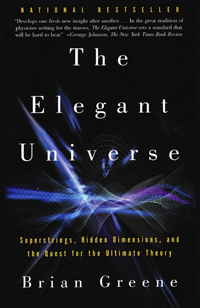
curved spacetime on a black fieldBrian Greene’s The Elegant Universe is my favorite non-fiction read. I’ve traveled its pages only three times thus far, because its concepts give my brain a workout. The prose is elegant (like our universe!) and accessible, but understanding the physical underpinnings of the cosmos is not something I do easily. I labor. And, yet, by book’s end, I feel like I’ve been peeking over the shoulder of the divine, granted a view of miracle. That’s worth some effort!

Greene starts with an entertaining overview of Einstein’s principles of special relativity and general relativity. I grin through this section, because his examples are amusing. In my latest perusal, I noticed a nugget about how we navigate spacetime that had previously escaped either my notice or my memory. (Amidst all the other wonders presented.)

Time Travel

We are always in motion, even when sitting still, both because we traverse time and because our planet whooshes ever onward around our sun, around our galaxy, and across the universe. However, Einstein’s principles of relativity allow me to declare myself as still in space when occupying my armchair reading The Elegant Universe.

When I’m not sitting and reading (or sitting and writing!), I’m moving through both space and time. Compared with the speed of light – 670 million mph – I’m traversing space very slowly, at 1 or 2 mph when I’m strolling in the garden, 25 mph driving down a residential street, or 300 mph jetting through the sky. But guess what? I’m traveling through the dimension of time very fast. At the speed of light, in fact! Of course, so is everything and everyone around me. So I don’t notice my speed!

Wow! I’d like to see Greene explore the ramifications more thoroughly, but he’s a man on a mission with a lot of conceptual ground to cover. His purpose is not to dance in Einstein’s preserve, but to connect superstring theory to it. He continues through the history of physics and into the paradox arising between the rules governing the macrocosm and those governing the microcosm. When physicists want to understand black holes or the moment of the big bang, they cannot, because these conditions require both general relativity and quantum mechanics. Which do not mix! Superstring theory proposes a solution for the paradox.

Superstrings Calm the Quantum Foam

When we think about the smallest particles that make up the physical universe – electrons and quarks – we consider them to be points that have no height or width or depth. They are dimensionless.

This way of thinking causes problems.warped and tattered grid representing quantum spacetime

It means we must deal with quantum tunneling. At a sufficiently small size, many of the usual rules of the universe no longer pertain. Gravity? Nope. Cause and effect? Gone. Knowing where and when? Farewell certainty.

Envisioning the smallest particles as strings rather than dimensionless points solves these problems in two ways.

First, the strings of superstring theory have length. They are loops of about the Planck length. “What is the Planck length?” you ask. It is very small: a millionth of a billionth of a billionth of a billionth of a centimeter. Greene gives us an analogy: if one atom were the size of the entire known universe, the Planck length would be the height of an average tree!

Very small, indeed, but NOT zero. Which means that we cannot probe physical reality below a certain size. Below the Planck length, in fact. Because nothing is smaller than that. In a sense it doesn’t exist.

And the quantum foam, where the rules of the universe go awry, exists mathematically only at scales smaller than the Planck length. But if we know the fundamental blocks of matter – strings – are too big to fit into the mathematical quantum foam, then all matter remains within a spacetime where the usual rules apply.

That is one way of looking at the issue. Superstring theory also gives us a second way.

In the Grandstands for an Event

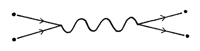
Consider two particles traveling at high speed that collide, say an electron and a positron (an electron’s antimatter counterpart).

The particles collide and are annihilated, releasing energy as a photon. The photon travels some while and then releases it energy, transforming into two particles that go their separate ways.

an electron and a positron collideA physicist’s diagram of the event would like like this.


And here’s the difficulty: Einstein’s relativity principles state that different observers would not agree about exactly when and where the two particles collided. When considering point particles, that truth seems impossible.

Which is it?

This?an electron and a positron collide


Or this?an electron and a positron collide with different details


How can it be both?


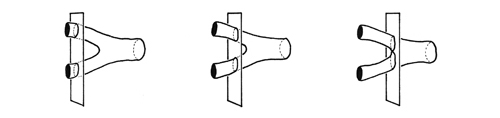
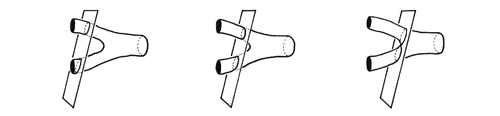
Now consider how it looks if the particles are strings.diagram of 2 strings colliding


One person might see the collision like this, at a certain time and place.an observer sees the collision at one place and time


While another might see it like this, at a different time and place.another observer sees the collision at a different place and time


No paradox at all. The quantum foam (which is paradox) has smoothed out.

Greene goes on to discuss the further wonders of superstring theory: Calabi-Yau spaces and their transformations, M-theory, and the striking similarity between black holes and strings. It’s an incredible romp through the foundations of physical reality. Greene leaps from marvel to marvel, ending with the tantalizing possibility that superstring theory might allow us humans to graze the ultimate why.

I’ll be re-reading The Elegant Universe every few years . . . when my brain is ready to stretch and work!

The Elegant Universe at Amazon

The Elegant Universe at B&N

The Elegant Universe as an ebook at Kobo

For more cool science trivia, see:
Sol
Water
Anatomy of a Pitch


Share

Phoenix Arisen

For those of you who read Locked in Mortal Combat, I have the happy . . . not ending, but next installment. I’ve solved both the problems chronicled last week and moved to new ones! (Which I trust I shall solve.) But let me tell you how I dug out of last week’s hole.

First the crying-scale problem. I learned that InDesign defines its links by specifying the folder in which the link resides. It doesn’t use some sort of “address” describing a precise location on the hard drive. Hope!

So . . . I put that wayward RTF file back in its origin folder, started up InDesign, and opened the Troll-magic file. Da da da dah! There it was! All formatting back just the way I’d left it before I parted the two files. Amazing!

The lesser problem? There are many different categories of fonts. True Type and Monotype and Adobe and Open Type and so on. The embellishments in my InDesign file were Open Type embellishments. Whereas the font I had moved into the font folder was a True Type font.

All I had to do was tell my file that I wanted it to change over all the Open Type embellishments to True Type embellishments. Font “seen” and problem solved.

Beautiful!

While I was at it, I printed out a sample page and decided my 12 point type was too big! I tried 11 point. Still too big. Ditto 10 point. But 9.8 point was perfect. I changed my style definition to make the change and then went through reworking my page breaks. And the book is still beautiful, but a “mere” 470 pages. This is very good, because I can lower the price of the book for my readers. Yay!

I did mention that I’ve moved to the next set of problems. Namely that when I uploaded the file to CreateSpace, there are “issues.” I expect the wrestling to get ugly again. But I also expect to win! Eventually. And at least I’m into new territory.

I’ll keep you posted!

Share

Locked in Mortal Combat

Today was supposed to feature an “inquiring mind” post. Not only that; I’d planned to tell you about my favorite non-fiction read.

But I’ve been wrestling with InDesign, the go-to application for designing print books. Wrestling with the electrons on my computer and, because I’m losing, wrestling in spirit and in heart. InDesign – thus far – has trounced me, toppled me, stomped and stumped me, and kicked me to the curb.

I hope to rise from my ashes.

In the meantime . . . draw close, my readers, and I shall tell of my midnight tussle and abrupt defeat! (That is, today’s blog is a “behind the scenes” post.)

First, a little background. I used to design books in PageMaker. I liked Pagemaker. It was straightforward, moved type and images around the way I wanted, and, in the immortal words describing Bilbo Baggins before his adventure, “never did anything unexpected.”

But PageMaker wasn’t so handy for designing book covers. In the fullness of time, another computer application arrived on the scene to handle color and permit the complicated wrapping of text around illustrations. I learned Quark. It never became so intuitive as Pagemaker (for me), but I could make it do what I needed.

Fast forward 20 years. InDesign is the book designer’s app and has been for some while, but this is my first time using it. I’ve heard it is remarkably similar to PageMaker. If you know the one, you know the other. Or can figure it out.

Well, okay then!

Kay Nielsen art depicting a lassie aback a north-bearI dive in, eager to turn the ebook Troll-magic into an ink-on-paper book. Trusting in InDesign’s kindly reputation, I don’t even bother to acquire a copy of InDesign For Dummies or some such title.

Mistake!

When I attempt to place the text of my story, InDesign cannot see my OpenOffice (Oo3) file where the text resides. I check the Adobe online help page.

Ah! Save the Oo3 file as a Word file and I’ll be good to go.

I do it, and now I can place the text. But, oh, what ugly ugly print! Some of it is tiny at 4 points, and some of it is huge at 18 points. Some of it overlaps, and some has 4 inches between lines. Plus all the italics – which my story uses to indicate thought versus the spoken word – have disappeared.

I return to the help page.

This time I save my Oo3 file in rich text format. This will – I’m told – retain things like type size and spacing. And italics.

W-e-l-l. It does look better than the Word file version, but all of the italics remain missing.

Hmm. What to do?

I decide that this is as good as it gets and wade in. Three days and 626 pages later, I have a book! Or the computer file for a book. (And, yes, I neglected my family: those were 16-hour days. Mea culpa!)

But the book is beautiful! Each page begins and ends cleanly, features lovely Palatino type plus elegant embellishments between scenes. I am thrilled. (Although my thrill has one buzzing and annoying fly: my InDesign file tells me it cannot find the font I’m using for those embellishments. But I feel sure I’ll sort it out.)

Flush with success, I decide to do a little tidying. Let’s sweep that useless Word file and the rich text format file into a folder along with the original Oo3 one.

Alas! There is the moment of my downfall.

Back in my PageMaker days, the illustrations in a book were not actually inside the PageMaker file. When I sent a book to the printer, I sent the PageMaker file and the TIFF files that were the illustrations. There was a link between the Pagemaker file and each of the TIFF files.

Now, in that era, the tidying of files also occurred. And the links were broken. Reforging them was not really a problem. I just had to be sure I did it (with the click of a few buttons) before sending the file to press.

But the text of the book was actually inside the PageMaker file itself. No links. The original Word file became an archived irrelevancy.

Not so for InDesign!

When my InDesign file and my rich text format file parted ways to different folders, I broke the essential link between them. (Apparently.) And restoring it was . . . well, it seemed simple until I looked at what I had wrought.

All my formatting had disappeared.

The paragraphs had lost their indents. The chapter headings looked just like the rest of the text, not big and bold. The page breaks, carefully crafted, were no longer present. And all the italics, lovingly reapplied word by word by word, were gone.

If I were the crying sort, I’d have sobbed. As it was, I merely sat stunned. Then closed the file without saving.

Is there a way to restore what I have lost?

Must I begin again from the foundations?

I don’t have those answers, but I do have a vision: the vision of the beautiful book I’d created before the tidying impulse took me. Rest assured, I will bring that vision to paper and ink, whether it can be done easily or only after great labor! Rise, my phoenix, oh rise!

Share